I’m sure you’ve seen the picture of the adapted Maslow’s hierarchy triangle with wifi and internet added at the bottom. It makes me smile when I look at it.

Back in the late 90’s in Ireland there were vast pockets of no or poor signal, rendering mobiles useless. This was especially noticeable when you left the city for the country.

These days the mobile providers claim coverage in the 90’s per cent. That has to be by population, concentrated in the cities as they are, rather than by geography. In 2018, in the west of Ireland, there are still large swathes of land where you can’t use your mobile. One of them is my house, in fact it’s most of my small town, what you might call a village in the UK. Now I think of it, there are plenty of offices in central London too where you can’t get a signal…

Vodafone can tell you my area has poor coverage, which is why I’ve used their Sure Signal box, plugged into my landline modem, to boost our mobile to a belligerent 5 bars. Lovely.

Except that the box has stopped working, is no longer sold or supported, with no substitute technology solution in the offing.

Which brings me back to Maslow’s pyramid. I work from home a lot, and use my mobile phone a lot, or I used too…

I heard a great phrase the other day, and it’s a very useful reminder of how to cover all the key bases in a business. In any business, especially a small business, you need 3 types of role: the finder, the minder and the grinder.

The finder is the prospector. The finder finds customers, partners and even investors. They are the public face of the company, the chief evangelist.

The minder minds the company. The minder looks after the cash. Their responsibility is finance, legals, compliance, looking after the company and making sure it’s meeting its various obligations.

The grinder is the one who delivers. They are operational, with their shoulder to the wheel and on the factory floor – literally or metaphorically. They execute what has been promised by the finder and charged for by the minder.

All of these roles are important, and you need each role working in synergy, recognising each other’s strengths and skills, rather than complaining that they do all the work while the others sit around.

In a sole tradership, of course, one person needs to fulfil all 3 roles, or else contract out some of the other roles profitably or productively. In a partnership you see the 3 roles being divided across the two people. Sometimes they take one role each and share the other. As any business scales it really needs one person dedicated to each role, eventually building to a team for each function.

I live in a country that has, supposedly, mobile coverage in the 90s per cent. That must be by population I imagine, since out of the cities and in the country there are plenty of pockets of poor signal.

One such pocket is my house, where our home and home office have enjoyed appalling mobile coverage for the last decade. All was not lost however, because several years ago we bought a mobile phone signal booster that connects to the landline broadband and is programmed by our mobile numbers for 5 luscious reception bars every time.

Except that 3 months ago the booster box broke and I discovered to my chagrin that the box is no longer sold or supported by Vodafone. Wifi calling is promised, which will solve the problem of poor mobile reception, but I’ve been working in tech long enough to know that roadmaps aren’t worth listening to at all.

I went onto the Vodafone community to look for discussion threads on the topic and found one, to which I wanted to comment and voice my disapproval. I had to log in to do that, and I was invited to do so either my mobile or landline account login. That was fine, but after I’d logged in I was taken to a general community page, and not straight back to the specific thread that I was on, as you would expect 9 times out of 10.

I then had to search for the thread again, and still it wouldn’t let me contribute. By this stage I was wise to the process and copied my contribution content in case I’d lost it.

After a couple more tries I gave up, since I got messages that it wouldn’t post. I returned back to the thread and my post was there, published.

Vodafone don’t seem to make it easy for you to post to their community portal. It’s almost like they’d prefer if you didn’t, rather like in the good old days in England when you could claim unemployment benefit between terms at University but the form was longer than War and Peace…

It’s a little known fact, but GDPR, of which you’re probably sick at this stage – if you’re reading this post soon after publication – doesn’t actually stand for General Data Protection Regulation.

Well, of course it does, but for me it stands for Great Delivery and Proposal Reduction.

I subscribe to a lot of email and I’ve found myself on a lot of additional lists as a consequence. As I’m sure you can attest yourself, all these organisations have been frantically getting in touch of late to make sure I’m properly opted in to continue to receive their communications.

I’ve received emails from organisations I had no idea either I was subscribed to, or had information on me in the first place. Consequently it’s a super way for me to cull my subscription lists. Those I don’t want to stay in touch with, or to market to me, I simply let lapse and after 25th May I should be theoretically free of their shackles. I have a great opportunity to reduce the delivery of offers, invitations and proposals coming into my email inbox.

On a more serious note, this is a big, big deal for a lot of European organisations, and other international organisations who do business with customers from Europe. It’s a ton of work to be compliant and they will see their subscription lists getting quite a severe haircut.

If we’re not careful, the winners in this will be the unscrupulous organisations who carry on regardless, and with no regard for the GDPR’s provisions, at the expense of their dutiful, compliant competitors.

I’ve debated for nearly the last five years as to whether to devote a blog post to this topic, whether it lowered the tone of this blog. I raised it with my good lady the other day and she said ‘it’s common knowledge, and it might help in a small way, so publish.’ So I have.

What I’ve observed over my decades of using public or shared toilet facilities is this, and it concerns male hygiene: a lot of men don’t wash their hands after using the facilities.  Horrifyingly, their propensity to not wash afterwards seems to increase when there’s food and drink involved, so in restaurants, bars and clubs.

I’ve never understood this. Your body expels waste products for a reason. Why would you not wash your hands and reduce the risk of infection? Why would you not reduce the risk of infection to others, to the people with whom you’re socialising?

Is it that men can’t be bothered, or is it that it’s more macho not to care about such things? Whether it’s laziness or lack of respect for our fellow man, it baffles me.

Too many what?

I don’t know about you, but I’m fascinated by the spurious messages you get from software to explain away an error. I’m also frustrated in equal measure, mind you, as I’m sure many of you are when mission critical stuff like email doesn’t function as it should.

I use outlook on a mac, my work hosting provider is register365 and my telecoms provider for Internet is vodafone. I think my email account is a pop3 account. Put them all together and it’s really flaky.

It will often say that incoming mail cannot be received because another account is receiving it, so it’s locked by another pop3 session. I use the work email on my phone too, so why I can’t get email on both devices, and why they can’t sync properly like my other email accounts do, is a mystery to me. Also, and I’m not looking for free help here, but my work email doesn’t allow me to send outbound email when I’m not in Ireland, but it will receive mail? I’ve tried a bunch of support-suggested options, and I know it’s not an easy solution, for some non-easy reason.

Yesterday I got the message above for why a person-to-person email wasn’t being sent. Have you ever heard something as laughable? It doesn’t mean anything and is utterly irrelevant. Too many recipients of what?

Stranger than fiction.

We’ve all heard the statistic that we use about 10% of our brain’s total capacity, the inference being that, to the precious few and perhaps some of us mere mortals too, additional unfathomable powers are at our fingertips, or rather at our synapses.

One of the first lessons I learned on those graduate work programs was the power of positive thinking and, specifically, the self-fulfilling prophecy. If you go into a situation with a certain frame of mind, then that’s the result you will probably end up getting. Go in thinking you will lose and you will, go in thinking you will win and you will. What is unsaid in all this is whether you can influence the actual outcome with the power of your thought. Perhaps we’re tapping into the 90% at that point?

I’ve always liked the idea of the self-fulfilling prophecy and I’ve used it myself, pretty successfully, before major events like sales meetings, prize-givings and so on. You can even use it for micro-events, like wanting to hit the treble twenty at darts or the outside corner with a tennis serve. If you imagine it clearly, and see it happening, it has a far better chance of happening. I’ve never found it works with gambling though…

The other day I was working away when an email pinged in with the results of a competitive bid process. My stomach did a small flip, as the bid was important to me. I relaxed, took 5 minutes to clear my other emails and then got to the award results email. I had a 1 in 4 chance of winning. Before I opened it I imagined reading the email awarding me the contract, and I even said the word ‘win’ a number of times in my head like a mantra.

I opened the email and found that I hadn’t won the contact. Just kidding! I had won, which was nice.

What is also interesting is that on the occasions when I have not been successful with the self-fulfilling prophecy, it’s because I have allowed doubt and negativity to intrude into my thoughts. Suspecting I might not have won was enough to poison the positive thinking.

Disclaimer: this does not mean you will win the lottery if you think positively as you buy the ticket or as each ball drops into the chute…

I play table tennis regularly, perhaps once or twice a week. I gave it up for 15 years and took it back up 2 years ago, but apart from that hiatus I’ve always played it, so I’ve managed to get to a semi-decent standard. It’s a very fast game, needing quick reflexes, good hand eye coordination, anticipation and split-second decision-making.

As a result of hitting millions of balls and playing thousands of matches, I’m in tune with when I’m not quite on my game. I played the other day and it was one of those days when I was not quite at the races.

I was tired, and as a consequence was a little off the pace, had small losses of co-ordination, poor concentration and I made poor decisions. I couldn’t get my body to do what I wanted it to do. It’s very frustrating when it happens, because the subconscious starts misfiring and the auto-pilot feels wonky.

Here’s the interesting thing, though. Was I mentally tired or physically tired? For a long time I simply assumed I was mentally tired, and was therefore sending poor or late signals to the body. I’m not sure that’s right, though. If I’m physically tired maybe the brain is functioning well but the body is too starved of energy to execute the commands.

It’s probably, as seems to be most of the time in work, sport and life, a combination of factors that’s causing the underperformance.

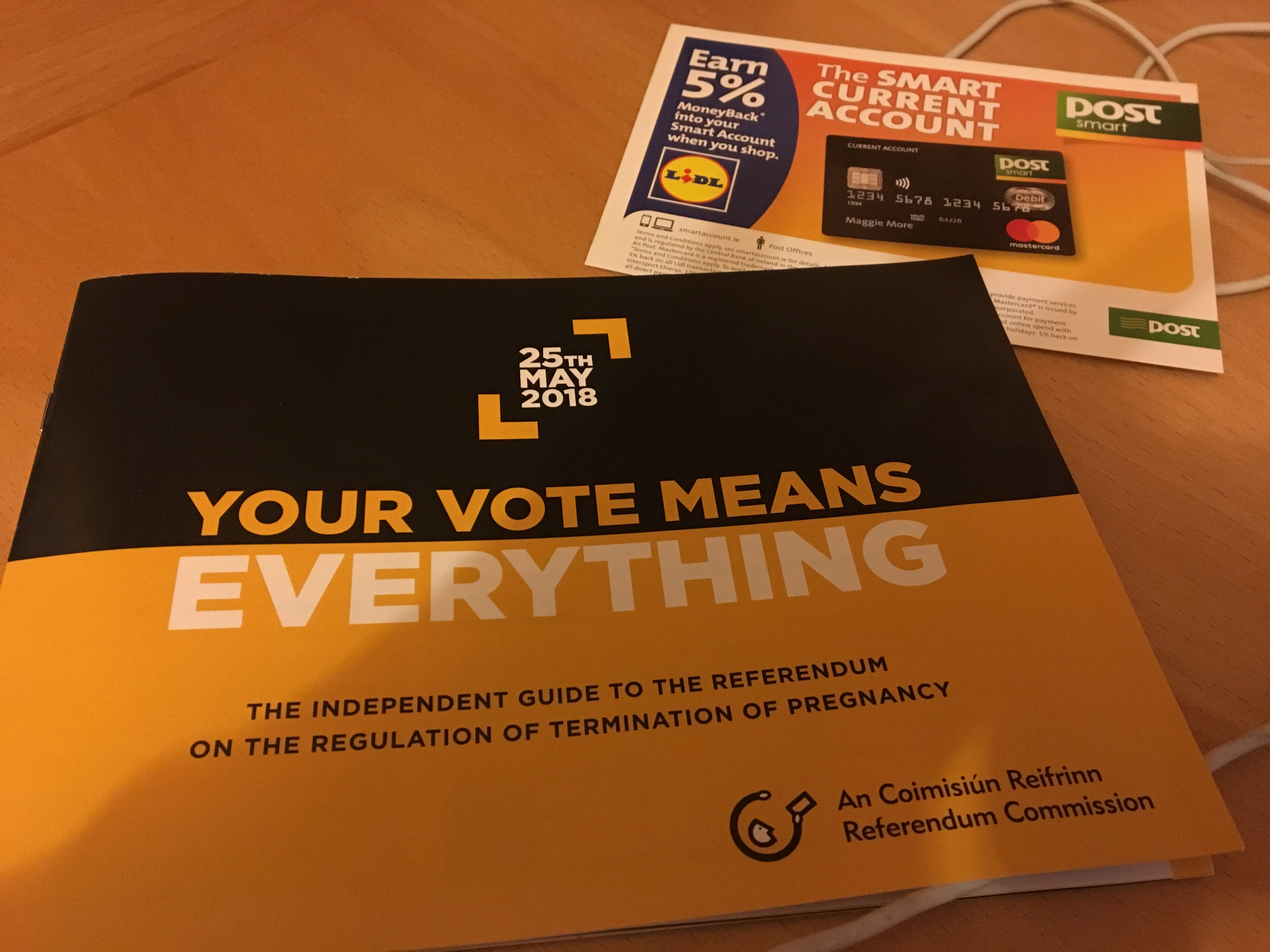
Referendum leaflet and interloper

Our household, along with a million or two other households, recently received a document on the upcoming referendum in Ireland concerning the regulation of the termination of pregnancy, more commonly known as the 8th amendment to the constitution.

The document is billed as an independent guide, produced by the government to explain citizens’ rights and options. It is a superbly written document, with clear, plain languages – English and Irish starting at each end of the booklet and joining up in the centre pages with an illustration of how to complete the ballot paper – and very well laid out.

This is no mean achievement, to summarise impartially what is involved and how the voting process works in what continues to be a most emotive, divisive and political issue.

What I found most incongruous was this. The leaflet came with an insert advertising a credit card service from the state-owned postal network ‘An Post’, supported by a well-known supermarket chain. I don’t know what’s going on here. Maybe the government decided to defray the cost of producing and distributing the document by getting one of the state bodies to part-fund it and do some fancy cross-charging. Perhaps they felt this was the perfect opportunity to market a service within a document that was benefitting from near total and national distribution.

Either way, it felt inappropriate to me. In my view it detracts from and denigrates the importance of the guide, regardless of the financial benefit. It could be just me though..

The English language is, according to our good friends at wikipedia, one of the three official, ‘procedural’ languages of the European Union, used in the conduct of daily business and in written and spoken proclamations. It also seems to be the most commonly used as well.

The UK joined the European Economic Community in 1973, and so did the Republic of Ireland. The UK also agreed by referendum to stay in the EEC in 1975. Then, in 1993, the EU was formed.

Some 65 million speakers of English as a first language are about to leave the body whose main language is English. That leaves the Republic of Ireland, with a population of somewhere between 4 and 5 million, depending on whether it’s in an economic upswing or downturn, as the sole native-English-speaking country representative of a group comprising a third of billion people.

To further muddy the waters, the official language of The Republic is Irish.

Am I the only person for whom this linguistic arrangement in the EU seems touch ironic?