Archives for category: Marketing

I mentioned in a previous post how the teachers and mentors you have in your younger years have a major influence on how you develop as an individual. I think that’s also true of your managers and your working life. With that in mind, and continuing this week’s theme of paying people back with thanks during the holiday season, I share with you here the great managers I’ve had in my 15 years in the tech sector.

There’s a saying that you should never manage anyone who’s older than you. Many of the ones below have successfully debunked that myth.

In more or less chronological order:

Jim Maher, former CEO of Allfinanz. A man who knew how to take the right risks, and was never afraid of walking away from a bad deal, Jim took a gamble on a guy untested in the tech space. I think he feels it was worth the risk.

Jonathan Gale, formerly Sales VP of MessageLabs, now part of the behemoth that is Symantec. Extremely able head of sales who took me on to manage a new service – and a new departure – for the company. Now heading up New Voice Media.

Stephen Millard, formerly Marketing VP of MessageLabs. Stephen started my career in product marketing. An excellent manager who understood intimately that management was about finding the right balance between delegating and guiding.

Gary Thomassen, formerly Direct of Product Management and Marketing at MessageLabs. Another first-rate manager and that rare breed who understood that you can pretty much leave specialists to themselves when they’re armed with their objectives.

Donal Daly, founder and CEO of The TAS Group. There is pretty much nothing that this chap can’t do better than you in your own field of expertise within his business. Sickeningly gifted and visionary.

York Baur, formerly CMO at The TAS Group. Immensely knowledgeable across a panoply of subjects, and infinitely patient and gracious on the regular occasions that his decision was a better one than yours. A huge fan of NASCAR, but hey, no-one’s perfect.

Paul Watson, formerly CEO at Star Technology Group. Living proof that nice guys do finish first, Paul has managed a number of projects that I helped him with as a consultant. Another extremely shrewd guy who excels at getting the best – which is not the same as the most – out of his people.

Andrew Norman, Director of Sales and Marketing at eSellerPro. With a dauntingly broad remit, Norms still finds the time to be a superb manager of people, whether they are staff, contractors or partners. One to look out for.

There’s eight of the best for you.  If you too have worked for one of them, you’ll know what I mean.
I have nothing but admiration for those who professionally or voluntarily put other people before themselves and their families. It takes a special type of person to make a success of being in a caring profession. I don’t think I could do it.

I wonder why it is that governments tend to come down particularly hard on the public sector caring professions. Maybe it’s because there are so many of them, composed largely of young people and women, that successive administrations think they can get away with non-existent – or derisory improvements in pay and conditions.

The bodies, like the NHS and the various individual trusts in the UK, and the HSE in Ireland, are often pilloried for being bungling, bureaucratic and buck-passing. The individuals that are employed by them, are usually exemplary.

I’ve had the misfortune to be admitted to hospital a few times on either side of the Irish Sea. On every occasion the staff have been fantastic, plain and simple. Professional, responsive, assuring, the list goes on.

For me, caring professionals fulfil the most important role in society and this is one of the tenets by which I think a life should be lived, and a society should be governed.

It’s all about levelling the playing field.

Everyone should get a fair chance and those that fall on hard times or simple bad luck should where possible be restored to parity to take that chance again. It’s what community and the tribe is all about.

I am lucky to be associated with another area of the caring profession, namely charity.  COPE Galway is a charity that addresses homelessness, domestic violence, and care of the elderly.  Is is all about ‘quality of life in a home of your own’. As you can imagine, at this time of year their work is particularly important.

Last month I got a tour of the various facilities that the charity operates.  No surprise, then, that I found the staff to be fantastic, plain and simple.  Doing important work that benefits the most vulnerable people in our community. If you had a few units of your currency to spare, they could certainly put them to good use.

It’s really important to me and it’s my blog, so I say this again: whatever you do in life, try and make it fairer for all by levelling the playing field.

A friend of mine suffered a LinkedIn unfriending the other day. He wasn’t sure whether he should be traumatised or relieved.

Getting unfriended or unfollowed in social media is like hearing some direct feedback from someone who doesn’t know you’re within earshot. You don’t get a note saying that someone has unfriended or unfollowed you. Instead, you find out about it indirectly.  In my friend’s case, he started getting daily suggestions to link in with this person. My friend has connected with this person, met him, they attended a social function, and then this person had deemed the relationship not worthy of maintaining and so severed it.

This is a good thing, in my opinion. It’s like getting an early ‘no’ in sales, so you’re not being strung along for weeks and months by someone who can’t or won’t say no. I think it’s good for two reasons:

1) They’re saving you the time of currying their favour. This buys you back time to figure out how to bypass them and their influence.

2) They’re not worthy of connecting with you anyway. Some accurate self-esteem is required to adopt this position!

Do you agree? Like many things, you can argue both ways.

At this time of year marketers like to bring out the cues that tap into our past, as we tend to get all nostalgic and reach for our wallets in a feel-good fog of warm fuzziness.

These cues can be visual, but the one cue that really strikes a chord and brings the memories flooding back is the musical cue. A few bars of the right ditty can bring you back to a precise time and place like very little else.

It’s not just the sounds constructed by composers that bring you back. It can also be sounds constructed by product designers.

We have one of those indestructible kettles in our kitchen. Sick of forking out every year for an electric kettle that seemed programmed to last a month beyond the guarantee period before conking out, Mrs D opted for a more traditional version. It takes a while to boil on a gas hob – and probably uses more energy than an electric plug kettle – and when it boils it emits a gradually more insistent high-pitched whistle that takes me back to my grandmother’s house from a long time ago. In fact, there’s nothing like a kitchen to draw on all 5 of our senses.

The online marketers have the same challenges as television advertisers: you can only rely on sight and sound to evoke the right feeling. The medium of radio can only rely on one sense. That’s an advantage that physical stores have over the remote media: smell, taste and touch. The smell of cinnamon in home and garden stores in December. The taste of the sample turkey food at the supermarket. The all-important squeeze of the avocado or the apple to indicate whether it’s the right time to buy.

Maybe that’s why, when we say ‘I’m getting a sense of deja vu,’ which means ‘already seen’, we often mean any sense of our senses.  For me it’s the sense of sound that brings me back the most strongly.

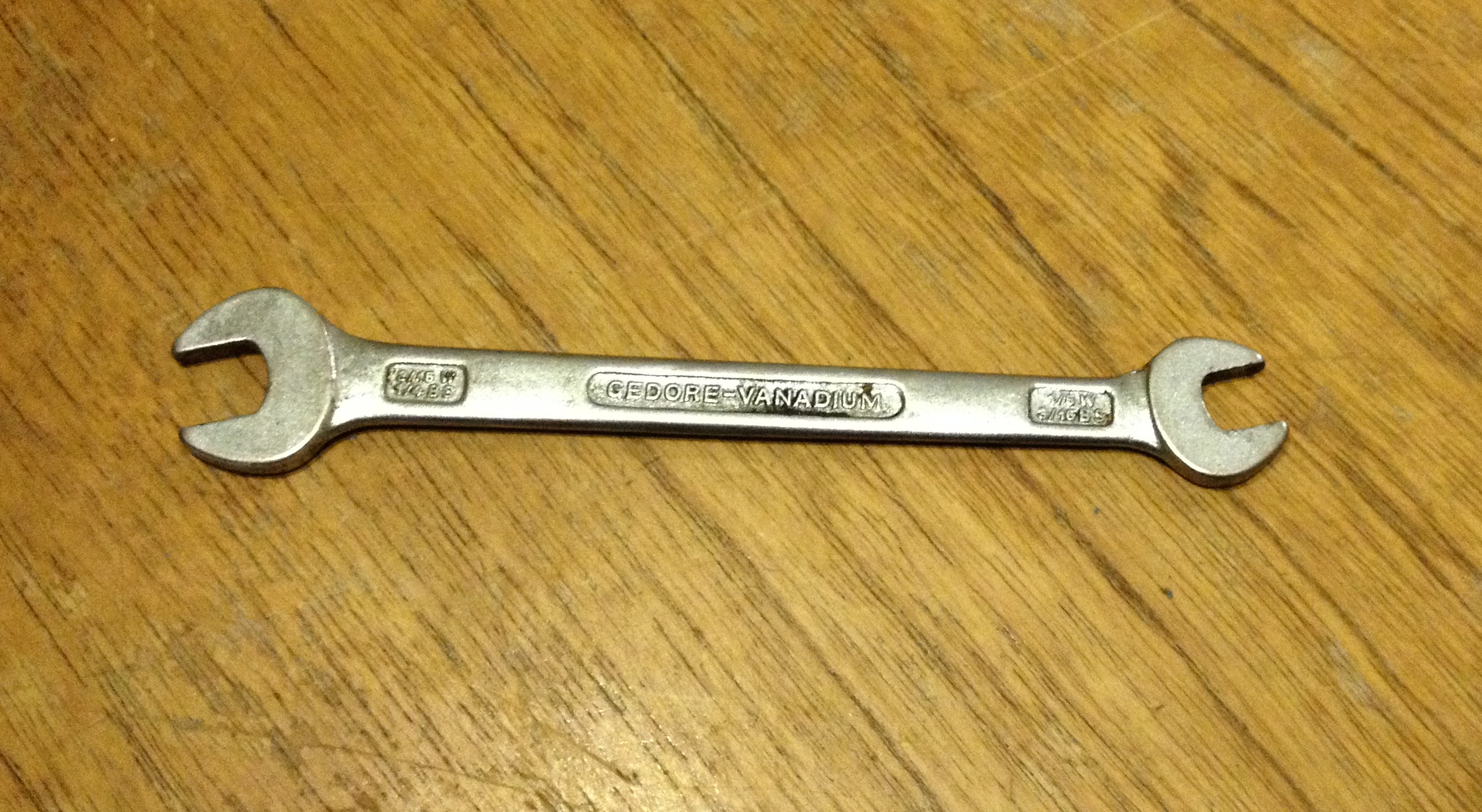
IMG_1509

This is a tool…

A spanner is the British-English word for a wrench, and in Irish when used colloquially means idiot – as in ‘Don’t leave the tap running, you spanner!’

In the British-English sense, a spanner is a specific size of implement that does the job of tightening or holding a bolt. The right size of spanner does exactly the job you require. It’s a tool and belongs in your tool-bag. It’s an essential part of your tool-kit.

If you work for a high tech company and you provide solutions to help companies address their key strategic goals, don’t use the word ‘tool’ to describe your technology – ever. I’ve heard sales people refer to what they sell as a tool when in some cases it’s an entire platform. Here are five reasons why you shouldn’t stoop to use the word ‘tool’.

– it conveys tactical, not strategic.  Tactics are short term and not mission critical.

– it conveys small, not significant.  You want your customers make large, important gains, not get bogged down managing lots of small gains.

– it conveys reactive, not proactive.  A tool fixes a problem, it doesn’t capitalise on a business opportunity.

– it conveys nice to have, not must have.  If you have no ‘must have’, you have no sales opportunity.

– it conveys IT, not business.  Technology solutions solve business problems, not technical problems, at least as far as you should be concerned.

Much better to say platform, resource, technology or even system.  Never call it a tool, please.

I was looking at a presentation the other day on 50 digital marketing metrics for CMOs, CIOs and other CXOs.  It was by a pretty stellar CMO who’s especially active on Twitter. It really was very thorough, a great piece of work. What I found odd, though was that only a couple of the 50 metrics focused on the sales side of the funnel.

Only this morning I was talking with a senior director of a globally renowned BI company about the divide that exists between sales and marketing, principally because the two areas – which should be joined at the hip – were judging success differently. One area saw a high volume of leads as successful, the other saw the lack of quality pipeline as unsuccessful. You see this gulf in many companies. I’m sure you’ve seen it in companies where you’ve worked.

To return to the marketing metrics presentation: the success of demand generation is in the amount of business that results from an activity. You should break this down further into 3 key metrics that have a direct bearing on the success and wellbeing of the entire company:

– deal size. What is the average deal size of a lead from a marketing activity that became an opportunity? What is the average deal size for the opportunities that you won? Some marketing activities will generate bigger average deal size than others.

– win rate. What percentage of the qualified leads did you win that were generated by marketing activities? What percentage of the qualified opportunities? Some marketing activities will generate better close rates than others. This tells you about the quality of leads you create, and the quality of your qualification process from lead to opportunity.

– close cycle. What was the average total elapsed time from lead creation to closed deal? From lead creation to opportunity creation? From opportunity creation to deal closure? Some marketing activities will generate faster close cycles.  Speed is of the essence when you’re trying to grow the business.

You have to tie marketing efficiency forward – not back – to revenues.  Better to focus on a few metrics that measure sales + marketing than 48 that measure marketing alone.

Last year a colleague of mine said: I’m never using the word ‘just’ again.  The more I thought about this, the more I realised how right he was.  It’s a nothing word, an excuse of a word, a word that devalues what you’re trying to say.  It’s practically a synonym for ‘erm’.

Consider these examples:

“Hi there, just a quick call to find out when you’re making a decision on our deal.”

“I’m just saying we shouldn’t do this.”

“I was just wondering what will happen if we get this wrong.”

‘Just’ belittles the worth of our contribution.  It negates us.  It’s a signal to the other person in the dialogue that subconsciously we don’t feel up to it.

Don’t use the word.  Just Do It®  🙂

The latest argument with Mrs D – or, as I like to call it, a robust discussion – reminded me of how important it is in both our personal and business lives to communicate well.  Have you ever been in a group dynamic (dinner party, dialogue for 2, meeting) and noticed how often people interrupt each other?  How often somebody asks a question and the next person chooses not to answer it, and asks their own question or makes a statement pushing their own view or agenda?  Annoying, isn’t it?

I’m no saint, and it’s something I have to work on all the time, but I try to respect the other person and wait til they’ve finished talking, and then either answer their question or further the topic in some way.  It’s about respecting the person and what they have to say, and contributing something that gets you both nearer to where you need to be.  It’s basic marketing isn’t it?  Listen-absorb-consider-contribute.

OK, so sometimes people will ramble, have nothing of worth to say, or love the sound of their own voice, and you need to work with them a little.  But generally speaking (pun intended), it’s a case of ‘I know you’re hearing me, but are you listening?’

Is it possible to be both an early adopter and a laggard?  Of course.  Just because you might be more comfortable getting later to some ideas and technologies as an individual, doesn’t mean you can’t play the role of prime-mover in others.

It’s just a question or perspective, mind-set and attitude, which can change when you need it to.

It also makes it harder for us marketers to figure you out, because we have to do it properly.  It clearly raises the stakes for the hardest part of the segment-target-position triumvirate, namely the segmentation.


Over a million of us have heard of Seth Godin and subscribe to his daily blog post either via Twitter, RSS or email.  I really like them.  They provide me with a fresh perspective, and give me that daily realignment to make sure I’m staying on the straight and narrow and doing my best.

Of course, a lot of Seth’s stuff is about taking action, breaking out of the mould, starting something and finishing it.  What I also found, to my delight, is that when you come back from vacation, you get to read a whole bunch of his posts in one go, and when you do that, you really do build up a head of steam to change things.