Archives for category: Marketing

It’s a little known fact, but GDPR, of which you’re probably sick at this stage – if you’re reading this post soon after publication – doesn’t actually stand for General Data Protection Regulation.

Well, of course it does, but for me it stands for Great Delivery and Proposal Reduction.

I subscribe to a lot of email and I’ve found myself on a lot of additional lists as a consequence. As I’m sure you can attest yourself, all these organisations have been frantically getting in touch of late to make sure I’m properly opted in to continue to receive their communications.

I’ve received emails from organisations I had no idea either I was subscribed to, or had information on me in the first place. Consequently it’s a super way for me to cull my subscription lists. Those I don’t want to stay in touch with, or to market to me, I simply let lapse and after 25th May I should be theoretically free of their shackles. I have a great opportunity to reduce the delivery of offers, invitations and proposals coming into my email inbox.

On a more serious note, this is a big, big deal for a lot of European organisations, and other international organisations who do business with customers from Europe. It’s a ton of work to be compliant and they will see their subscription lists getting quite a severe haircut.

If we’re not careful, the winners in this will be the unscrupulous organisations who carry on regardless, and with no regard for the GDPR’s provisions, at the expense of their dutiful, compliant competitors.

Too many what?

I don’t know about you, but I’m fascinated by the spurious messages you get from software to explain away an error. I’m also frustrated in equal measure, mind you, as I’m sure many of you are when mission critical stuff like email doesn’t function as it should.

I use outlook on a mac, my work hosting provider is register365 and my telecoms provider for Internet is vodafone. I think my email account is a pop3 account. Put them all together and it’s really flaky.

It will often say that incoming mail cannot be received because another account is receiving it, so it’s locked by another pop3 session. I use the work email on my phone too, so why I can’t get email on both devices, and why they can’t sync properly like my other email accounts do, is a mystery to me. Also, and I’m not looking for free help here, but my work email doesn’t allow me to send outbound email when I’m not in Ireland, but it will receive mail? I’ve tried a bunch of support-suggested options, and I know it’s not an easy solution, for some non-easy reason.

Yesterday I got the message above for why a person-to-person email wasn’t being sent. Have you ever heard something as laughable? It doesn’t mean anything and is utterly irrelevant. Too many recipients of what?

Stranger than fiction.

We’ve all heard the statistic that we use about 10% of our brain’s total capacity, the inference being that, to the precious few and perhaps some of us mere mortals too, additional unfathomable powers are at our fingertips, or rather at our synapses.

One of the first lessons I learned on those graduate work programs was the power of positive thinking and, specifically, the self-fulfilling prophecy. If you go into a situation with a certain frame of mind, then that’s the result you will probably end up getting. Go in thinking you will lose and you will, go in thinking you will win and you will. What is unsaid in all this is whether you can influence the actual outcome with the power of your thought. Perhaps we’re tapping into the 90% at that point?

I’ve always liked the idea of the self-fulfilling prophecy and I’ve used it myself, pretty successfully, before major events like sales meetings, prize-givings and so on. You can even use it for micro-events, like wanting to hit the treble twenty at darts or the outside corner with a tennis serve. If you imagine it clearly, and see it happening, it has a far better chance of happening. I’ve never found it works with gambling though…

The other day I was working away when an email pinged in with the results of a competitive bid process. My stomach did a small flip, as the bid was important to me. I relaxed, took 5 minutes to clear my other emails and then got to the award results email. I had a 1 in 4 chance of winning. Before I opened it I imagined reading the email awarding me the contract, and I even said the word ‘win’ a number of times in my head like a mantra.

I opened the email and found that I hadn’t won the contact. Just kidding! I had won, which was nice.

What is also interesting is that on the occasions when I have not been successful with the self-fulfilling prophecy, it’s because I have allowed doubt and negativity to intrude into my thoughts. Suspecting I might not have won was enough to poison the positive thinking.

Disclaimer: this does not mean you will win the lottery if you think positively as you buy the ticket or as each ball drops into the chute…

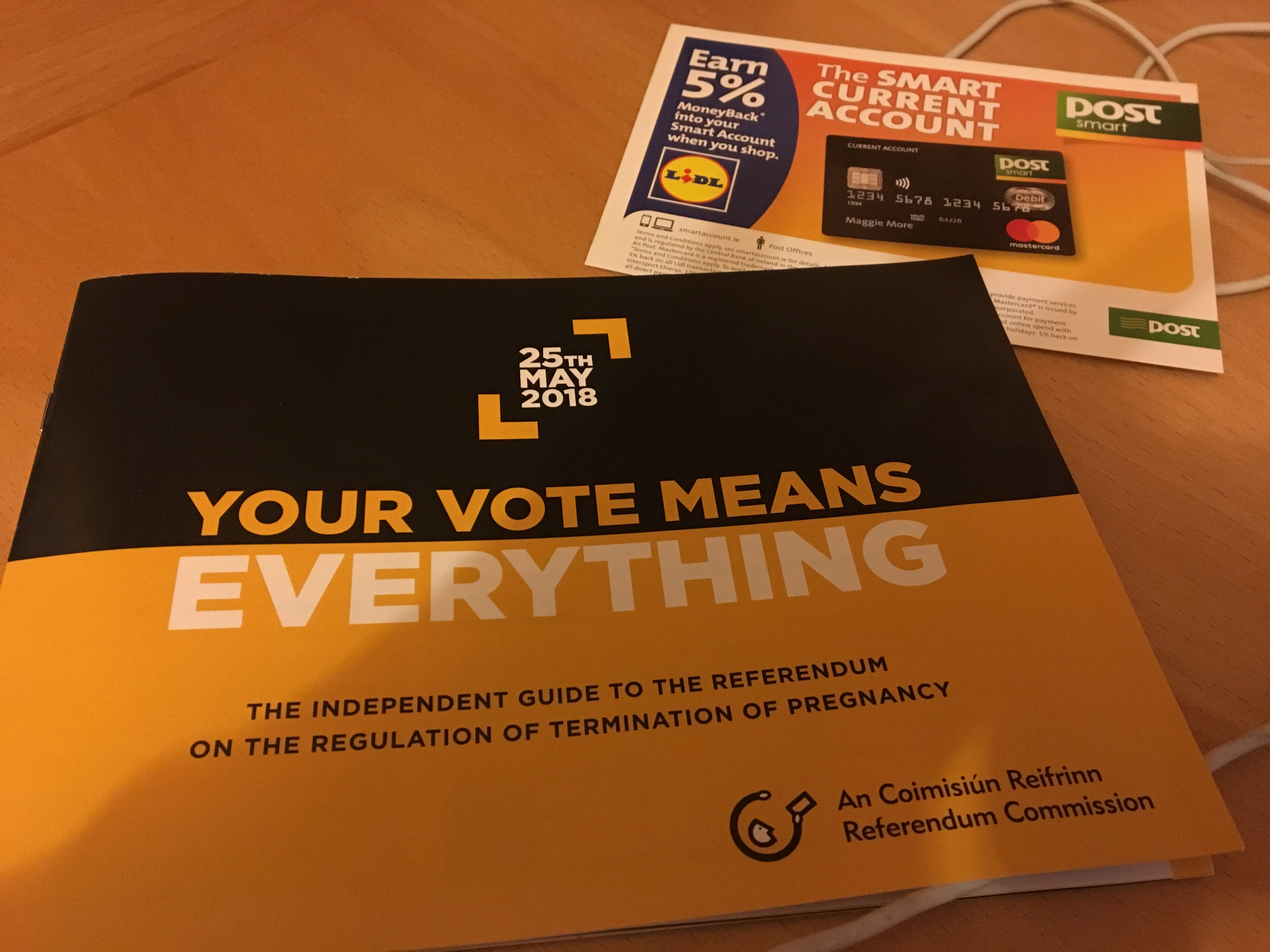
Referendum leaflet and interloper

Our household, along with a million or two other households, recently received a document on the upcoming referendum in Ireland concerning the regulation of the termination of pregnancy, more commonly known as the 8th amendment to the constitution.

The document is billed as an independent guide, produced by the government to explain citizens’ rights and options. It is a superbly written document, with clear, plain languages – English and Irish starting at each end of the booklet and joining up in the centre pages with an illustration of how to complete the ballot paper – and very well laid out.

This is no mean achievement, to summarise impartially what is involved and how the voting process works in what continues to be a most emotive, divisive and political issue.

What I found most incongruous was this. The leaflet came with an insert advertising a credit card service from the state-owned postal network ‘An Post’, supported by a well-known supermarket chain. I don’t know what’s going on here. Maybe the government decided to defray the cost of producing and distributing the document by getting one of the state bodies to part-fund it and do some fancy cross-charging. Perhaps they felt this was the perfect opportunity to market a service within a document that was benefitting from near total and national distribution.

Either way, it felt inappropriate to me. In my view it detracts from and denigrates the importance of the guide, regardless of the financial benefit. It could be just me though..

Childhood curiosity is a wonderful thing. That wild-eyed wonder as young children find out how basic stuff hangs together, what makes it tick. ‘But why, Daddy?’ is the constant question. Sometimes our curiosity gets us into trouble, but most of the time it’s a natural, healthy response to our environment so we can better navigate it.

In marketing and sales, curiosity serves us very well. When we stay curious we’re accepting that we don’t have perfect knowledge, and we’re always looking to fill out the picture and build our understanding. When we understand something better – our customer, product or market – we’re more effective at marketing to it, selling it.

The other day I was waiting to pick up one of my kids from a lesson and started reading the sleeve notes of a CD I was listening to in the car. As I was reading it I started to wonder what their creative process was, whether they started with lyrics first or a melody, and how they put the two together, or whether they collaborated from scratch and the thing came together naturally. Just what are the creative processes for music and who uses which ones, I mused.

As working adults, it’s not so much childhood curiosity as childlike curiosity that we should maintain, to stay fresh, close, and engaged to things.

Not currently recyclable 5

Not currently recyclable 1

I’ve been in slightly bad form lately, the last few weeks in fact, and I couldn’t put my finger on the source of the malaise, until the other day. It’s because of recycling.

Or lack of it. In a post a while back, in fact about a year ago, I talked about how I recycle as much as possible but have no real knowledge of what happens once my bin is tipped into the truck.

I was chatting to a friend the other day, glorying in how much we recycle. We recycle all our plastics, I said, even shopping bags. You shouldn’t do that, he said, because you can only recycle hard plastic and it contaminates and adds to the cost of the recycling process.

He was right. Sure enough I was reading an article about the very same thing, confirming what he said. I had been doing it wrong. So I started doing it right, checking all of the packaging on stuff before I threw it away.

This led to my current feeling of frustration and exasperation. WE RECYCLE SO LITTLE OF OUR PACKAGING, EVEN NOW, IN 2018. How have we allowed governments and companies to get away with this for so long, to produce packaging that is ‘Not Currently Recyclable’? To me it seems beyond laughable, if it wasn’t so sad, that we can’t recycle:

  • Shopping bags
  • Shrink-wrap that binds our food and our drink containers together
  • All forms of packaging for perishable goods

This is the grim recycling realisation. We have so far to go.

As a consumer, you want to be able to consume conveniently, easily, quickly and painlessly. This applies in both the offline and online world.

The other day I was planning to take a punt on the Euromillions, since the jackpot had done that thing it does every few months where it gets up to a ridiculous amount and draws in punters like moths to a flame. It was the middle of the day so I told myself I’d do it later. After all, there was an invitation to play in my webmail inbox.

I got tied up with work for the rest of the day and was glancing through my webmail after work when I saw the lottery email. It was about 27 minutes past 7pm, and the cutoff for the draw was 7:30pm the same day.

I went onto the lottery.ie site, and selected Euromillions. There was 2 minutes and 15 seconds left in which to play for that evening’s draw. I logged in, picked a line of random numbers, confirmed it and paid. The transaction took 30 seconds. I could have waited another minute and 45 seconds and still would have beaten the deadline.

Now that’s slick, in my book. Mind you, with millions of euros coming in every hour through the site on busy days, you would have expected them to get the process perfect. And it is, in my view.

Sadly, my numbers weren’t perfect. Not even close to perfect.

2 x 2 segmentation matrix

I ran a series of marketing workshops a few months ago, covering a pretty wide range of topics in a relatively short space of time. It was quick-fire, perhaps 30 minutes on a topic and then an exercise to put into practice what we’d discussed.

The one area that people struggled with the most was segmentation, and the task of segmenting your market. It’s easy to see why. It’s a really important part of the marketing process. How you segment your market determines who you will sell to, and also who you will compete against. Segmentation can be basic, such as by country, region, or company size, or it can be more sophisticated, covering groupings around values, or buying criteria.

Generally, you see people pick two axes against which to judge their segments or groups. For example, one axis might be how easy it is for us to sell to each group, and the other might be how attractive is this group to us. Then you plot each group against these two axes – low, medium or high – to decide which quadrant or group is worth targeting.

The trouble is, how you group your companies, and which axes you choose to judge them against – and there could be many possible axes – is critical. Bad decisions here can lead to you targeting bad companies, bad for you that is. Also, you could end up competing against the wrong competitors. As this post reminds us, if you know your market, define it, and segment it better than anyone else, you may find yourself to be the only competitor.


I’ve been mentoring for a few years, to a range of SMEs, and I’ve learned a lot. Here are 5 of my distilled thoughts on mentoring. It’s not intended to be a how to, more a set of observations.

  • Listening more than talking. As a sounding board, I think our job is to listen and absorb, then to suggest, rather than to tell
  • Focus on the few. Any business has a thousand things it could do, so I try to focus on a small number of key points. If you end up handing out loads of pointers, then your mentee goes away confused and overwhelmed
  • Process is important. When you’re in the thick of all those entrepreneurial factors, it helps if someone external is helping you with simple approaches to process, structure, and priorities for execution
  • It’s easy to say, hard to do. It’s all very well for consultants, mentors and advisers telling people what they should do. We then get to walk away and leave it to them to do the difficult bit, which is executing. I’m acutely aware of this, which is why my company’s ethos is to focus on using my experience to being responsive and practical in my recommendations
  • Be humble. Generally you’re advising someone who’s getting out there and giving it a go with their own business. They deserve a ton of praise for that alone. They’ve put themselves out there and it can be a nerve-wracking, lonely existence. The last thing they need is arrogance or haughtiness. They need empathy, constructive criticism – which comes from our experience – and encouragement

Mentor can mean teach, but for me it’s better to think in terms of advise and support.

To tender or not to tender, that is the question.

Whether ’tis nobler in the mind etc… when I worked in the sales effectiveness business, the golden rule was that your success rate for an unsolicited tender is between 0 and 5% – yep, a terrible return – for a host of factors too numerous to mention here. Perhaps for another post.

This is a statistic that should bring out the most sober analysis of how our business development time is best spent, but the truth is that it really applies to the private sector. The public sector is often duty-bound to go out to tender from a pretty low base contract value, and with increasing levels of sophistication at higher threshold amounts.

I decided to respond to my first tender in a long time last year. It was a pretty good fit for my skill-set, but it’s still an agonising decision to invest the considerable time into collecting references, getting legal documentation signed and writing the response.

I wanted to go through the process for the journey itself, to get a feel for it since it would better colour future decisions. I ended up winning the tender, and the reasons why you win are always invaluable when you do a ‘drains up’ – win or lose – with the awarding company.

Emboldened by the fact that I was batting 1,000 as the Americans would say, I promptly entered another tender, and lost it, thereby killing my excellent average.

So what can we conclude from this? My $0.02 is this. Unsolicited private sector tenders, don’t touch them. If you weren’t expecting it, you’re simply making up the numbers. Public sector tenders, if it’s a genuine project, and it’s worth it to you, and it’s a good fit, and you intuitively feel you’re in the top 3, it’s worth throwing your hat in the ring.