Archives for category: Customers

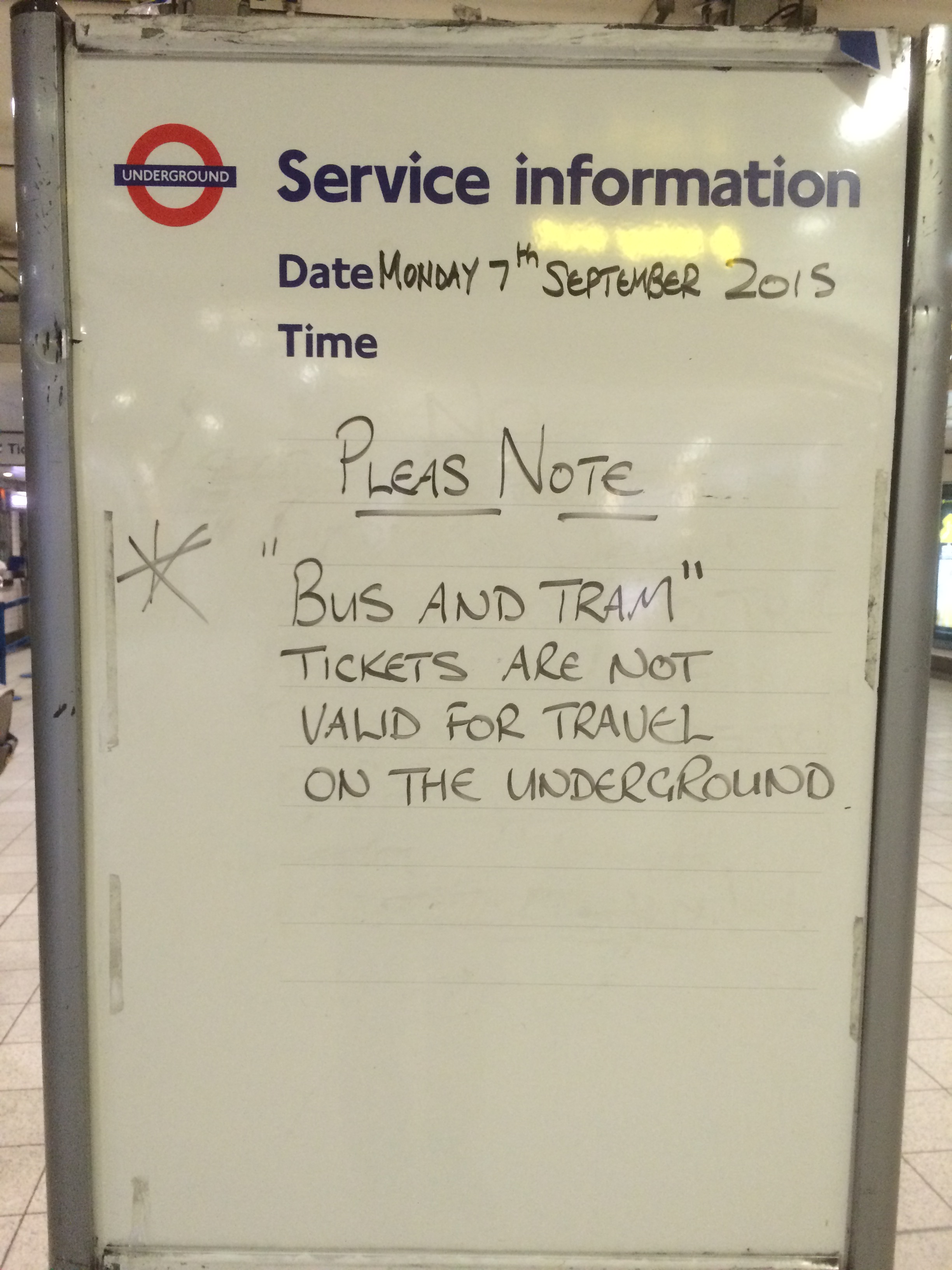
IMG_3535Where’s a physical spell checker – otherwise known as a dictionary, which nobody carries any more – when you need one? I remember about 20-some years ago in the US I saw a ticket tout with a sign saying ‘I wont (sic) tickets’.

Here’s a picture of a slightly more recent gaffe.

Online spell-checking tools in our email and document creation applications make it easy for us to avoid elementary blunders. They’re like calculators though, they make us lazy with our command of the basic skills of literacy and numeracy.

It’s OK to make these mistakes verbally, because it’s a different language to the written form and no-one can read what you say. Not so when your output is codified for all to see.

We can’t always rely on our friends to put us right on our mistakes. We have to do the work ourselves, or risk being found out.

Screen Shot 2015-08-14 at 08.24.46As a consumer, I’m bombarded by advertising, both targeted or 1:1 and mass or ‘above the line’.

As a marketer, I pay attention to advertising and imagine that I’m subconsciously judging it as well as responding to it as a consumer. You know the metrics; I’m no different and 98% or so of them pass me by for a variety of reasons, some good, some bad.

These days, we’re all conditioned to understand that when an ad for a site we recently visited is presented to us online, this is simply retargeting. Those of us who use webmail are also subjected to a barrage of ads, which is only fair – in my view – for a free app or service.

I use hotmail, amongst others, and see a ton of skyscraper ads to the right of my inbox and emails. I notice them all, but act on almost none.

I do, however, like the one here, that was presented to me a couple of weeks ago. I’m not really in the target demographic, so it won’t have been a retargeting effort, but I liked it all the same. I’ll tell you why:

  •  Squeeze the Day is a fab line! It’s a call to action in its own right, a play on the famous carpe diem phrase, but most importantly it reinforces one of the brand’s key differentiators, namely that kids squeeze the packs to get all the drink out
  • It suggests action, energy, getting important things off your bucket list – and satisfaction, either thirst-quenching or completing something worth doing
  • It’s visually arresting, fun and it’s clear what they’re asking you to do

All in all then, in the opinion of this writer it ticks all the boxes. All the boxes except one – the only critical one – which is whether or not it’s received a successful number of click throughs. That I don’t know.


Want to know what the most important word will be for sales and marketing professionals in 2016?

Engagement.

Well, it’s out there now.

I used to think the key word was ‘resonate’, but that doesn’t go far enough. When what you say resonates with someone, it’s like they’re a string you’ve plucked. You’re on their frequency, to mix a simile and a metaphor. But the string doesn’t vibrate for ever, it fades away, or loses interest and it becomes immovable, in both senses of the word.

No, to succeed we all need to engage our audience. If we work in sales, we have to get our customers engaged so that they will do something with us. If we work in marketing or sales enablement, we also have to engage our sales people, those internal customers who never read an email we send them, or a document we prepare for them. We have to find ways of making them listen and realise that this is what they need, what they have been asking for, what is going to make them more money because they can satisfy more of their customers and prospects.

Sales engagement – and partner engagement for that matter – is a crucially important slice of the pie, but it’s often the slice that gets left to go cold. And no-one likes cold pizza, at least not like they do sizzling warm pizza that engages the senses.

So if engagement is the key word in 2016, what is the key process for us for the rest of this year?

It’s this: the journey to establish and effectively communicate what we have – or what we will need to have – that will truly engage our customer.

I think I’d like to try being a baggage handler. It looks like a fun job, active and physical, if perhaps a little monotonous.

Baggage handlers are a problem for the airlines. Actually, they’re a problem for the airports, but it’s the airlines that feel the problem. Baggage handlers handle baggage onto and off the planes in the full glare of passengers watching from the departure lounges. They are a wonder of economy of physical effort, moving tens of thousands of pounds of luggage every day.

Unfortunately, they also pay scant regard for the contents of bags, and from a customer-oriented point of view this is a problem. I recently spent an idle 20 minutes watching guys loading bags onto a conveyor belt into the plane’s hold. One chap pulls the luggage off the luggage truck, from the top bag down so that each stack falls closer to him, then pivots from the baggage truck 180 degrees behind in and throws each bag onto the belt. Then the chap standing in the door of the hold takes each bag of the belt and launches them left and right over runners in the hold.

The bags take a hell of a beating, to borrow from a well known Norwegian soccer commentator. And that’s just the parts of the process we see plane-side. We don’t see the bags getting onto the trucks outbound and off the trucks inbound. If you don’t have the sturdiest of baggage materials, you risk losing anything that’s remotely brittle or fragile, and that creates a bad impression with the paying punter, at least this one.

I think I’d be a gentler handler if I got the chance. But perhaps I’d be too careful, too slow, too poorly productive, and be relieved of my duties.

Two years ago today I published my first blog post on ‘Paul Dilger’s blog – Musings on stuff I come into contact with.’ I committed to do 3 posts a week, Monday, Wednesday, Friday, going out between 7:30 and 8:30 am London/Dublin time, regular as clockwork. It didn’t seem worth the commitment to do one when I felt like it, since that would degenerate into one a month, and pretty soon none a month.

Two years later, and some 300-plus posts later, it’s still going strong, regular as clockwork. I like to think that I’m still true to the values from the early days: mostly sales and marketing stuff, posts that take a maximum of 2-3 minutes to read – rather than 10 seconds or half your morning – and posts that I hope interest and enable people.

It serves as the chief dollop of fresh content for my business web site, but it doesn’t feel like work. I really enjoy writing the posts, and I know the discipline of creating them is good for me.

I hope you enjoy dipping into them as well. Here’s to the next post :-).

It’s not about starting a project. It’s not about coming up with a great idea that could make millions. It’s not about deciding to walk coast to coast for charity.

Anyone can start something. Kids start new things every day, but how many do they finish before they get bored and move onto the next shiny metal thing?

It’s not about starting something.

It’s about finishing something. It’s about following through, executing, closing the loop, learning from the experience and moving on to the next thing.

This is not so much 3 separate Cs as one rule with 3 C’s in it.  Here is my golden rule of customer intimacy:

Customers Crave Consistency.

Consistency is a comfortable armchair after a long day. It’s a familiar tune, or a fly ball to centre field. Easy.

When you’re consistent, and deal with your customers in a consistent way, they know what to expect. They grow with you, they’re comfortable with you, and the relationship deepens and develops. Remember the ‘one more thing’ of Jobs-led Apple product launches? We know it’s coming, and it sucks us in.

When you’re unpredictable, haphazard and inconsistent, customers are confused, discombobulated, frustrated. It turns them off.

I try to keep my posts consistent, to a consistent standard. It’s not a case of ‘this is getting stale, let’s change it up.’ It’s more like ‘I’m going here, it feels like home.’

For more on my consistency soapbox, see here.

Joined up marketing is what you really want to do in B2B, but it’s actually quite hard to do. It needs a lot of deep thought before you start executing.

The temptation – especially when you have monthly demand generation and pipeline targets to hit – is to take a scattergun approach and puts loads of stuff out there and see what sticks. You can get into a cycle, or perhaps it’s a rut, where you have to get content out there and rather than pause for a week or two and get your strategy tightened down you fire ahead and keep pumping out material.

Notice that I’m not talking about closed loop marketing, though that’s a pretty good approach too.

What I mean by joined up marketing is that your messages appear joined up to your customers. They understand how the messages fit together because you zero in on a certain aspect or message, and then zoom out to show how each aspect fits into the overall picture. You give your customers context, and they understand the buttons they need to push to get the impacts they need to solve the problems you have helped them identify.

To do this right, you have to get your big picture sorted, as well as the component parts that make up your big picture. It’s worth it in the long run though, because with a joined up approach each element reinforces your overall positioning, your stance on the world, the difference that the market acknowledges you make.

Question: Why go to a consultant rather than someone in your company to get something important done?

There are myriad reasons, but the 3 I like and the 3 where I feel people like me can add value are these:

1) Specialised experience. You pay for experience in the field where you need help, because a consultant’s experience allows them to know which corners you can cut to execute quickly and save time.

2) Hard-nosed practicality. Consultants know what works and what doesn’t work. The practical, workable solution gets the job done.

3) Laser-like responsiveness. A good consultant knows that you went with them because they are free from any internal company politics or distractions and because they can deliver.

These 3 reasons are the ones we stand behind at M4 Marketing, which is my consulting practice. Together, they add up to what I think is a compelling offering, namely accelerating a company’s time to market for any important project.

Answer: You should go to a consultant because you want to get something important done.

Empty Promise - No Paper

Empty Promise – No Paper

Don’t make empty promises, promises you know you can’t keep.

Don’t offer things you don’t have. You’ll create a need for something that people now want but that you can’t deliver.

Don’t invite people to use your resource sparingly and then have none of that resource available.

If you run out of something, remove the notice or label it refers to, or amend your stock to say – yes, you’ve guessed it – ‘out of stock’.

These are all easy things you can do.

Remember, you’re looking to establish a relationship with your customer, one based on trust and the mutual expectation that each can deliver their side of the bargain. Don’t blow it by failing to do the easy stuff.

Otherwise, you run the risk of phantom marketing, creating demand which you can’t satisfy. You’ll annoy your audience, turn them off and break whatever bond you had built up. Then you’ll have to work doubly hard to get it back.