Archives for category: Customers

In the last of this week’s cluster of posts on the spelling and meaning of a couple of words in this glorious language, I want to touch on the application called Grammarly, about which I profess to know very little.

I often see ads for Grammarly playing before I watch a video on the BBC international website, and by the American accents on the ad and the American base of the company, I assume the application helps with US-English phrasings, spelling, meanings, syntax and so on. There may well be a UK-English version too, though I doubt there’s an Irish-English version, or a Scottish-English, Welsh-English or any other variant that blurs the edges between language and dialect.

Two lads from the Ukraine founded the application, so perhaps its real benefit is for those for whom English is a second language. For many of us, however, we already have a lot of this functionality built into our office productivity applications and our browsing applications. For instance, if you erroneously search for ‘Grammerly’ – presumably an easy mistake to make if you’re the person who might need and want to use the correctly spelled version – on Chrome, you get returned suggestions for Grammarly.

Those of us who already get help from our everyday software and have a decent command of the language are using our skill and judgement on the grammar and phrasing side of things anyway. We use the tools to correct typos and omissions, and we use ourselves to correct the other more subtle areas of the language.

Which possibly explains why the application is probably very successfully catering to the vast numbers of people who need to converse in the dominant language which is not their dominant language.
What is it about those inclusive hotel packages? In this last  in a 3-post series on holiday musings, I have a confession to make.

We recently went on holiday and opted for a half-board package. You get breakfast and dinner, but no lunch. Not only that but it was all the breakfast you could eat, in a self-serve stylee, and all the dinner you could eat. The food was excellent.

I couldn’t help myself. I can’t help myself. It’s something about the bountifulness and being able to go up as many times as you want. I would have 4 small courses for breakfast, topped off by buck’s fizz, natch. I would also have 4 small courses for dinner. It was like tapas on steroids.

We decided not to upgrade to full board – the all inclusive package – while we were there. It was €30 per day to upgrade, for which you also got lunch and all the drinks you wanted from a specific list. A long specific list, including mojitos that were €12 a pop to the non-full boarders. It was ludicrously good value.

I wouldn’t have been able to control my intake with a 24/7 carte blanche. With all inclusive it’s as if the laws of supply and demand no longer apply. We can suspend Newton’s 3rd law of physics and gorge on a seemingly unending supply of body fuel.

It’s a good job there was a gym and a couple of pools in the complex. An extra stone over the course of a week does not sit well on a 10-stone frame.

In this second post of a 3-post series on ‘musings on holiday stuff I come into contact with’, I wanted to talk about water.

When we’re at home we try and get the kids into the habit of having a quick shower, no more than 4 or 5 minutes if possible. It’s not only good practice for when Ireland finally gets its act together in terms of water metering, but it’s good for us and future planetary inhabitants too.

We were on holiday recently, in the warm-all-year-round canaries. It’s always a pleasant surprise to come out of the shower into into a naturally warm environment. The first day or two I was tempted to have a long luxurious shower. After all, there’s loads of water around here. We’re surrounded by an ocean of the stuff, I was thinking.

Of course, this is stupid, selfish thinking. As the Rhyme of the Ancient Mariner goes, ‘water, water everywhere, and not a drop to drink.’ The island still has to treat all that sea water to turn into the water that comes out of our taps and shower heads and flows into our pools. They’re as keen on conserving water as any other country, probably more so.

So I kept my showers down to the minimum time, having had a word with myself. Water is a precious resource, so conserving it – even for a business like a hotel, with lawns, plants and flowers to keep looking good – makes sense whatever your circumstances.

Since I went away with the extended family for a warm weather break a few weeks ago, this is the first in a 3-post series on holiday travel. I was tempted to call this post the Ryanair Scam part 2, since they have recently introduced a rule by which you can only have your cabin bag in the overhead locker if you’ve booked priority boarding. Otherwise it goes in the hold. This is fine if you already have a large bag in the hold, but a pain if you’re travelling light, since you have to factor in extra time and effort to retrieve your bag from the destination baggage belts.

I recently experienced this policy at first hand. The reality is that it works pretty well if, as I mentioned, you already have large holiday bags checked in, at additional expense of course. We did, so it was a no brainer and it means less to carry on and off the plane. However, it’s a ton more work for the hard-worked, exasperated gate crew – the check-in/boarding staff and baggage handlers – who now have to manually tag and load around 100 additional non-priority bags per holiday flight.

As it happened, our flight was delayed leaving. The conveyor belt into the plane from the baggage carts broke, presumably under the workload of having to deal with many more bags than it was used to. This turned a useful conveying device into a shelf, so the bags had to be manually carried into the hold.

This is what often happens to a process which you’re constantly tweaking and looking to improve. You pinch here, you feel it somewhere else. Ryanair do keep moving, changing, innovating though. Fair play to them for that.

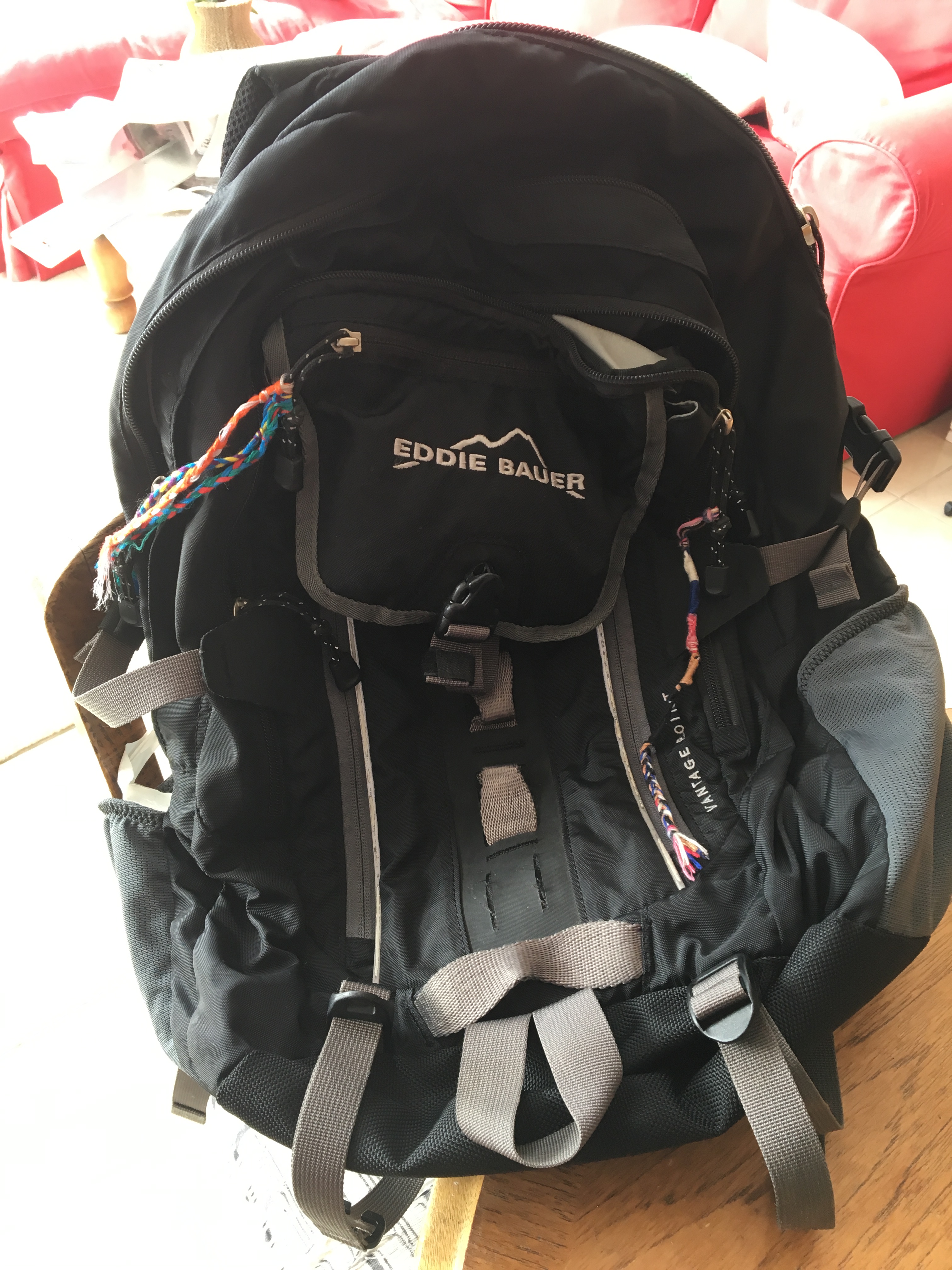
My Eddie Bauer bag

My Eddie Bauer bag

What a pity is was that Eddie Bauer went bust. When was it, maybe 2009 or so?

I was in the US on business about a decade ago and bought a really warm down coat. While I was there I saw a laptop-holding travel bag that I’d been looking for for ages. It had an extra section that turned it from an overnight bag into something you could use for 3 or 4 nights, perfect for those short-ish business trips. For some reason, this kind of bag with the extra section and the extra 15 litres or so of capacity is really hard to find.

I spend a lot of time in the software industry and this bag fits right in. There must be 30 pockets in there, of all shapes, sizes and uses. The laptop section is very snug for devices of all sizes.

This bag accompanies me on almost every journey I make when I need to bring a laptop, and most even when I don’t. It always fits in the airplane overhead bins, and I never get asked to check it in, even when it’s full to bursting.

A treasure of a piece of travel luggage. I don’t know what I’ll do when I have to replace it.

I meant to call my wife the other day, but ended up calling the next name down my favourites list, my youngest brother. His 8-year old son answered the phone. The call went like this:

  • Hello?
  • Oh…[nephew’s name], is that you?
  • Yes, who is this?
  • It’s your uncle Paul, sorry, I called you by mistake..
  • Do you want to speak to my Dad?

Kids are great, aren’t they? They have no filter. You always know where you stand with them.

As we get older we develop layers of self-consciousness and diplomacy. Consequently, we have to peel back layers with adults to get to what they really mean. Sometimes this can present a challenge with sales and marketing, especially when we’re looking for feedback or indication from a customer about what they really think of our product, service or company.

The number of layers each adult has depends on their own unique filter setting. As you probably know, some adults have a low filter setting, blurting out exactly what they think in an uncontrolled fashion, or else telling you exactly what they think because that leaves no room for ambiguity. I much prefer this, as honesty is true feedback, as long as they don’t express it in a needlessly nasty way.

Many adults on the other hand, and this varies culturally, have a high filter and our job is then to try and get to what they really mean, by probing and asking essentially the same question in a different way.

Getting work done – by other people who do it for a living – around the house is always difficult I find. It’s feast or famine, from a supply point of view.

When the economy is tanking, no-one has any money and providers can’t get enough work, so they get involved in other areas. Famine for them. When the economy is flying, there’s too much work to go around and you can’t get anyone. But, because providers can only do the jobs for which they have available people, they can pick and choose between jobs and their schedules are chockablock for the short term. That’s the feast.

For those of us who don’t want to wait around beyond the short term, we encounter voicemails and our messages don’t get returned. When we finally get them to agree to an appointment, they don’t keep it, or they rearrange it, more than once. They play a balancing act of keeping everyone on the long finger so they can do concurrent jobs and always know what’s coming down the pipe, at least for next new weeks. The end customer suffers from a less than perfect outcome.

You get what you pay for, which simply heaps the pipeline of possible work onto the few reliable providers of house-related work, those folk that call when they say they’ll call, quote when they say they’ll quote, and start the job when they say they’ll start. And, because they know that almost all the competition is unreliable, they can charge a premium for their services.

Yes, it’s feast or famine. Unless you have a relative in the professions or you can do it yourself, getting stuff done is hard.

Mothercare store front

I was at my mother’s house in England the other day, casting an eye over all the toys we had as kids, which she has saved of course, and which her grandkids now enjoy.

I came across the edge of a toy package from Mothercare. This company has been around for ages and is clearly a highly respected name in anything to do with children. I love the identity – which I think the company has now moved away from – with the little child image literally under the protection of the m of mother.

What struck me for the first time that I can remember was how outdated the name was; the actual words mother and care put together to make a new name, as many company and product brands do. Back when Mothercare came into being, parenthood was possibly the almost exclusive preserve of the female parent, and that’s simply not the case any more.

The funny thing is, and I feel this about many household names and brands, we never question the name. We see the word mothercare and we equate it with a parenting brand for children. This is what a brand does to us. We rarely take the name out of context, deconstruct it, before realising that it’s perhaps not as appropriate as it used to be.

I think there are lots of examples of this, brands that we take for granted because they’re much more than the sum of their words. Lots of them, hiding in plain sight.

In this ultra-PC world we live in, as I’ve noted previously, communication is never far away.

I was travelling on a train in the UK the other day and the automated announcer reminded everyone that they needed a ticket to travel and couldn’t get one on the train. This message came from the ‘Revenue Protection’ department.

That’s the fraud protection department, right, since travelling without a ticket is fraud? I’m left wondering what message they’re going for, what impression they’re trying to project, with the term revenue protection.

Isn’t that a little like calling a short person like me vertically challenged? Perhaps they don’t want to antagonise the fare-dodger.

If someone travels without a ticket, and they’re not entitled to free travel, then they’re damaging the profitability of the transport company. As a consequence, all of us fee-paying passengers are indirectly punished when the company has to raise fares, or reduce services, or go for more government subsidy – which is of course a function of the taxes you and I pay – and we end up paying more.

So why not call it what it is? Fraud prevention is better, methinks.

The Win/loss analysis is a really important part of business. That said, when people think about win/loss analysis, they generally mean loss analysis.

Calling up the customer, asking how did we lose out, what could we have done better, who got ahead of us. This is all valuable information for introducing back into the mix so that we can improve.

Not many companies actually do win/loss analysis, which is a glaring omission in strategy and sales process. The funny thing is, and this even worse, people hardly ever do the win analysis call or meeting. Why did we win? Why did you give us the business? Where could we have improved? These are vitally important questions, and the answers to them are even more important.

I did a short, 20-minute win analysis call with a customer the other day. He said, ‘I’ve been doing this job 9 years, and I handle around 30 tenders a year. This is only the 3rd time someone’s done a win analysis debrief with me.’ So that’s 1 win analysis call every 90 tenders, a fraction over 1%.

The win analysis call is the simplest, most obvious sales call that no-one hardly ever does. I’m in a generous mood, here’s another one: going back to a recent new customer and asking them for 1 to 3 more non-competing sales leads.

This is obvious, right?