Archives for category: Language

In an earlier post I talked about the differences between American English and British English. One area the two homes of English speaking differ markedly is in pronunciation.  For example, I might say missile, they say ‘missle’.

When you get to polysyllable words, then you’ll often hear the differences. I might say controversy, they might say controversy. I definitely say laboratory, whereas our American friends prefer to put the accent on the first syllable and let the others trail behind like the links of a chain dragged along the ground.

Wherever you choose to place your accent, be aware that it’s a real differentiator, and not just between these two countries. When you get it wrong altogether it signals that the language is not your first choice. ‘It’s really important,’ as a former boss of mine is fond of saying, ‘to put the emphasis on the right syllable.’
Of all the spelling mistakes that jarr the senses, the use of ‘of’ when we mean ‘have’, is the worst.  It makes me cringe – which one should pronounce as ‘curringe’, with the accent on the second syllable, for emphasis – as it betrays a lack of understanding of the basics of our beloved language.

It stems I think from the use of the shortened form of ‘have’ in common parlance, as in ‘I could’ve been there’.  Two things stick out for me here. Firstly, surely they know that the full length version is ‘should have’ and can make the micro-leap to ‘ve?  Secondly, isn’t it odd how words like isn’t and should’ve are spelt as one word, not two?  You would logically expect to see is ‘nt, or should ‘ve, but I guess we’ve been economical over time and moved the orphaned word into the bosom of the main verb.

For more on this, see a rather good summation from Dave’s ESL Cafe.

It’s not really acceptable to use it in texts either, since ‘ve’ works perfectly fine as its own word in that medium, with or without the apostrophe. Our use of language in mobile device texts is a whole other ball game though, and will probably provide plenty of fodder for future posts.

Of course, you could avoid looking a bit stoopid by saying ‘shoulda’.  As long as you don’t write shouldo…

I do like a good cognate accusative, or internal accusative as it is also termed. I first came across the term when doing Greek at college. Those ancient Greeks liked them in their literature. The accusative case, as you may remember from your language classes, usually signifies the direct object of a verb. When you do something, that something is accusative, and in some languages the pronoun or noun changes to indicate a direct object.

The cognate accusative is where the direct object and the verb share the same root word. We fought the good fight, I dreamed a dream, she walks the walk.  He lived a life worth living. A bit over the top that last one, but you get the idea. They sound simple, direct, weighty, aphoristic. I like them a lot.

Incidentally, while we’re on the subject of linguistic quirkiness, the word ‘dreamed’ also has a variant ‘dreamt’, which is the only word in the English language ending in ‘mt’. One for you quiz aficionados to store away for safe keeping. No charge for that.

H is a funny letter. In the English language, it almost always signals aspiration, the obvious exception being ‘herbs’, which our American friends pronounce ‘erbs’.

The letter itself is actually spelt ‘aitch’, and as a letter is pronounced without an ‘h’ sound. Most people, especially certain regions of England, routinely pronounce the letter ‘haitch’, and my daughter finds it particularly difficult to drop the ‘h’ when I test her spelling. ‘There’s no such letter as ‘haitch’, sweetie.’ ‘but Dad, listen to the word ‘house’, or ‘hello’, it must be ‘haitch’.

She’s right of course, it’s completely counter-intuitive. Your plosives, consonants which coincide with an expulsion of air, tend to begin with the sound they signify.  Examples are b and p. Dental consonants, same thing really, examples being d and t.  Your fricatives and labials – like f and and l – are harder for our mouth to form in order to start the word, so instead we prefer to prefix their names with a ‘e’ sound to get the syllable going.

The letter h, though, goes out of its way to avoid the sound that it signifies. In that sense it’s a bit like the letters w – ‘double-u’ – and y – ‘wye’ – which are also a bit maverick, but nobody ever mispronounces those two letters.  Which leaves the letter h to glory in its own eccentricity.  Hawesome.

IMG_1509

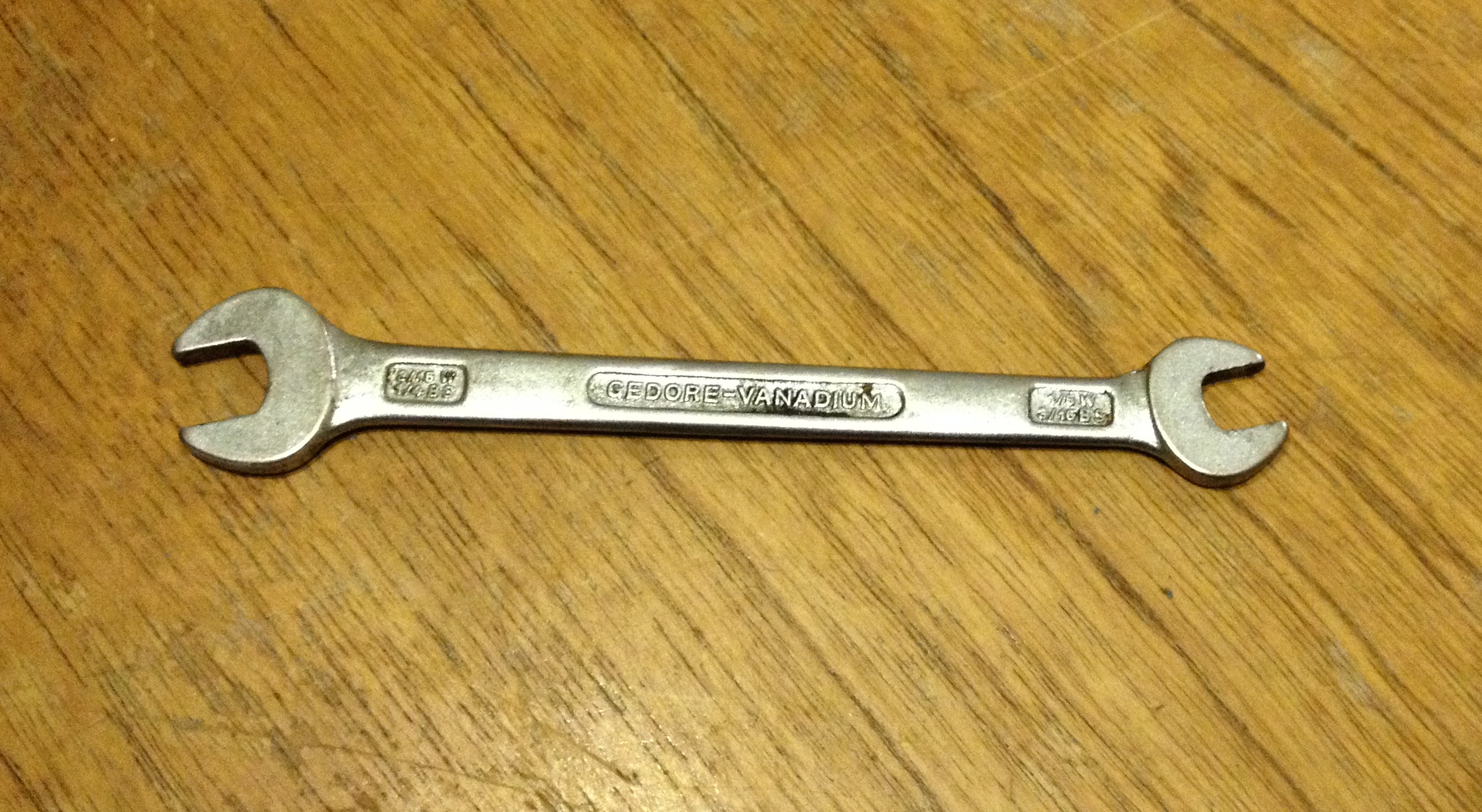
This is a tool…

A spanner is the British-English word for a wrench, and in Irish when used colloquially means idiot – as in ‘Don’t leave the tap running, you spanner!’

In the British-English sense, a spanner is a specific size of implement that does the job of tightening or holding a bolt. The right size of spanner does exactly the job you require. It’s a tool and belongs in your tool-bag. It’s an essential part of your tool-kit.

If you work for a high tech company and you provide solutions to help companies address their key strategic goals, don’t use the word ‘tool’ to describe your technology – ever. I’ve heard sales people refer to what they sell as a tool when in some cases it’s an entire platform. Here are five reasons why you shouldn’t stoop to use the word ‘tool’.

– it conveys tactical, not strategic.  Tactics are short term and not mission critical.

– it conveys small, not significant.  You want your customers make large, important gains, not get bogged down managing lots of small gains.

– it conveys reactive, not proactive.  A tool fixes a problem, it doesn’t capitalise on a business opportunity.

– it conveys nice to have, not must have.  If you have no ‘must have’, you have no sales opportunity.

– it conveys IT, not business.  Technology solutions solve business problems, not technical problems, at least as far as you should be concerned.

Much better to say platform, resource, technology or even system.  Never call it a tool, please.

For a language that is the lingua franca – and I’m aware of the irony of using that term – of the business world, and most of the tourist world, English is a tad tricky at times. Actually it’s a lot tricky. With a ton of irregular verbs and more heteronyms than you can shake a stick at, it’s no wonder people for whom it’s a second language struggle from time to time.

It’s not that much different for people using it as their first language. Take some of the irregular verbs and their past tenses. We’re talking run-ran-run, drink-drank- drunk, ring-rang-rung. One’s for the present tense, one’s for the simple past – or Aorist if you love your classical Greek – and one’s for the perfect tense, as in I have done something.

From time to time you’ll hear among native English speakers phrases like “I rung him already,” or “I’ve already rang him.”

The way to remember it is this: simple past is generally the ‘a’ word. I ran round the block. I rang Paul yesterday. We drank to her health. When you’ve got the word ‘have’ in there, it throws it ‘back’ farther to the ‘u’ word.  I have rung the changes. We have run a mile. He would have drunk more if he’d stayed.

Of course, the other way to avoid getting it wrong it to take the wonderfully circuitous route favoured by the Irish: I’m after ringing him. I’m after drinking a toast.  Marvellous.

Why do people use brackets, or parentheses as our American friends would say, in the written word?

We don’t use them verbally, other than an aside perhaps. For me, brackets are rarely used to explain some background detail, like something you might see in a footnote.

When I see content in brackets, I think it reduces the power of what you’re trying to say.  It feels like you know you should write less, but don’t have the courage to edit down, so you put your potentially superfluous text in brackets. Or maybe you just want to separate clauses out.  For that you could use the hyphen – or is a dash? – to get your reader to pause.

Remove the brackets and let your words go free, or lose them altogether (or not, as the case may be).

I checked my daughter’s homework today and her grammar questions were on the different uses of it’s and its. She’s 10. She got them all right.

It amazes me how many times you see the incorrect version used in emails and signed off communications from senior people and established companies. Have they forgotten the rule, or did they never know it? It must make every teacher or former teacher cringe when they see these kinds of mistakes.

Of course, the confusion lies in the fact that the apostrophe can denote both a missing letter and possession.  Paul’s a simpleton stands for Paul is etc, whereas Paul’s friend is a simpleton denotes the friend belongs to me. The exceptions to the ‘apostrophe for possession’ rules are – inconveniently – his, her and its, otherwise known as your possessive pronouns.

So, therefore, I offer you a primer.

It’s is ONLY EVER USED TO DENOTE A SHORTENING OF ‘IT IS’ or ‘IT HAS’ .

Its is ONLY EVER USED TO DENOTE ‘IT’ POSSESSING SOMETHING.

Thus, you say: It’s a dog, and it’s got its bone.

Does this post help, or does it come with its own headache?

Just a few more words on the word ‘just’, dear reader. I was recently talking about the much maligned (and rightly so) adverb, not the deeply important adjectival version which is worth a post or two in its own right. In fact, it’s worth dwelling on the panoply of meanings that accrue to this 4-letter word. I’m struggling to think of another that works so hard for our beloved language.

It seems there are other people who have issues with the word. Only today, the highly esteemed (and rightly so) Seth Godin posted his concerns. In Seth’s post, the context of ‘just’ as a throwaway is what rankles with him.

What it boils down to is this. You’ve got to know your context, and use ‘just’ when it positively qualifies what you’re trying to say. Don’t use it if it obfuscates or reduces what you’re trying to say. You need to know the ‘mot juste’ for just. And rightly so.

Swiss linguist Ferdinand de Saussure was a clever bloke.  He distinguished between 2 languages: langue, the language, and parole, the spoken language.  We speak one, and we read and write the other.  They can be quite different.

So it seems a bit odd to me that we write to be read, rather than to be heard, especially in the stripped down, dumbed down, sound-bite-driven world that we inhabit these days.  The blog seems to me to be a classic example of this.   You can certainly get quicker through those posts that are written closer to the language of conversation.

Re-read the sentences from this post.  Could you see yourself saying them, exactly as written?  Some of them maybe, others not?  Odd, isn’t it?   Perish the thought you do a spell check and Word tells you your sentence is not a sentence, but a fragment.  Shocking.  🙂