Archives for category: Customers
IMG_1610

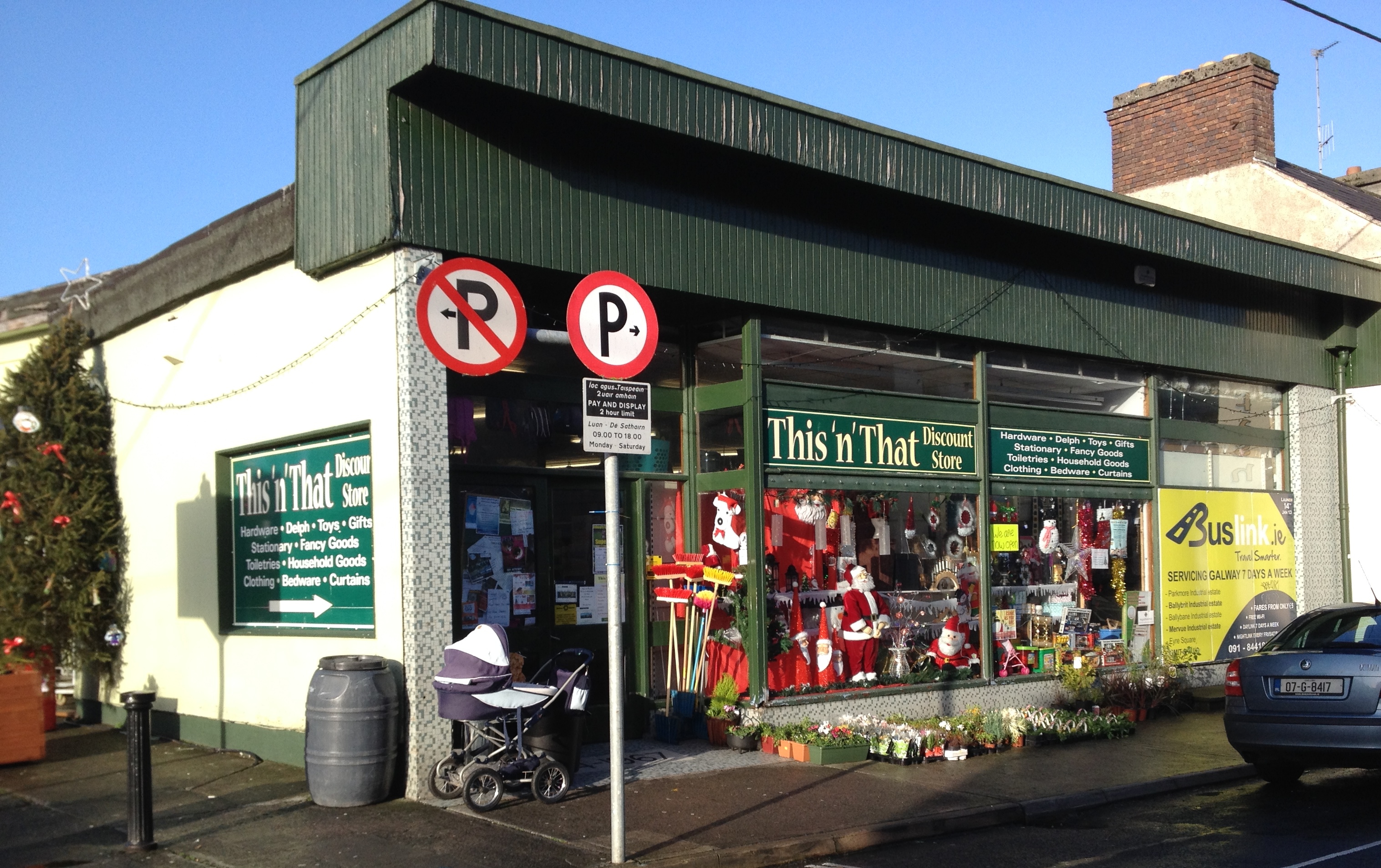
This ‘n’ That shop, Athenry, Galway, Ireland

Closing the series of posts in praise of people or things, I’m recommending my shop of the year.

Unless you happen to live in the same village as me, chances are you will have never seen or heard of This ‘n’ That discount store in Athenry in the Ireland’s county of Galway. Nor will you ever find it online either, as this is your traditional shop that eschews all modern ways of selling and is truly bricks and mortar only.

Tucked away in Northgate Street, near the town’s iconic arch from the original medieval walled town, This ‘n’ That, as the name suggests, sells pretty much every item you would ever need at a very reasonable price. From binders to bed sheets, clothes to car mats, heaters to hair brushes, toys to toiletries, it’s all here at a fraction of the high street or even online price. My daughter got about 8 Christmas presents for €18 in there the other day. Fabulous.

It’s the staff that make a place in almost every service-led business, and this one is no different. There seems to be loads of staff working there at any one time, of varying nationalities.  They are always super helpful and have the unerring ability to locate an item you need among a seemingly infinite array of stock, rather like those mechanics who can find exactly the wrench they need among what looks like a cultivated chaos.

It’s cash only at This ‘n’ That. Credit cards would be a bit too 20th century. The staff check that battery-operated items like torches – flashlights to our American friends – work properly before selling them to you. Such a breath of fresh air compared to the usual grumpy curmudgeons you get in this type of shop.

As our traditional shops get more and more squeezed by the massive malls or online merchants – creating what is known as the ‘donut effect’ in some English towns and cities – it’s local shops that sell a tablet case for €3.50, as opposed to 3 to 5 times that amount elsewhere, that will survive or even thrive. Cheerio 2013.
This is my 50th post, and I’m dedicating it to my postman.

I don’t know his name, but he’s been delivering the mail in the 6-plus years that I’ve lived here, and probably 30 years before that in my adopted home town. Always good natured, he’s as reliable as the bad weather that he cycles through to get the stuff delivered. I think he does half the town.

It’s almost like he’s from another age, part of the scenery, known to all and respected by all in the same way as every village’s PC Plod used to be.

I remember reading a book by Rob Parsons called The Heart of Success a few years ago. I’m going to quote you a slice of it:

“One night when my father was getting ready for work I interrupted him: ‘Don’t you ever get bored of just pushing letters through doors?’

“If I hurt him he didn’t show it. He said, ‘Son, your father delivers the Royal Mail.’ He made it sound like the Queen herself had asked him to do it. ‘People rely on me – businesses, armies and police forces, friends and relatives from overseas – I deliver all their letters. You should come with me some day and see somebody waiting at their door to see if I’ve got a letter for them. It may be about a job they’ve been hoping for or from a daughter they haven’t heard from for a while, or perhaps just a birthday card. No, son, I don’t get bored.'”

I reckon my postman has hand-delivered 1,000 letters and parcels to me in the last year. The postal service has already been paid for every single delivery he makes, before he delivers it. He still does it well, and with a smile on his face.

That’s why I tip my postman. Merry Christmas.

Most of us have been shopping online for 15 years or more. I remember my first ever online purchase. It was on Amazon. I couldn’t believe how easy it was. To this day Amazon remains the benchmark of how to serve customers.

For someone like me, who doesn’t live in the country where he was born and raised, online shopping is a thing of beauty. I can send birthday and Christmas presents to family and friends at good prices, avoiding any postage charges because the gifts are being delivered domestically. For people who are at their busiest at this time of year, it is convenient, quick, secure and good value.  What more can you want?

Ironically, I’ve been doing some work with a provider of an ecommerce platform that allows retailers and merchants to extend their coverage across marketplaces. Not just Amazon and eBay, who consume not far off two-thirds of all global ecommerce, but all their international counterparts, as well as a host of other smaller or more niche marketplaces. Having been a consumer for a decade and a half, it’s been a fascinating few weeks seeing how things work from the other side of the transaction.

There’s one thing I’m sure of. The numbers for online are only going in one direction in the future. Indeed, we’re looking at not much more than the tip of the iceberg of what is possible on the web. And by all accounts, the web itself will be but a mere frippery compared with the ‘Internet of things’.  Change is a constant :-).

IMG_1509

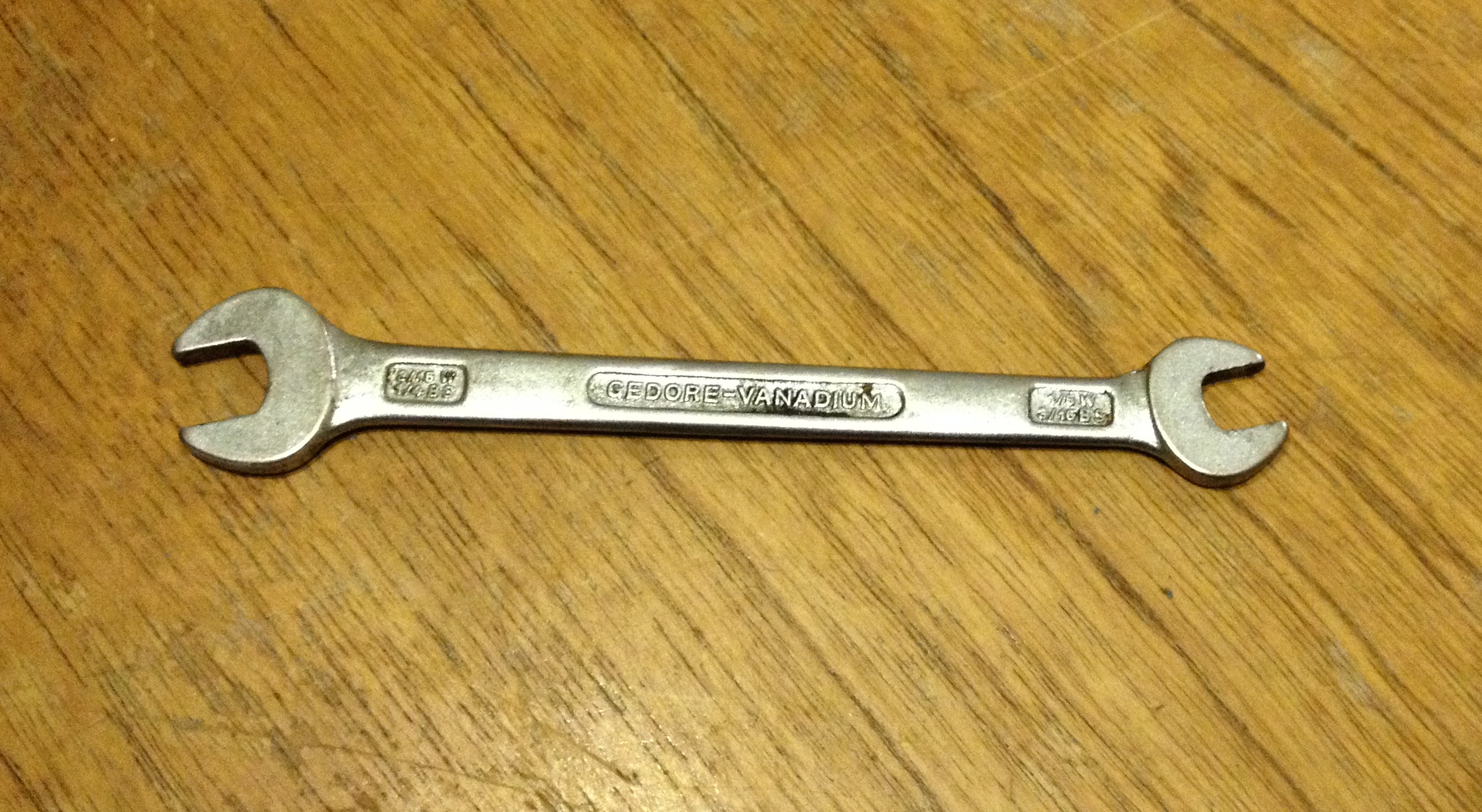
This is a tool…

A spanner is the British-English word for a wrench, and in Irish when used colloquially means idiot – as in ‘Don’t leave the tap running, you spanner!’

In the British-English sense, a spanner is a specific size of implement that does the job of tightening or holding a bolt. The right size of spanner does exactly the job you require. It’s a tool and belongs in your tool-bag. It’s an essential part of your tool-kit.

If you work for a high tech company and you provide solutions to help companies address their key strategic goals, don’t use the word ‘tool’ to describe your technology – ever. I’ve heard sales people refer to what they sell as a tool when in some cases it’s an entire platform. Here are five reasons why you shouldn’t stoop to use the word ‘tool’.

– it conveys tactical, not strategic.  Tactics are short term and not mission critical.

– it conveys small, not significant.  You want your customers make large, important gains, not get bogged down managing lots of small gains.

– it conveys reactive, not proactive.  A tool fixes a problem, it doesn’t capitalise on a business opportunity.

– it conveys nice to have, not must have.  If you have no ‘must have’, you have no sales opportunity.

– it conveys IT, not business.  Technology solutions solve business problems, not technical problems, at least as far as you should be concerned.

Much better to say platform, resource, technology or even system.  Never call it a tool, please.

The connected economy makes it increasingly easier for us to be productive from the comfort of our laptop or smart device. You still can’t beat a face-to-face, though, and for that you need to travel.

I had occasion to travel yesterday, for a meeting in London, in and out from Ireland in the space of a few hours. Three events reminded me of how travel is still not the experience it should be, and it boils down – like most things, to how you treat customers and your peers, or in this case, fellow travellers, and how you plan.

Firstly, boarding the plane. It always amazes me how people will be oblivious to their fellow passengers as they block the aisles, take ages loading up their bags or taking things out of their bags before they sit down. And this is despite the gentle encouragement of the airline to find your seat as quickly as possible.  Is it so hard to plan out in your head as you look for your seat: ‘now what do I need out of my bag before I sit down and where is it? It’s like those people who queue in a shop to pay for something and then when it’s their turn they don’t have their money ready, as if the last thing they expected in the world was for them to be expected to pay for their item. Sheesh.

Secondly, near monopolies are always a problem from a service point of view. Take the much touted London Heathrow Express. I can’t think of a more expensive train journey on a per mile basis. I opted to go straight through Terminal 1 on arrival to use the bathroom on the train. Guess what? There was only 1 toilet on the train and it was out of order. I also have data roaming switched off when I travel overseas, so I wanted to use the wireless. Guess what? No wireless. ‘Oh dear, no toilet and no wireless,’ mused the conductor almost wistfully. Oh dear indeed. It’s 2013, you need to provide a better service for a 15-minute, £20 journey.

Thirdly, sometimes airports just don’t help themselves. The competition for your patronage among airports is really fierce, yet Shannon Airport must have taken the news about new Ryanair Routes coming to Shannon as a chance to take the day off. As we were coming into land, we started ascending, increasing in speed and circling. It turned out the Airport’s landing system and radar had become unserviceable (unserviceable – hello?!) and we were diverted to Dublin, where we refuelled and waited for them to fix things. As I waited in Dublin, I noticed on the airport website that the Ryanair flight (I was flying Aer Lingus) from Manchester had landed anyway. Maybe it’s true they don’t cary excess fuel and were landing come hell or high water. The fact that there either is no back-up system, or the back-up failed is amazing to me in an industry where ‘5 nines’ uptime is the sine qua non of being in the business. This meant I arrived 2 and half hours later than planned, and I went to enquire whether the airport would be prepared to pay for the extra parking. The airport in turn blamed Aer Lingus and the Irish Aviation Authority. I went to pay for my parking and found that by 9 minutes I had tripped over into the 12-24 hour rate, which was a staggering €19.50. When you drive into the parking the signage recommends you stay short term for under 24 hours, which is a serious disservice to those coming in and out in one day.

When we did land, we had the most labyrinthine route you can imagine to get out of the building, despite the fact that we were the only passengers left in the place.  It was as long as it takes to get out of Terminal 1, which is 10 times the size.

This kind of experience leads you to voice your frustration on the social media and online review channels, which in the connected economy comes back to bite the service provider. It doesn’t take a rocket scientist to figure out that if you provide a good service, it creates a virtuous cycle, not a vicious one, to borrow from Michael D Watkins terminology.

Last year a colleague of mine said: I’m never using the word ‘just’ again.  The more I thought about this, the more I realised how right he was.  It’s a nothing word, an excuse of a word, a word that devalues what you’re trying to say.  It’s practically a synonym for ‘erm’.

Consider these examples:

“Hi there, just a quick call to find out when you’re making a decision on our deal.”

“I’m just saying we shouldn’t do this.”

“I was just wondering what will happen if we get this wrong.”

‘Just’ belittles the worth of our contribution.  It negates us.  It’s a signal to the other person in the dialogue that subconsciously we don’t feel up to it.

Don’t use the word.  Just Do It®  🙂

It’s so much better to give than receive, isn’t it?  That feeling of satisfaction when you improve the lot of someone else and level the playing field somewhat.  It’s sensible business practice as well, as what goes around will come around, which is the golden premise of social media.  You give, while expecting nothing else in return, unless or until you’ve earned it, and only your customer decides that.

Big or small, it’s the thought that counts.  A compliment to someone who’s served you a great meal; a thank you to someone who’s not used to getting them; a repayment of a favour with a bigger favour.  It doesn’t cost anything to be thoughtful.

Here’s a thought: we’re used to receiving gifts from our suppliers, but when was the last time we gave them a gift?  How many awards do you see organised for suppliers by their customers?

Make someone’s day, pay it forward and you’ll never know what you might start.

Even though business is complicated, it always pay to keep things simple, because this gives us clarity and focus for making decisions. Speaking of which, they used to say that a company had basically three broad strategies to follow.

Either you could focus on customer intimacy, and compete by being super close to your customers.  Think Zappo’s, the celebrated US online shoe retailer now owned by Amazon.  Or, you could go for product leadership, and design and build the best product on the market.  For this you could name Apple.  Lastly, you could major in on operational excellence, and do things much more efficiently than your competitors.  Ryanair would be a good example.

Imagine that each strategy sits at the point of a triangle.  When crafting your strategy you can only move around the outside the triangle.  You pick your strategy, or perhaps you opt for a combination of 2 strategies – a bit of one and a bit of the other.  But you can’t hedge your bets and go inside the triangle, looking for a combination of all three strategies.  That’s no strategy at all, just a big compromised mess.

In this sense it’s just like the holy trinity of delivering software, the price-quality-time conundrum.  If you move in one strategic direction, you lose elements of the other.  For example, focusing on quality has an impact on price and time (to market).  (You’ll also hear people talking about the triangle of cost, time and scope, all of which determine product quality, but you get my point.)

The trouble is, everyone’s starting to realise they HAVE to be customer intimate, regardless of their strategy.  If you’re not customer-focused, it will always come back to bite you.  For a long time I’ve been arguing that Ryanair’s drive towards operational excellence at the expense of customer happiness will rebound.  Charging you excessively to check in a bag reduces weight in the plane, fuel required for transportation, and flight turnaround times.  But your customers resent you.

Interestingly, Ryanair has started to acknowledge that its lack of respect for the customer has to change.  Furthermore, and if you have time, for an altogether funnier take on the resentment people feel that the initial price of a flight is never the final price, this song is well worth a look.

So if customer intimacy should be everyone’s strategy, we now need to think outside of the triangle.

There’s a lot of ‘izing’ going on at the moment, especially in business.  Maximize this, optimize that, as well as that lovely American habit of ‘izing’ a lot of words to give us ‘productizing’ and the like.

I heard a new one the other day.  Awesomize.  As in, let’s not optimize the software, let’s awesomize it.  It gets to that whole fixation with the word awesome, over-used but literally inspiring awe in us. It also gets to the kernel of business though, which is about delighting the customer.

So for me, it’s not a case of supersize me, I want you to awesomize me.

Bit of grand title I know, but here’s my view.  Marketing is all about trying to put yourself in the shoes of your customer, because they should drive everything you should do.  It genuinely should be all about them and not all about you, so that ‘here’s a product we invented, now who can we sell it to’ changes to ‘we’re seeing customers move in this direction, how can we help them do that?’.

It occurs to me that this approach helps us in relationships and in fact in any social or behavioural situation.  Disagreements emerge from differences of opinion and misunderstandings of peoples’ priorities.  If only we could put ourselves in the shoes of the other person, we would find it easier to understand where they’re coming from, and what they want.

Sounds blissfully easy, but how many of us really engrain it into our behaviour?  I’m not talking about necessarily putting others first and being altruistic to the point of self-denial.  It’s more about being aware, being conscious, and being in sync.

So here’s to more productive negotiations, less arguments, happier customers, longer partnerships, and a bit more harmony in the world.