Archives for category: Communication

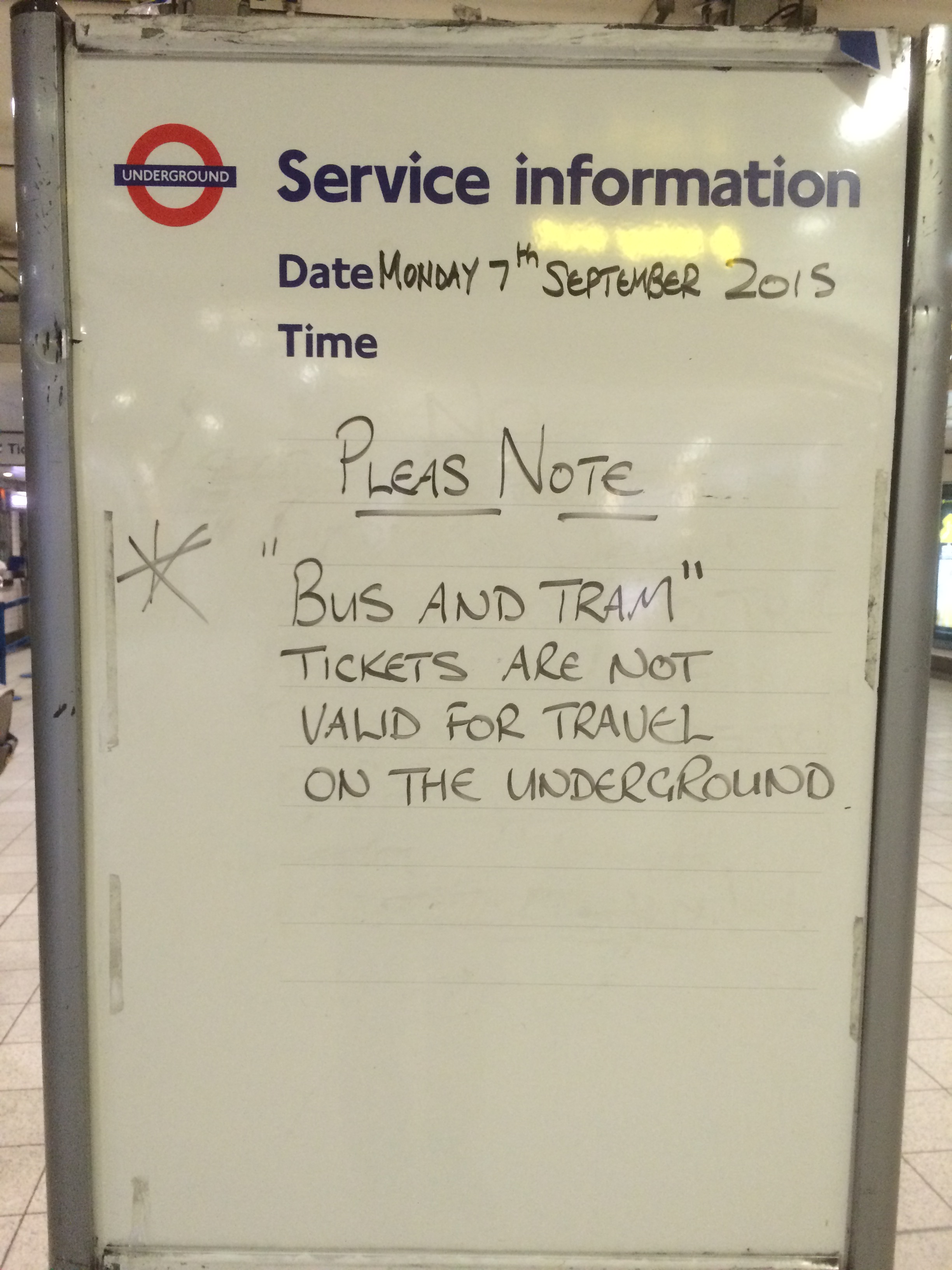
IMG_3535Where’s a physical spell checker – otherwise known as a dictionary, which nobody carries any more – when you need one? I remember about 20-some years ago in the US I saw a ticket tout with a sign saying ‘I wont (sic) tickets’.

Here’s a picture of a slightly more recent gaffe.

Online spell-checking tools in our email and document creation applications make it easy for us to avoid elementary blunders. They’re like calculators though, they make us lazy with our command of the basic skills of literacy and numeracy.

It’s OK to make these mistakes verbally, because it’s a different language to the written form and no-one can read what you say. Not so when your output is codified for all to see.

We can’t always rely on our friends to put us right on our mistakes. We have to do the work ourselves, or risk being found out.

Screen Shot 2015-08-14 at 08.24.46As a consumer, I’m bombarded by advertising, both targeted or 1:1 and mass or ‘above the line’.

As a marketer, I pay attention to advertising and imagine that I’m subconsciously judging it as well as responding to it as a consumer. You know the metrics; I’m no different and 98% or so of them pass me by for a variety of reasons, some good, some bad.

These days, we’re all conditioned to understand that when an ad for a site we recently visited is presented to us online, this is simply retargeting. Those of us who use webmail are also subjected to a barrage of ads, which is only fair – in my view – for a free app or service.

I use hotmail, amongst others, and see a ton of skyscraper ads to the right of my inbox and emails. I notice them all, but act on almost none.

I do, however, like the one here, that was presented to me a couple of weeks ago. I’m not really in the target demographic, so it won’t have been a retargeting effort, but I liked it all the same. I’ll tell you why:

  •  Squeeze the Day is a fab line! It’s a call to action in its own right, a play on the famous carpe diem phrase, but most importantly it reinforces one of the brand’s key differentiators, namely that kids squeeze the packs to get all the drink out
  • It suggests action, energy, getting important things off your bucket list – and satisfaction, either thirst-quenching or completing something worth doing
  • It’s visually arresting, fun and it’s clear what they’re asking you to do

All in all then, in the opinion of this writer it ticks all the boxes. All the boxes except one – the only critical one – which is whether or not it’s received a successful number of click throughs. That I don’t know.


Want to know what the most important word will be for sales and marketing professionals in 2016?

Engagement.

Well, it’s out there now.

I used to think the key word was ‘resonate’, but that doesn’t go far enough. When what you say resonates with someone, it’s like they’re a string you’ve plucked. You’re on their frequency, to mix a simile and a metaphor. But the string doesn’t vibrate for ever, it fades away, or loses interest and it becomes immovable, in both senses of the word.

No, to succeed we all need to engage our audience. If we work in sales, we have to get our customers engaged so that they will do something with us. If we work in marketing or sales enablement, we also have to engage our sales people, those internal customers who never read an email we send them, or a document we prepare for them. We have to find ways of making them listen and realise that this is what they need, what they have been asking for, what is going to make them more money because they can satisfy more of their customers and prospects.

Sales engagement – and partner engagement for that matter – is a crucially important slice of the pie, but it’s often the slice that gets left to go cold. And no-one likes cold pizza, at least not like they do sizzling warm pizza that engages the senses.

So if engagement is the key word in 2016, what is the key process for us for the rest of this year?

It’s this: the journey to establish and effectively communicate what we have – or what we will need to have – that will truly engage our customer.

I came across a great phrase the other day – unintellectual property. A work colleague says she uses it when she drops a verbal clanger and asks a question or makes a comment an instant before she wishes she had paused and kept her mouth shut.

It got me thinking; what if there was a legal concept called unintellectual property? Not a great idea or process that you want to protect and make your own, but the exact opposite, rather like an ‘anti-idea’.

Who says we can’t profit from the funny and the d’oh moments too, as well as the brilliant ones? I’m sure the winners of the best one-liners at the Edinburgh Fringe festival have thought about it…

Two years ago today I published my first blog post on ‘Paul Dilger’s blog – Musings on stuff I come into contact with.’ I committed to do 3 posts a week, Monday, Wednesday, Friday, going out between 7:30 and 8:30 am London/Dublin time, regular as clockwork. It didn’t seem worth the commitment to do one when I felt like it, since that would degenerate into one a month, and pretty soon none a month.

Two years later, and some 300-plus posts later, it’s still going strong, regular as clockwork. I like to think that I’m still true to the values from the early days: mostly sales and marketing stuff, posts that take a maximum of 2-3 minutes to read – rather than 10 seconds or half your morning – and posts that I hope interest and enable people.

It serves as the chief dollop of fresh content for my business web site, but it doesn’t feel like work. I really enjoy writing the posts, and I know the discipline of creating them is good for me.

I hope you enjoy dipping into them as well. Here’s to the next post :-).

The one thing a good marketer should have is – a good eye.

A good eye for what looks good. Good marketers know good design when they see it. They appreciate a well designed page, product, thing. They know what to look for and they know how to brief others to create ‘good’.

A good eye for detail. The devil is in the detail, which means he – or she – is in the data, the words, the images, the emotions.

A good idea for what reads well and sounds good – for which you probably need a good ear too. Remember that what reads well and what sounds good are not the same thing. You’ll find few good marketers who are not good communicators, not good at writing, not good at speaking, not good at listening.

You can learn to get a good eye, you don’t have to be born with it. But you must have this one thing to be good.


As a marketer, writer and communicator, I love words. They’re what I do.

The other day I was flicking through a daily mood flip board that my wife gave me a while back. It has a huge range of one word, one emoticon options that sum up – and signal to others – how you feel that day.

I eventually settled on ‘subversive’ – it was a Friday after all – but I digress.

I came across the word ‘copacetic’. Ever seen or heard of it? Me neither. With my background in Latin and Greek I can sometimes figure out a word’s rough meaning from the roots, but not this time.

Turns out it’s a North American colloquialism meaning ‘OK’, with an unclear heritage.

Great word, isn’t it? A new one for us European English speakers to throw into the conversation.


It’s not about starting a project. It’s not about coming up with a great idea that could make millions. It’s not about deciding to walk coast to coast for charity.

Anyone can start something. Kids start new things every day, but how many do they finish before they get bored and move onto the next shiny metal thing?

It’s not about starting something.

It’s about finishing something. It’s about following through, executing, closing the loop, learning from the experience and moving on to the next thing.

Selling isn’t yelling. Marketing isn’t yelling either.

That’s the wrong direction.

Selling is NOT:

– talking

– telling

– reciting

– shouting

– bullying

– lecturing

– pontificating

Selling IS:

– asking

– listening

– qualifying

– disqualifying

– challenging

– guiding

– advising

That’s the right direction. It comes from the customer to you, not the other way around. Pull versus push.

So how do you initiate the conversation? Tell them something that compels them to engage with you, to put their hand up, to come to you.

When you look at support generally, it seems to me that the bell curve is in operation quite a lot. A few support questions account for the almost all of the bell curve in terms of the frequency with which they occur, and then a multitude of obscure and uncommon queries occupy the outer reaches.

Companies in the support business (all companies, really) try and whip through the major bell curve with content and answers to FAQs designed to pre-empt the vast numbers of people contacting them. What happens then is that their metrics and their productivity get sucked away by the time and effort spent on the unusual, hard-to-categorise, hard-to-legislate-for stuff. Or they ignore them and focus on the 90%.

I have my broadband and my mobile contracts with the same provider. I also have an interesting issue, namely that my outbound email works fine from the country where I live, whereas when I’m overseas, the outgoing SMTP server fails to send my mail. It works fine inbound, and fine for webmail in either direction, obviously.

I have spent the last couple months trying to find a solution, which is either to change the outgoing SMTP server on my laptop, or else connect via my mobile phone and change the outgoing server on that. Except it’s not that easy, and as you can imagine I’ve been pushed from pillar to post by people who are tasked with getting support queries off their stack and onto someone else’s rather than solve the customers’ problems and see their metrics killed.

The last communication by email was from the broadband side of the house advising me to send a mail to care@ the mobile provider, which I did. One week later I got an auto-respond email back – one week later! – saying that the care@ email address has not been supported since 2004 – 2004! I then contacted the mobile provider via live chat – for there is no way of emailing a support query, which you knew if you were keeping up – who told me that I needed to call the tech support call centre which charges by the minute.

This has left me ticked off and my provider no further forward because it has invested significant aggregated time failing to fix my issue – which is important to me because I travel often.

If you’ve got an unusual support query, you’ll find yourself at the ugly end of the support bell curve, the end where nobody wins, unless you’re prepared to pay additional cash.