Archives for category: Communication

We’re always encouraged to look forward, to plan for the future. I remember trying to get an interview for a job a long time ago. ‘Do you want a copy of my CV? I asked. ‘No,’ said the guy, I’m more interested in what you’re planning to do, not what you’ve done.’

I admit it’s unusual for a recruiter to say that, and I should temper his comment by saying that it turns out he was head of a multi-level marketing company, but my point is that people take the approach that since you can’t change the past should focus on doing something about the future. Past performance is not a guide to future performance, the financial ads are fond of telling us.

The past can inform, however. That’s why we learn the importance of the rear view mirror when we start driving. Nowhere is this more important than in monthly or quarterly demand generation plans, or in fact any kind of plan. It’s all too tempting to sweep the last indifferent plan under the rug and start again with a fresh- forward-looking plan. If you do that every period, you’re not accountable, because you’re not learning or improving with experience. You have no reference point and you’re simply presenting yourself as a moving target for people whose aim will eventually catch up with you.

So before you build your next demand generation plan, measure and analyse what worked the last time, and what the conversion rates were at each stage, so that you can plan the next period with some knowledge. You should then be able to improve your targeting and forecasting with each subsequent period, having done the closed loop thing on the previous period.

Practice makes permanent if you never look back, but it makes perfect if you look back and learn.
In the old days, if we wanted to find out something we’d ask someone, and if they didn’t know we’d have to look it up, which possibly involved a trip to the public library to do a spot of research.

Nowadays, if we need to know something, we ask Larry and Sergey, otherwise known as the founders of Google. Or we could consult wikipedia. I’ve used wikipedia thousands of times, and probably linked to it – with a credit – on this blog approaching 100 times.

For me it’s the gift that keeps on giving. It’s never asked me for money and seems to be well funded. I get the occasional feeling that I’m taking it for granted and not giving back, but the feeling soon passes.

It’s useful for background reading on pretty much any topic and while it may not be the most erudite source, it’s a freely and publicly available one, and that for me gives it a high value.

I don’t get caught up in the politics, because there are always two sides to any story, but in the interests of fairness, there’s a link to the donation page here, together with fairly strongly worded arguments against donating here and here.

What about you? Do you treat wikipedia as a ‘go to’ resource on the same level as Google?


Most meetings over-run. Why is that? Two reasons spring to mind. Firstly, they’re not properly managed. Secondly, we always try and pack way too much into them.

It’s not just meetings, it’s the same with presentations, anything involving an agenda, business or travel itinerary. We get too ambitious, want to cover too much and we don’t allow enough time for each item. As I’m fond of saying, we’re trying to stuff 10 pounds of dung into a 5 pound bag, with ugly and unsatisfying results.

Sometimes we deal with an item more quickly than we thought we would, but more often than not we take longer than we planned. It’s human nature, we’re social beings. With a modest amount of experience you can see straight away if an agenda is going to over-run, it’s not rocket science. I like to allow more time than I think I need for a meeting, because then I aim to finish early and give people some of their day back, rather than the other way with most meetings. It’s the temporal equivalent of under-promising and over-delivering. Then you start to garner a reputation as someone who can properly manage meetings. “I’ll go to his meeting, I’ll get something out of it and I won’t be chasing my tail for the rest of the day.”

It’s all about finding the right productivity balance between an agenda that’s too long, and one that’s too short, which then becomes prey to Parkinson’s Law. In my view though, it’s better to have a meeting with a light agenda where you get some useful discussion and some firm decisions, over a heavy agenda where you end up having to park everything and the time invested is wasted.

I have a friend – it’s true I tell you – who’s from Germany. His German is flawless, as you might expect, and his English is better than fluent. The one area he struggles with is This and That.

Note that I’m not talking about my favourite shop of the year in 2013, which luxuriates in the same name.

You see, there’s one German word – dieser/diese/dieses depending on the gender of the noun – to signify this and that, so they’ve never had to make the distinction, which is a problem where they communicate in those languages that do make the distinction.

The way I explain it is that it’s a question of distance, geographically and temporally. We use ‘this’ if it’s near to us, we use ‘that’ when it’s far, relatively speaking.

A couple of examples will suffice:

Customer: I want that apple please [pointing], the one there.

Grocer: What, this one here [picking it up]?

Customer: Yes please.

or…

That was good [past tense, further away], but this is better [present tense, near].

Germans have no issue with here and there, because they have different words, hier and da. Drawing a parallel between how they should use this and that, with how they already use here and there, helps them out considerably. Next time you hear a German making this mistake, it could be your good deed for the day to put them right :-).

I did a survey recently for a customer who was looking to establish how their B2B customers preferred to receive communications.

The demise of email has been touted for as long as social media platforms have been around. Younger generations like millennials are simply not into email any more, we’re told. They’re all about chat and instant communication in its various different guises.

Interesting, then, that the standout preference was for getting stuff via email. Yes, folk get loads of emails and no, they don’t read many of them. They still want them, though, so they can mine them and sort them if they need to refer back to something. Alternatively, they might mark them as unread for a later date. They want well crafted emails so that they can tell instantly whether or not they want to engage. So it’s still about value then. The cream rises to the top and the good stuff gets read and actioned.

Admittedly, my survey was less than 20 one-to-one conversations with a cross section of business owners and ecommerce managers, but the feedback is telling and informative nonetheless, methinks.

Internet-based chat works of course, socially. It’s mimicking what we do in person. C2C and B2C usually lead the way for B2B to follow, and this same trend may eventually sweep up email as well, but probably not before the latest generation is the current generation and the mainstay of our economic growth.

The word content is everywhere. It’s the buzz word for marketing, especially digital marketing, sales and the online world. You’re nowhere and no-one without content.

Content hasn’t really changed its meaning from the original. It’s still the stuff inside that’s important.

My 2 brothers and I are in 3 completely different industries. I’m in sales and marketing consulting, brother 1 is in natural history broadcasting and publishing, brother 2 is in English language teaching literature.We all create content for a living, which is perhaps what you might expect of 3 siblings with conjoined DNA.

We’re all involved in content, but we wouldn’t call it that. We would call ourselves writers (among other things, polite and otherwise).

Don’t get hung up on the word content. It’s not a new piece of jargon to be afraid of. It’s still about writing engaging stories that your audience can identify with and derive something from.

The number system is a handy thing. You know the sequence of it and this helps you navigate life and work in an incalculable – pun intended – number of ways.

It’s only when the numbering system becomes unpredictable and lets you down that you feel helpless and want to exclaim ‘WTF!’ very loudly.

Take the numbering system in the estate I live in. Calling it maverick would be like calling a serial killer troubled. You struggle to fathom why they did it that way. I swear people never give a thought for how someone – possibly at some point a customer or buyer – can find it so hard to find a place for the first time. I don’t know a resident of the estate who understands how the numbering works. Our postman does, but that’s his job after all. You get visitors coming in asking ‘excuse me, I’m looking for number 37?’ and you have to say ‘I’m sorry, I do live here, but I don’t know. The numbering system is a mystery. You might try down there, but no promises.’

The other day I was travelling to the new London office of a client for a meeting. I had in my head a picture of where the office was, but when you emerge from the underground you rarely know which side of the road you are. There tend not to be helpful exit signs like ‘High Holborn – south side’. As a consequence, you don’t know which direction to go. Try asking someone which way is east, west, north or south – so easy in the US and engrained in city-building and thus people’s heads – and you’ll get a confused look as if you asked them what the chances were of seeing a Hutu tribesman on the south Pole.

I was advised to go in one direction, which I did for a few minutes. Following numbers is harder than you might think, as few offices or shops display their number, possibly because they don’t want you to find them the first time. After a while I realised that the numbers on both sides of the street were heading in the wrong direction. So I did a one-eighty and headed the other direction, but suffered the same fate. Worried that the bank of offices I needed were in fact held somewhere in a parallel universe, I enquired again and was sent back the original way. Sure enough, the numbering went against me again, but then after 5 minutes started to move in my favour.

Why on earth would you make it difficult for people to find you the first time, people who want to give you their time and money? Madness I tell you, madness.

I recently wrote a post on the successful sales manager’s magic word. That word was buffer.

It might also be prudent to offer a suggestion on what the successful marketing manager’s magic word is.

That word is buffer, as well. In fact, building buffer is a pretty good mantra for everything we do, from all types of work to how we manage our leisure time, our coffee appointments, our train departures and our meetings.

Just as the successful sales manager builds buffer around a team target that’s lower than the sum of the individual rep targets, so too should the successful marketing manager build buffers around the different marketing initiatives, especially around demand generation which in B2B circles is so essential to the successful sales manager, relying as they do on a steady stream of leads from marketing.

If you have a team of individual outbound ‘demand gen’ reps working the phones, make sure that the total of their individual targets is more than the team or company total. Similarly, if you have a range of outbound activities planned for the quarter, make sure that the sum of the targets for each of those activities – in terms of leads, opportunities and resulting revenues – exceeds the team or company total. You need to insure yourself against activities not happening or underperforming, or a rep underperforming, getting sick or leaving to give you a back-fill headache.

Remember to go back and measure the actual performance against target too, for the previous period. Then over time you can improve and be able to refine the amount of buffer you need to build into each area.

Even the best laid plans and estimates go awry. Give yourself some buffer, to make sure you can over-deliver on your promises.

The Power of Personalisation

The Power of Personalisation

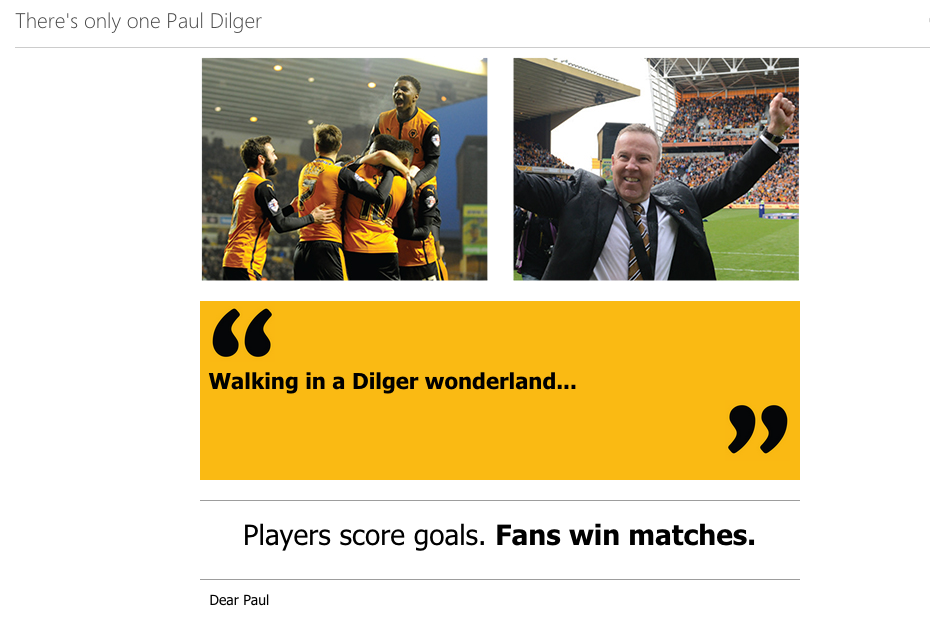
I received this email in my web mail inbox the other day – and I loved it, both as an individual recipient and consumer of email and as a marketer.

There’s nothing new in it, and I won’t be able to convert my interest in action as I live in another country and can’t easily attend games.

That said, for me it epitomises the power of personalisation. Both the subject line and the quoted phrase are redolent of sporting chants, as well as pandering to my ego. The email is visually appealing, the strapline appeals to me as a fan – and a customer – who can make the telling contribution to success, and the ask is a simple one: we’d like you as a season ticket holder.

Superb stuff. Of course, I don’t know how the email turned out. I don’t know too much about the target demographic. I am willing to bet, however, that it performed particularly well against target.

Have you noticed how much in business and pleasure is governed by disingenuous and disrespectful language?

Life is competitive, otherwise it would be pretty dull, but these days we get subjected to so much of this:

– Hype

– ‘Trash talking’

– Misinformation

– Hearsay

– Mind games

The biggest lie is that you only get honesty, sincerity and respect the day after a political election, competition, contest or the death or retirement of an adversary. A day or two after that, the gloves are back on and it’s business as usual.

How much differently and enjoyably would we view the world we work and live in if the way everyone dealt with other people, teams and companies was open and respectful? Politically speaking (with a small ‘p’), if everyone who had a gun shot themselves it would be problem solved, to paraphrase a certain George Harrison