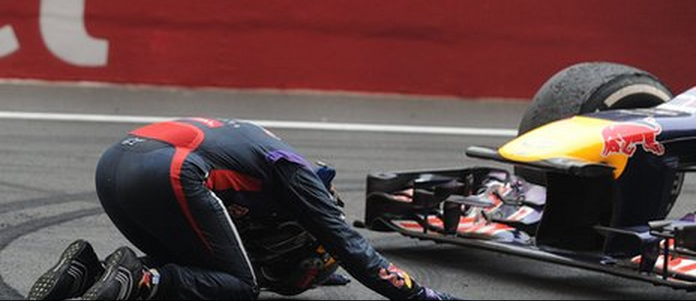
Vettel bows before his championship-winning Red Bull F1 car

Vettel bows before his championship-winning Red Bull F1 car

The role of technology is to make our lives easier.  To help us make better decisions.  To make us look good – and take that in any way you like.

Is it us or the systems? The more modest among us say: ‘Thanks, but we made a great investment in this software, I know how to get the best out of it, and it does all the work for me.” The less modest among us share only the middle clause in the quote.

The truth lies in the middle.  We have selected the right technology because we defined carefully what it needed to do for us. We took the time to learn how to use it properly and fine-tune it for our uses. We tried to be ruthlessly consistent with the inputs so that we could trust the conclusions we were making from the inputs. We tested, reviewed, tweaked and improved as we went. (Wo)man and machine, in perfect harmony.

Establishing exactly where in the middle the truth lies is really difficult.  It’s a constant source of debate in Formula 1 motor racing.

Talk about a deeply philosophical title.  I dread to think how many people will be drawn to the title on Google thinking they’ve stumbled on some astronomical treasure trove.

What I’m referring to here is how much time is wasted interacting with our fellow humans. Calling round to empty homes, voicemails, occupied signs, over-running meetings, traffic delays, busy signals. If only we could align ourselves better for the common good – and not pull rank or status to short cut getting to who we need – then we will all benefit.

Of course, with the human a particularly competitive race this is never going to become a reality, and I have touched on why this is the case in part in a previous post. The best we can do is consider who it is we’re trying to interact with and make it as easy as possible for them to do that with us, and so that they have a net benefit to reward their effort.

One thing is for sure: the connected economy is slowly but surely reducing inefficiencies, rounding off corners, and make our world less imperfect due to its economies of scale, its immediacy, and its convenience. And that can only be good.

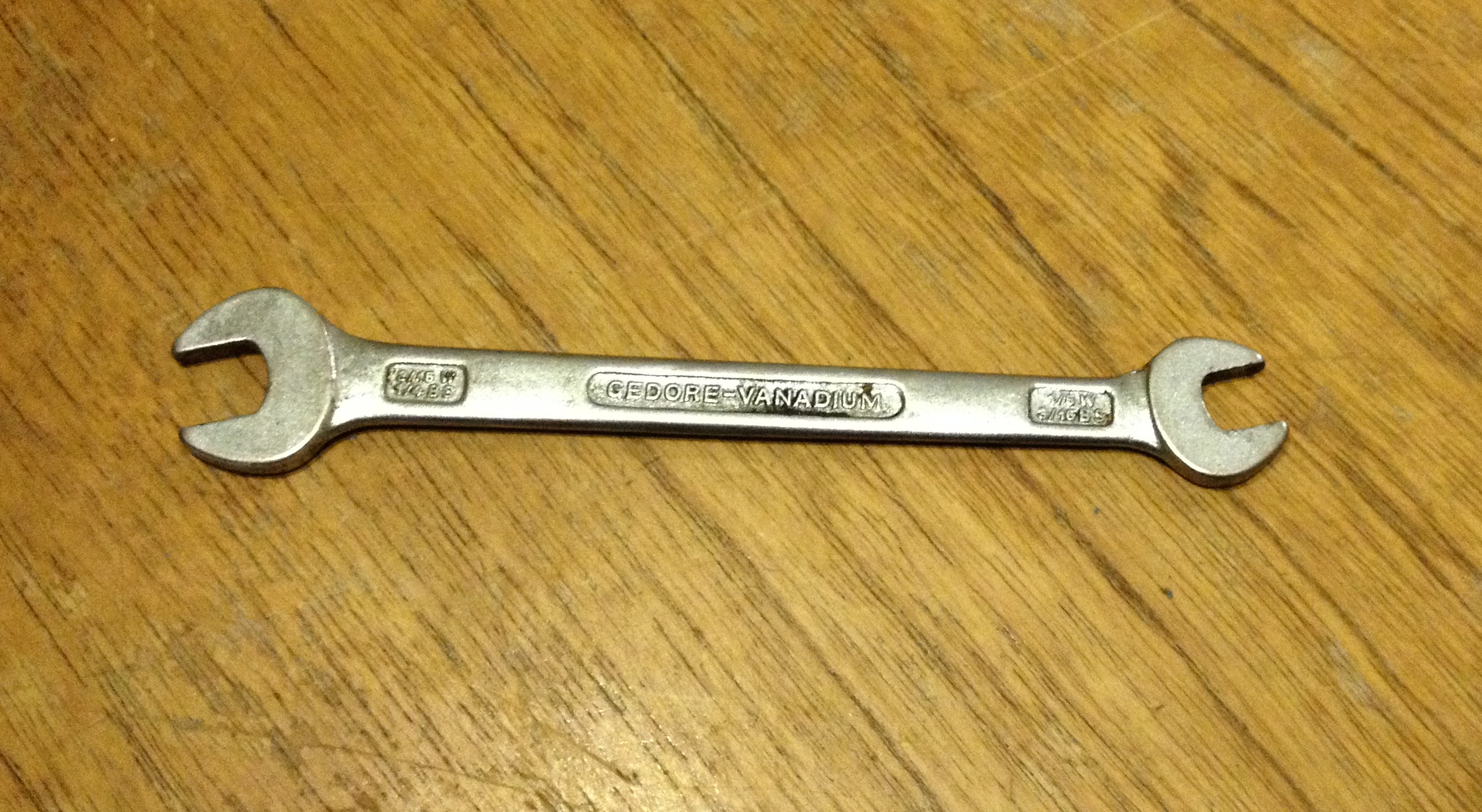
IMG_1509

This is a tool…

A spanner is the British-English word for a wrench, and in Irish when used colloquially means idiot – as in ‘Don’t leave the tap running, you spanner!’

In the British-English sense, a spanner is a specific size of implement that does the job of tightening or holding a bolt. The right size of spanner does exactly the job you require. It’s a tool and belongs in your tool-bag. It’s an essential part of your tool-kit.

If you work for a high tech company and you provide solutions to help companies address their key strategic goals, don’t use the word ‘tool’ to describe your technology – ever. I’ve heard sales people refer to what they sell as a tool when in some cases it’s an entire platform. Here are five reasons why you shouldn’t stoop to use the word ‘tool’.

– it conveys tactical, not strategic.  Tactics are short term and not mission critical.

– it conveys small, not significant.  You want your customers make large, important gains, not get bogged down managing lots of small gains.

– it conveys reactive, not proactive.  A tool fixes a problem, it doesn’t capitalise on a business opportunity.

– it conveys nice to have, not must have.  If you have no ‘must have’, you have no sales opportunity.

– it conveys IT, not business.  Technology solutions solve business problems, not technical problems, at least as far as you should be concerned.

Much better to say platform, resource, technology or even system.  Never call it a tool, please.

I was looking at a presentation the other day on 50 digital marketing metrics for CMOs, CIOs and other CXOs.  It was by a pretty stellar CMO who’s especially active on Twitter. It really was very thorough, a great piece of work. What I found odd, though was that only a couple of the 50 metrics focused on the sales side of the funnel.

Only this morning I was talking with a senior director of a globally renowned BI company about the divide that exists between sales and marketing, principally because the two areas – which should be joined at the hip – were judging success differently. One area saw a high volume of leads as successful, the other saw the lack of quality pipeline as unsuccessful. You see this gulf in many companies. I’m sure you’ve seen it in companies where you’ve worked.

To return to the marketing metrics presentation: the success of demand generation is in the amount of business that results from an activity. You should break this down further into 3 key metrics that have a direct bearing on the success and wellbeing of the entire company:

– deal size. What is the average deal size of a lead from a marketing activity that became an opportunity? What is the average deal size for the opportunities that you won? Some marketing activities will generate bigger average deal size than others.

– win rate. What percentage of the qualified leads did you win that were generated by marketing activities? What percentage of the qualified opportunities? Some marketing activities will generate better close rates than others. This tells you about the quality of leads you create, and the quality of your qualification process from lead to opportunity.

– close cycle. What was the average total elapsed time from lead creation to closed deal? From lead creation to opportunity creation? From opportunity creation to deal closure? Some marketing activities will generate faster close cycles.  Speed is of the essence when you’re trying to grow the business.

You have to tie marketing efficiency forward – not back – to revenues.  Better to focus on a few metrics that measure sales + marketing than 48 that measure marketing alone.

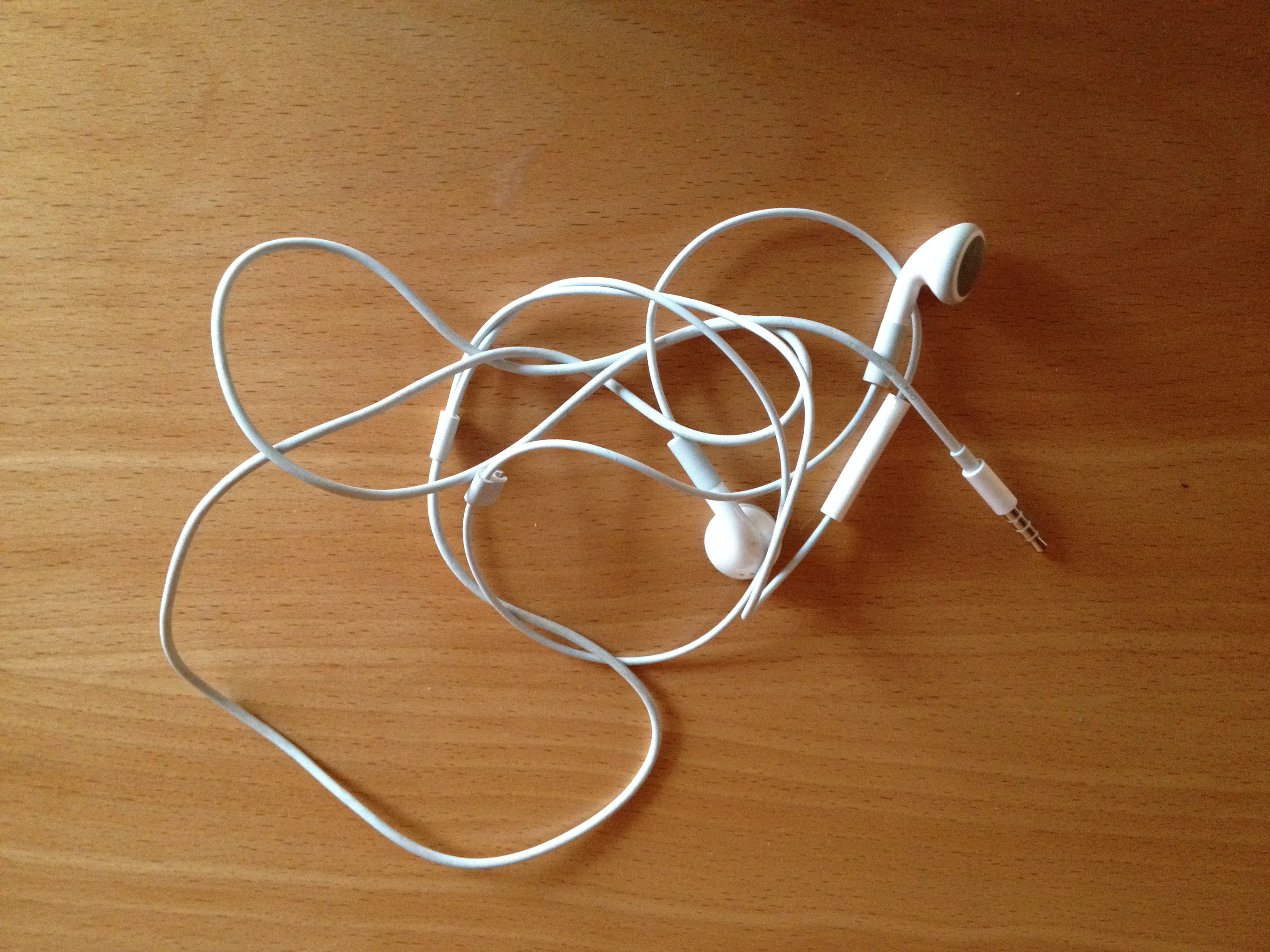
Tangled flex landscape

I’m as big a fan of beautifully engineered products as the next guy. I want to argue, however, that the device cable is part of the customer experience, part of the product, and needs some fairly urgent design attention.

I’ve a MacBook Air and an iPhone.  Not the latest versions of them, but pretty recent, let’s say the last 12 months. They’re lovely, and lovely to work with. The cable for my iphone has a mic, volume control, ear buds, all the usual stuff. So what’s the but, I hear you say? Well, it’s always getting tangled, and takes a while to get untangled, before I can use it, in that fiddly sort of way that inanimate objects have of turning me from mild-mannered man into raging psychopath in a matter of seconds.

If you calculated the total time lost globally from messing around getting cables and wires sorted, the productivity losses would be staggering. Yet it shouldn’t be that way.  I remember being round at a girlfriend’s apartment many moons ago, before cordless phones became mainstream, and marvelling at the cord on her telephone.  It was immense, and enabled her to potter round the sizeable apartment with the phone cradled between chin and shoulder. More impressive though, was that it had been engineered in some way to be tangle-proof.  It never got twisted up.

Even now with today’s phones you have to lift up the cord every once in a while and let the suspended handset helicopter itself back into a state of ‘untwistiness’.  Surely we shouldn’t have to put up with this nonsense in 2013? If the materials and the capability was there a quarter of a century ago, you can’t tell me it’s not important any more.

We need to start encouraging device makers to focus as much on the peripherals as the core device, as both contribute to the collective user experience.

I’m almost a week into my fourth Movember campaign. There’s always been something oddly horrifying about a moustache, at least in the last 20 years or so. You just don’t see them in business, and you almost never see the middle classes sporting one, which is probably the same thing.

The only colour you can get away with for a genuinely ‘free standing’ moustache is grey. Ideally you need also be a retired army colonel. Otherwise people look at you funny, or assume you’re from out of town, or both.

I’ll tell you what’s so attractive about the Movember campaign. It’s the easiest way to raise money. You simply don’t shave a particular area of your face for a month.  In fact, when you look at it that way, do you less work and you raise money. It certainly beats running a marathon.

You also get a certain frisson wearing a moustache in public, since you are effectively absolved – and even lauded – for looking ridiculous.

A few years ago I was getting ready for a sales meeting in London with a senior guy and a couple of colleagues.  It was mid-November and I decided the right thing to do was to shave it off for the meeting and start again mid-month.  My colleagues said ‘Hey, where’s your mo?’ When I explained, they were in adamant agreement that I should have left it on, as it would have been a good ice-breaker and isn’t that the whole idea of Movember anyway? They were right of course. You’re drawing attention to something you feel strongly about.

I’m off to think of a business idea that’s as easy as growing a muzzer for chiridee…

If you’re a healthy person trying to get fitter, or indeed an unhealthy person looking to get healthy – and you’re serious about it, I have one piece of advice for you.

Being in good shape is of course a complex blend of lifestyle, genetics, circumstances and so on. This is not the advice part by the way. Some of these things are beyond our control, but we can to a large extent get or stay in shape by managing our diet and exercise.

It seems to be that you need to do both. We’re subject to a basic calculation: calories in and calories out.  In that sense we’re a bit like cars, taking in fuel and using it up to do work.  The more we exercise, the more we can eat, put in an over-simplified way. If you burn less calories than you absorb, you gain weight.  If you burn more, you lose weight. You could do 100’s of sit-ups a week, but if you can’t cut out the rubbish, you won’t see the benefit.

Now I’m partial to rubbish. Very partial. Cakes, sweets, biscuits, chocolates – these are the 4 basis food groups as far as I’m concerned. Added to that, I’m not as sprightly as I used to be, and nor’s my metabolism. So this is only going to end one way if I’m not more careful.

Here’s where I get to my advice, which if course I already gave you in the heading. Keep a food diary. I have kept one for the last 5 years, recording in general terms what I’ve been eating. It’s not particularly scientific, but what I do find is that it helps me acknowledge exactly what I’m eating, and that for me is half the battle. If you ate 4 chocolate biscuits after your tofu salad, then record them. I also try to record how much water I drink (I can’t stand water; it’s an effort for me to drink it) as well as tea and coffee. Finally, I also record any exercise I do that’s more strenuous than a walk around the block.  Any day without any exercise is recorded as ‘Black Day’.

Recording exactly what you eat reminds you of exactly what you eat. When you’re monitoring it, you’re effectively measuring it. And as the business gurus will tell you, if you can measure it, you can manage it.

For a language that is the lingua franca – and I’m aware of the irony of using that term – of the business world, and most of the tourist world, English is a tad tricky at times. Actually it’s a lot tricky. With a ton of irregular verbs and more heteronyms than you can shake a stick at, it’s no wonder people for whom it’s a second language struggle from time to time.

It’s not that much different for people using it as their first language. Take some of the irregular verbs and their past tenses. We’re talking run-ran-run, drink-drank- drunk, ring-rang-rung. One’s for the present tense, one’s for the simple past – or Aorist if you love your classical Greek – and one’s for the perfect tense, as in I have done something.

From time to time you’ll hear among native English speakers phrases like “I rung him already,” or “I’ve already rang him.”

The way to remember it is this: simple past is generally the ‘a’ word. I ran round the block. I rang Paul yesterday. We drank to her health. When you’ve got the word ‘have’ in there, it throws it ‘back’ farther to the ‘u’ word.  I have rung the changes. We have run a mile. He would have drunk more if he’d stayed.

Of course, the other way to avoid getting it wrong it to take the wonderfully circuitous route favoured by the Irish: I’m after ringing him. I’m after drinking a toast.  Marvellous.

Why do people use brackets, or parentheses as our American friends would say, in the written word?

We don’t use them verbally, other than an aside perhaps. For me, brackets are rarely used to explain some background detail, like something you might see in a footnote.

When I see content in brackets, I think it reduces the power of what you’re trying to say.  It feels like you know you should write less, but don’t have the courage to edit down, so you put your potentially superfluous text in brackets. Or maybe you just want to separate clauses out.  For that you could use the hyphen – or is a dash? – to get your reader to pause.

Remove the brackets and let your words go free, or lose them altogether (or not, as the case may be).

Most people will give you a recommended reading list, books they’ve read and think are worth you reading as well.

Here’s a list of 13 important books I wish could finish, not because they’re hard work but because I don’t have the time to get through them. I have at some point either started these books, or read a recommendation to read them. They all currently reside on my bedside table.

You’ll notice I describe them as important. I think I could make the time to read them, but they’re either very long, or they’re a complex, detailed read, or they present within them a challenge to me that I’m not ready to address yet. Here we go:

– The Intelligent Investor, by Benjamin Graham. One of the original – and still one of the best – books on how to invest wisely.

– The Golf of Your Dreams, by Bob Rotella. How to plan to improve your golf game by one of the sport’s great thinkers.

– Teach Your Child How to Think, by Edward de Bono. The creator of Lateral Thinking helps you get out of the ‘my child’s at school and that’s all the thinking s/he needs’ mindset

– D-Day – The Battle for Normandy, by Anthony Beevor. A super detailed and researched account of one of the key events shaping the second half of the twentieth century.

– Visions of England, by Roy Strong. How people historically viewed England through other people’s view of it, like in paintings.

– Seven Deadly Sins – My Pursuit of Lance Armstrong, by David Walsh. One of the ‘told you so’ books mopping up the aftermath of one of the largest bubbles to burst.

– Pick Four, by Seth Godin. Zig Ziglar’s legendary goals program, updated and simplified by his Lordship.

– 101 Irish Records You Must Hear Before You Die, by Tony Clayton-Lea. More of a ‘dip in and buy the album’ read.

– Dreams From My Father, by Barack Obama. Yep, you’ve probably already read it.

– Hurling – The Warrior Game, by Diarmuid O’Flynn. The definitive guide to one of Ireland’s two national games.

– Steve Jobs, by Walter Isaacson. Yep, you’ve probably already read it.

– The Calendar, by David Ewing Duncan. The authoritative account of how people have fought – and how we have taken for granted – to measure the passage of time, which I also touch on here.

– How to Win Friends and Influence People, by Dale Carnegie. The word ‘seminal’ is overused, but certainly justified here.

Yes, I know, it is a pretty robust bedside table.