
Archives for category: Sales
IMG_1610

This ‘n’ That shop, Athenry, Galway, Ireland

Closing the series of posts in praise of people or things, I’m recommending my shop of the year.

Unless you happen to live in the same village as me, chances are you will have never seen or heard of This ‘n’ That discount store in Athenry in the Ireland’s county of Galway. Nor will you ever find it online either, as this is your traditional shop that eschews all modern ways of selling and is truly bricks and mortar only.

Tucked away in Northgate Street, near the town’s iconic arch from the original medieval walled town, This ‘n’ That, as the name suggests, sells pretty much every item you would ever need at a very reasonable price. From binders to bed sheets, clothes to car mats, heaters to hair brushes, toys to toiletries, it’s all here at a fraction of the high street or even online price. My daughter got about 8 Christmas presents for €18 in there the other day. Fabulous.

It’s the staff that make a place in almost every service-led business, and this one is no different. There seems to be loads of staff working there at any one time, of varying nationalities.  They are always super helpful and have the unerring ability to locate an item you need among a seemingly infinite array of stock, rather like those mechanics who can find exactly the wrench they need among what looks like a cultivated chaos.

It’s cash only at This ‘n’ That. Credit cards would be a bit too 20th century. The staff check that battery-operated items like torches – flashlights to our American friends – work properly before selling them to you. Such a breath of fresh air compared to the usual grumpy curmudgeons you get in this type of shop.

As our traditional shops get more and more squeezed by the massive malls or online merchants – creating what is known as the ‘donut effect’ in some English towns and cities – it’s local shops that sell a tablet case for €3.50, as opposed to 3 to 5 times that amount elsewhere, that will survive or even thrive. Cheerio 2013.
I mentioned in a previous post how the teachers and mentors you have in your younger years have a major influence on how you develop as an individual. I think that’s also true of your managers and your working life. With that in mind, and continuing this week’s theme of paying people back with thanks during the holiday season, I share with you here the great managers I’ve had in my 15 years in the tech sector.

There’s a saying that you should never manage anyone who’s older than you. Many of the ones below have successfully debunked that myth.

In more or less chronological order:

Jim Maher, former CEO of Allfinanz. A man who knew how to take the right risks, and was never afraid of walking away from a bad deal, Jim took a gamble on a guy untested in the tech space. I think he feels it was worth the risk.

Jonathan Gale, formerly Sales VP of MessageLabs, now part of the behemoth that is Symantec. Extremely able head of sales who took me on to manage a new service – and a new departure – for the company. Now heading up New Voice Media.

Stephen Millard, formerly Marketing VP of MessageLabs. Stephen started my career in product marketing. An excellent manager who understood intimately that management was about finding the right balance between delegating and guiding.

Gary Thomassen, formerly Direct of Product Management and Marketing at MessageLabs. Another first-rate manager and that rare breed who understood that you can pretty much leave specialists to themselves when they’re armed with their objectives.

Donal Daly, founder and CEO of The TAS Group. There is pretty much nothing that this chap can’t do better than you in your own field of expertise within his business. Sickeningly gifted and visionary.

York Baur, formerly CMO at The TAS Group. Immensely knowledgeable across a panoply of subjects, and infinitely patient and gracious on the regular occasions that his decision was a better one than yours. A huge fan of NASCAR, but hey, no-one’s perfect.

Paul Watson, formerly CEO at Star Technology Group. Living proof that nice guys do finish first, Paul has managed a number of projects that I helped him with as a consultant. Another extremely shrewd guy who excels at getting the best – which is not the same as the most – out of his people.

Andrew Norman, Director of Sales and Marketing at eSellerPro. With a dauntingly broad remit, Norms still finds the time to be a superb manager of people, whether they are staff, contractors or partners. One to look out for.

There’s eight of the best for you.  If you too have worked for one of them, you’ll know what I mean.

Most of us have been shopping online for 15 years or more. I remember my first ever online purchase. It was on Amazon. I couldn’t believe how easy it was. To this day Amazon remains the benchmark of how to serve customers.

For someone like me, who doesn’t live in the country where he was born and raised, online shopping is a thing of beauty. I can send birthday and Christmas presents to family and friends at good prices, avoiding any postage charges because the gifts are being delivered domestically. For people who are at their busiest at this time of year, it is convenient, quick, secure and good value.  What more can you want?

Ironically, I’ve been doing some work with a provider of an ecommerce platform that allows retailers and merchants to extend their coverage across marketplaces. Not just Amazon and eBay, who consume not far off two-thirds of all global ecommerce, but all their international counterparts, as well as a host of other smaller or more niche marketplaces. Having been a consumer for a decade and a half, it’s been a fascinating few weeks seeing how things work from the other side of the transaction.

There’s one thing I’m sure of. The numbers for online are only going in one direction in the future. Indeed, we’re looking at not much more than the tip of the iceberg of what is possible on the web. And by all accounts, the web itself will be but a mere frippery compared with the ‘Internet of things’.  Change is a constant :-).

A friend of mine suffered a LinkedIn unfriending the other day. He wasn’t sure whether he should be traumatised or relieved.

Getting unfriended or unfollowed in social media is like hearing some direct feedback from someone who doesn’t know you’re within earshot. You don’t get a note saying that someone has unfriended or unfollowed you. Instead, you find out about it indirectly.  In my friend’s case, he started getting daily suggestions to link in with this person. My friend has connected with this person, met him, they attended a social function, and then this person had deemed the relationship not worthy of maintaining and so severed it.

This is a good thing, in my opinion. It’s like getting an early ‘no’ in sales, so you’re not being strung along for weeks and months by someone who can’t or won’t say no. I think it’s good for two reasons:

1) They’re saving you the time of currying their favour. This buys you back time to figure out how to bypass them and their influence.

2) They’re not worthy of connecting with you anyway. Some accurate self-esteem is required to adopt this position!

Do you agree? Like many things, you can argue both ways.

At this time of year marketers like to bring out the cues that tap into our past, as we tend to get all nostalgic and reach for our wallets in a feel-good fog of warm fuzziness.

These cues can be visual, but the one cue that really strikes a chord and brings the memories flooding back is the musical cue. A few bars of the right ditty can bring you back to a precise time and place like very little else.

It’s not just the sounds constructed by composers that bring you back. It can also be sounds constructed by product designers.

We have one of those indestructible kettles in our kitchen. Sick of forking out every year for an electric kettle that seemed programmed to last a month beyond the guarantee period before conking out, Mrs D opted for a more traditional version. It takes a while to boil on a gas hob – and probably uses more energy than an electric plug kettle – and when it boils it emits a gradually more insistent high-pitched whistle that takes me back to my grandmother’s house from a long time ago. In fact, there’s nothing like a kitchen to draw on all 5 of our senses.

The online marketers have the same challenges as television advertisers: you can only rely on sight and sound to evoke the right feeling. The medium of radio can only rely on one sense. That’s an advantage that physical stores have over the remote media: smell, taste and touch. The smell of cinnamon in home and garden stores in December. The taste of the sample turkey food at the supermarket. The all-important squeeze of the avocado or the apple to indicate whether it’s the right time to buy.

Maybe that’s why, when we say ‘I’m getting a sense of deja vu,’ which means ‘already seen’, we often mean any sense of our senses.  For me it’s the sense of sound that brings me back the most strongly.

IMG_1509

This is a tool…

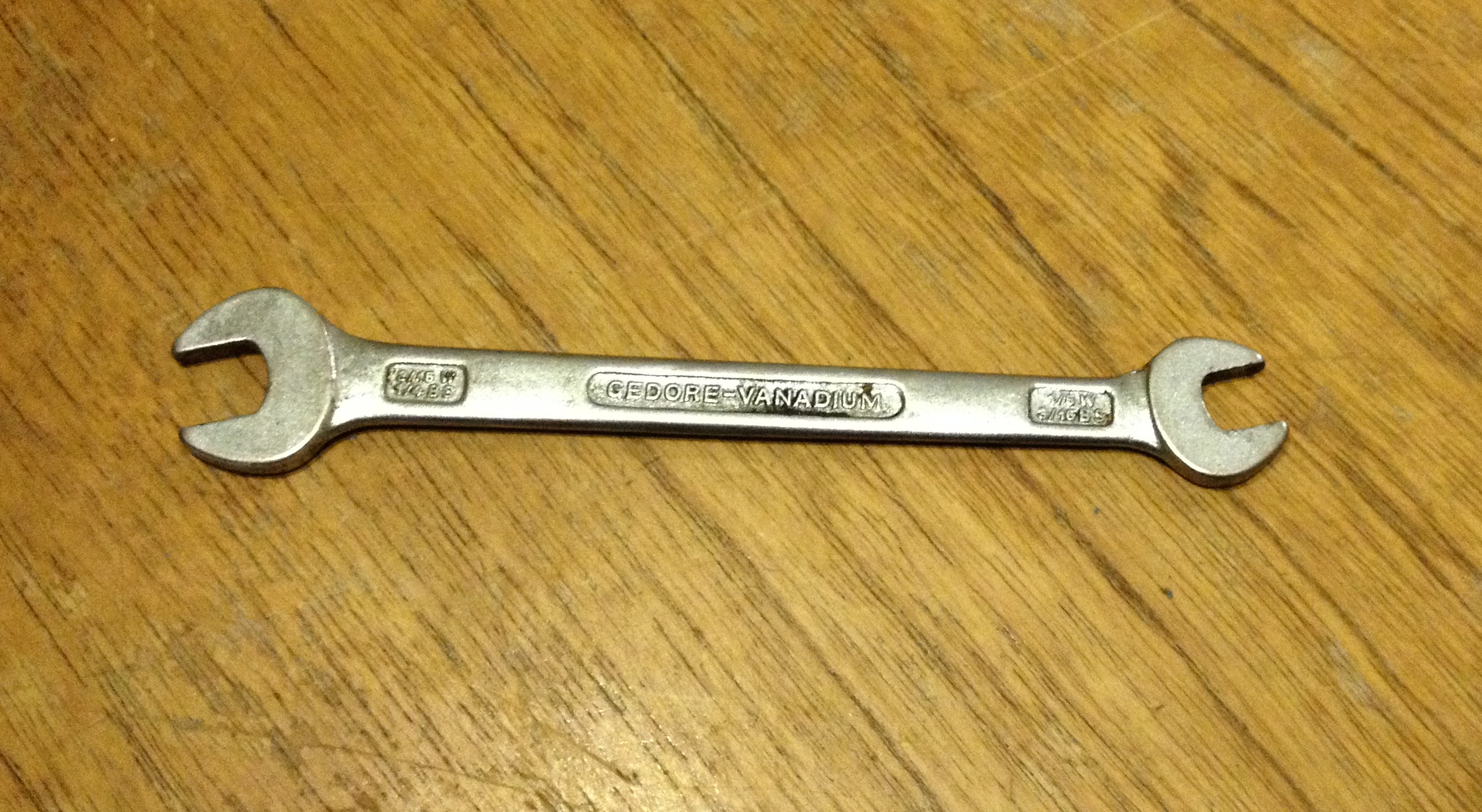
A spanner is the British-English word for a wrench, and in Irish when used colloquially means idiot – as in ‘Don’t leave the tap running, you spanner!’

In the British-English sense, a spanner is a specific size of implement that does the job of tightening or holding a bolt. The right size of spanner does exactly the job you require. It’s a tool and belongs in your tool-bag. It’s an essential part of your tool-kit.

If you work for a high tech company and you provide solutions to help companies address their key strategic goals, don’t use the word ‘tool’ to describe your technology – ever. I’ve heard sales people refer to what they sell as a tool when in some cases it’s an entire platform. Here are five reasons why you shouldn’t stoop to use the word ‘tool’.

– it conveys tactical, not strategic.  Tactics are short term and not mission critical.

– it conveys small, not significant.  You want your customers make large, important gains, not get bogged down managing lots of small gains.

– it conveys reactive, not proactive.  A tool fixes a problem, it doesn’t capitalise on a business opportunity.

– it conveys nice to have, not must have.  If you have no ‘must have’, you have no sales opportunity.

– it conveys IT, not business.  Technology solutions solve business problems, not technical problems, at least as far as you should be concerned.

Much better to say platform, resource, technology or even system.  Never call it a tool, please.

I was looking at a presentation the other day on 50 digital marketing metrics for CMOs, CIOs and other CXOs.  It was by a pretty stellar CMO who’s especially active on Twitter. It really was very thorough, a great piece of work. What I found odd, though was that only a couple of the 50 metrics focused on the sales side of the funnel.

Only this morning I was talking with a senior director of a globally renowned BI company about the divide that exists between sales and marketing, principally because the two areas – which should be joined at the hip – were judging success differently. One area saw a high volume of leads as successful, the other saw the lack of quality pipeline as unsuccessful. You see this gulf in many companies. I’m sure you’ve seen it in companies where you’ve worked.

To return to the marketing metrics presentation: the success of demand generation is in the amount of business that results from an activity. You should break this down further into 3 key metrics that have a direct bearing on the success and wellbeing of the entire company:

– deal size. What is the average deal size of a lead from a marketing activity that became an opportunity? What is the average deal size for the opportunities that you won? Some marketing activities will generate bigger average deal size than others.

– win rate. What percentage of the qualified leads did you win that were generated by marketing activities? What percentage of the qualified opportunities? Some marketing activities will generate better close rates than others. This tells you about the quality of leads you create, and the quality of your qualification process from lead to opportunity.

– close cycle. What was the average total elapsed time from lead creation to closed deal? From lead creation to opportunity creation? From opportunity creation to deal closure? Some marketing activities will generate faster close cycles.  Speed is of the essence when you’re trying to grow the business.

You have to tie marketing efficiency forward – not back – to revenues.  Better to focus on a few metrics that measure sales + marketing than 48 that measure marketing alone.

Last year a colleague of mine said: I’m never using the word ‘just’ again.  The more I thought about this, the more I realised how right he was.  It’s a nothing word, an excuse of a word, a word that devalues what you’re trying to say.  It’s practically a synonym for ‘erm’.

Consider these examples:

“Hi there, just a quick call to find out when you’re making a decision on our deal.”

“I’m just saying we shouldn’t do this.”

“I was just wondering what will happen if we get this wrong.”

‘Just’ belittles the worth of our contribution.  It negates us.  It’s a signal to the other person in the dialogue that subconsciously we don’t feel up to it.

Don’t use the word.  Just Do It®  🙂

IMG_1420

The domino chain theory

It’s not just sales people who struggle to get the attention of their customers.  At some point we all find it difficult to get time with other people who seem to be more busy than us, or just busy on other stuff.

That’s because what’s important to us is usually not what’s important to them.

Imagine a line of dominos stacked up and all facing the same way.  You’re one of these dominos.  You can’t see the face of the domino in front of you, the domino whose attention you want.  They’ve got their back to you.  They’re focused on the domino in front of them, whose attention they’re trying to get.  The trouble is, the domino in front has their back to them, and so it continues.

This is why we can’t tie down a meeting, or get a call back, or get a reply to an email, or get that thing we need.  It’s not important to the other person, like it us to us.  They have their own list of priorities and things that are important to them, and they’re going about it in the same way as we are.

Sometimes it feels like an entire supply chain is like this.  Half the battle is understanding the domino chain, and understanding why the people you need something from are not focused on you.

The other half is helping them with what they’re focusing on.  Then you get their attention, they face you, and the 2 dominoes are talking.