Archives for category: General

Founders – you need to prepare to lose the ‘o’.

If you’re the founder of a business, it’s more than likely that you’ll be the funder too.

In other words, to prove you’re serious about your business – and that others should be serious about it too – you’ll need to be funder as well as founder, to get it off the ground, winning and keeping customers.

Once you’ve been a funder, and you’ve proven your product/market fit, you can add the ‘o’ back in and get back to being a founder again.

Most meetings over-run. Why is that? Two reasons spring to mind. Firstly, they’re not properly managed. Secondly, we always try and pack way too much into them.

It’s not just meetings, it’s the same with presentations, anything involving an agenda, business or travel itinerary. We get too ambitious, want to cover too much and we don’t allow enough time for each item. As I’m fond of saying, we’re trying to stuff 10 pounds of dung into a 5 pound bag, with ugly and unsatisfying results.

Sometimes we deal with an item more quickly than we thought we would, but more often than not we take longer than we planned. It’s human nature, we’re social beings. With a modest amount of experience you can see straight away if an agenda is going to over-run, it’s not rocket science. I like to allow more time than I think I need for a meeting, because then I aim to finish early and give people some of their day back, rather than the other way with most meetings. It’s the temporal equivalent of under-promising and over-delivering. Then you start to garner a reputation as someone who can properly manage meetings. “I’ll go to his meeting, I’ll get something out of it and I won’t be chasing my tail for the rest of the day.”

It’s all about finding the right productivity balance between an agenda that’s too long, and one that’s too short, which then becomes prey to Parkinson’s Law. In my view though, it’s better to have a meeting with a light agenda where you get some useful discussion and some firm decisions, over a heavy agenda where you end up having to park everything and the time invested is wasted.

I wrote recently about the so-called Circle of Life, and how it relates to our working lives in a ‘cradle to grave’ stylee.

It occurs to me that within this ‘macro’ trend there are lots of mini cycles, rather like an agile development flow if you’re from a software background.

These cycles can be weekly, monthly, yearly or pretty much any length, but before you know it they link up into a mega trend that defines us.

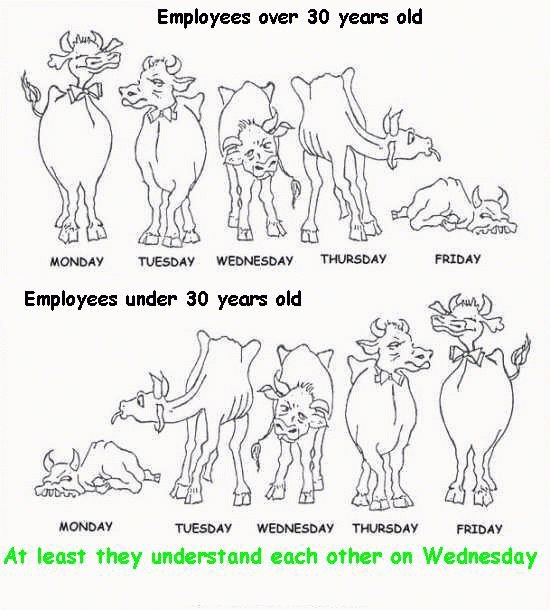
Here’s an image which pretty well sums up the converse ebbs and flow of the working week for younger and older workers. I hope you can relate to it 🙂

I must admit to a certain frisson of pleasure at the closing of things. Mundane, inconsequential things.

Let me give you examples. That feeling when you load up the dishwasher – surely the single greatest invention of all time – put the cleaning tab in, hit the ‘on’ button and close up the lid. So satisfying.

It’s same when you close the heated oven door after carefully preparing your dish for cooking. Here’s two more for you: Closing and locking the house front door at the end of a day, ideally a Friday, when everyone’s home, last thing at night. Closing the car door when all the family is inside after a long walk somewhere, ready for the drive home.

I know, the last ones have serious womb syndrome about them, but you see parallels in the working world. Submitting that final report, either paper-based or electronically, is a rush too. Signing off on an initiative, a project, a job even, come on, you must feel it too. Sales people – closing a deal! How good is that feeling?!

Perhaps the ultimate work-related frisson of closure is the day you fully retire, as long as what you have lined up after it is better. This post harks back to a recent post about the circle of life, which makes them both all the more valid I think.

The circle of life has a truth and completeness about it. We come into the world, we need help, support, guidance so that we can learn the ropes and participate as independent people, until its our own turn to do the same for the next generation.

Then we gradually fizzle out and eventually reach a similar stage of dependence on others, until we exit, stage left.

This got me thinking about our working lives as well, how we start not knowing anything – about a new career, new job, new company and their products and services – reliant on others to show us the way, give us the knowledge and the inside track until we can work alone, be trusted, and contribute productively.

My rule of thumb was 12 months. I felt it was a full 12 months before people were genuinely up to speed and actively leading or contributing. Then their experience of having seen a full 4 quarters play out allows them to build on the previous calendar year and improve the business. Some people think that after the second period of 12 months you start to stagnate and should move to a fresh challenge, but that has always seemed premature to me. Sure, I’ll give a new career or move 2 years, but will stay longer if I’m enjoying it and enhancing the business.

We improve as working individuals and start to climb the corporate ladder in our 30’s and 40’s, but does there come a time when we start to lose our creativity and the well starts to run dry? Do we step back a little and look to the next wave of high achievers to come up with the fresh ideas that we can help execute and bring to fruition?

I think there’s some truth to it, but conversely there are plenty of people making huge contributions well into their 6th decade of working, and a good proportion of them are at the very top of their profession, and their company.

The body may weaken over time, but the mind, the experience, and the ability to delegate the heavy lifting – literally and figuratively – to others goes the other way. As long as we have the mental energy and the curious mind to go with it.

The number system is a handy thing. You know the sequence of it and this helps you navigate life and work in an incalculable – pun intended – number of ways.

It’s only when the numbering system becomes unpredictable and lets you down that you feel helpless and want to exclaim ‘WTF!’ very loudly.

Take the numbering system in the estate I live in. Calling it maverick would be like calling a serial killer troubled. You struggle to fathom why they did it that way. I swear people never give a thought for how someone – possibly at some point a customer or buyer – can find it so hard to find a place for the first time. I don’t know a resident of the estate who understands how the numbering works. Our postman does, but that’s his job after all. You get visitors coming in asking ‘excuse me, I’m looking for number 37?’ and you have to say ‘I’m sorry, I do live here, but I don’t know. The numbering system is a mystery. You might try down there, but no promises.’

The other day I was travelling to the new London office of a client for a meeting. I had in my head a picture of where the office was, but when you emerge from the underground you rarely know which side of the road you are. There tend not to be helpful exit signs like ‘High Holborn – south side’. As a consequence, you don’t know which direction to go. Try asking someone which way is east, west, north or south – so easy in the US and engrained in city-building and thus people’s heads – and you’ll get a confused look as if you asked them what the chances were of seeing a Hutu tribesman on the south Pole.

I was advised to go in one direction, which I did for a few minutes. Following numbers is harder than you might think, as few offices or shops display their number, possibly because they don’t want you to find them the first time. After a while I realised that the numbers on both sides of the street were heading in the wrong direction. So I did a one-eighty and headed the other direction, but suffered the same fate. Worried that the bank of offices I needed were in fact held somewhere in a parallel universe, I enquired again and was sent back the original way. Sure enough, the numbering went against me again, but then after 5 minutes started to move in my favour.

Why on earth would you make it difficult for people to find you the first time, people who want to give you their time and money? Madness I tell you, madness.

Most people like to see the underdog triumph, especially when they’re not invested in the outcome.

There’s huge stigma attached to being an underdog, to escape the ineluctable eddy of the also rans and vault the barrier into the winners’ circle. It’s not simply the statistical mountain you have to scale. And it’s not only the story of the plucky small team and its fan.

No, it’s the psychology of winner versus underdog that’s the hardest to overcome, at least in the opinion of this blogger. It spreads out like a virus, infecting referees and fans alike. You see it in sports, where referees seem subconsciously swayed – at least I hope it’s subconscious – to give the big clubs the edge in the key decisions. Big club refereeing, my Dad used to call it.

People like to be in the safe bosom of voting to stay with the big dog, whether they care to admit it or not. It’s no different in business either. The person who make a significant purchase on behalf of the company knows that they’ll probably escape any blame by going with the big supplier. They haven’t stuck their neck out. This is what the underdog supplier is up against, and what the underdog supplier needs to work doubly hard to overcome.

It’s not so much Stockholm syndrome as stock hold syndrome…

There is a certain time that kills your productivity in work and life. I call it the Lemming Time, after the animals that are supposed to jump off cliffs in droves to their deaths.

You know the Lemming Time when you see it. It doesn’t happen every time and it’s hard to predict. You might be driving your car in town and it seems like every few metres a car is trying to turn into your path, a pedestrian is attempting an ill-advised crossing or people’s rushed behaviour turns erratic and mildly dangerous. It’s the time of day when everyone has decided they simply have to get something urgent done, yourself included.

It happens in work as well. A deadline is looming, you’re getting close, and suddenly the replies come in, the phone calls, emails, requests for a quick chat. Everyone else getting to the finish line of their own thing needs a quick interaction or two with someone else before they can put their thing to bed. All of a sudden you’re in a funk, that 3-syllable word that starts in cluster and ends in an anglo-saxon word for sexual coition. Bad for your productivity and peace of mind.

Avoid the Lemming Time. Plan better.


Do you want to be more successful at B2B sales and marketing? Then you need to do three things.

First, figure out how your customers want to buy from you. What do they want to do, when, in what order? If you don’t know, ask them. If they don’t know, consult with them and help them.

Second, map your roles, processes and systems to how they want to buy, so you can deliver that perfect buying journey for them. Then, adapt your roles, processes and systems accordingly.

Third, involve your people in steps one and two so they understand why it’s in everyone’s interest to adapt and come up with some great suggestions for how they can best get there.

Go map yourself. You’ll be glad you did. But not as glad as your customers. In some cases they may not buy what you have very often, and so you have to listen to what they’re trying to do and guide them through the steps they need to get there.

Change is hard. We all know that, as individuals and companies. People naturally resist any changes that break their routine, especially if they don’t understand or buy into the reasons.

At the same time, you can’t simply draw a line in the sand and expect people to change the way they do things overnight. It’s not in their nature, and it’s not in the interests of their business.

That’s because they have a job to do, objectives to meet, targets to hit, or a business to run. The clock doesn’t stop running while we try something different.

Successfully changing the way people do things is a very delicate balance between small, consumable exposures to the new ways and getting the day job done. That way you can effect a smooth, gradual, and above all measured transition that has a strong chance of being successful. You give people the chance to help shape the new ways and the time to ease into the process. Then the knife edge of change management is cutting for you, not into you.