Archives for category: General

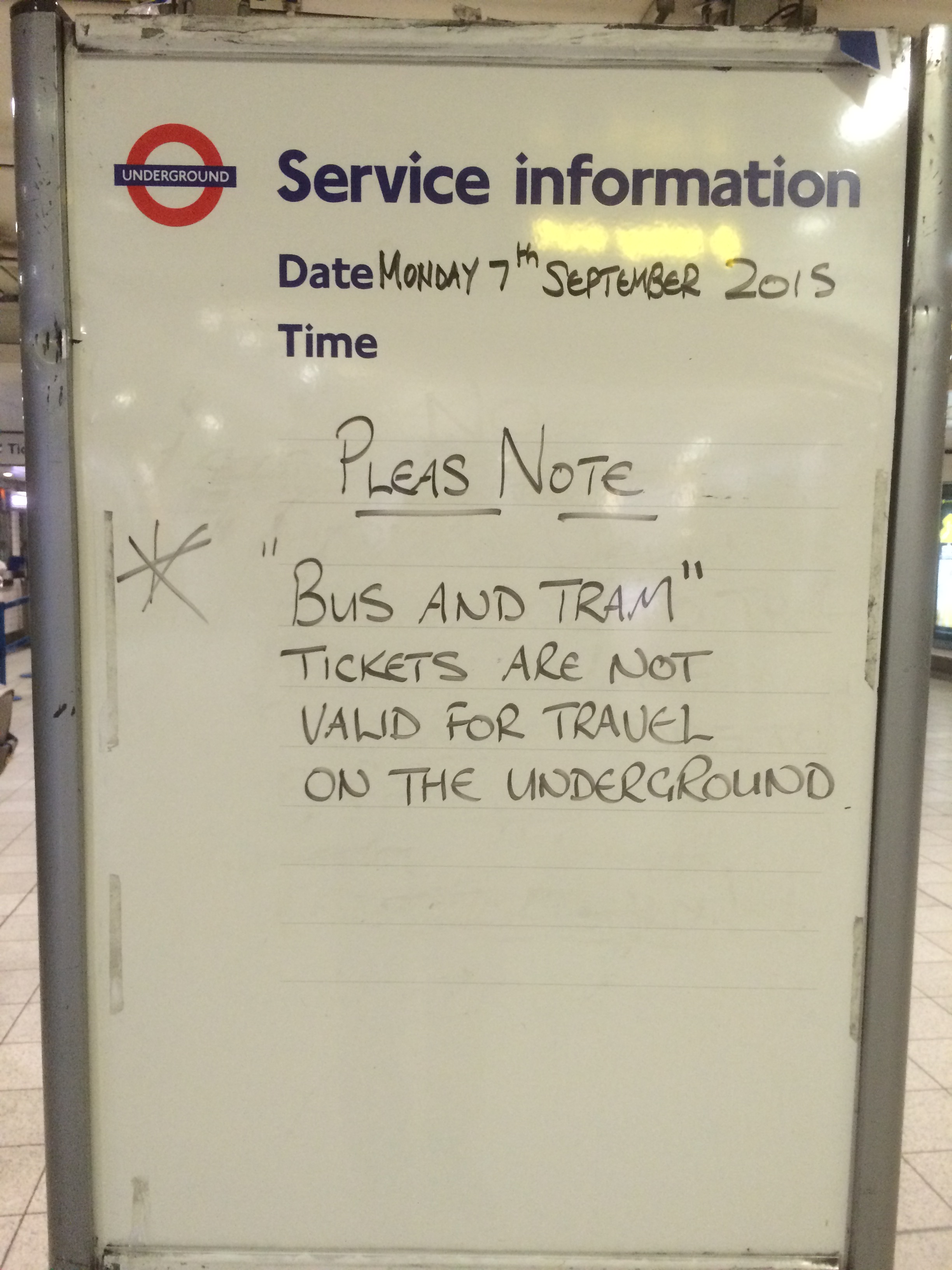
IMG_3535Where’s a physical spell checker – otherwise known as a dictionary, which nobody carries any more – when you need one? I remember about 20-some years ago in the US I saw a ticket tout with a sign saying ‘I wont (sic) tickets’.

Here’s a picture of a slightly more recent gaffe.

Online spell-checking tools in our email and document creation applications make it easy for us to avoid elementary blunders. They’re like calculators though, they make us lazy with our command of the basic skills of literacy and numeracy.

It’s OK to make these mistakes verbally, because it’s a different language to the written form and no-one can read what you say. Not so when your output is codified for all to see.

We can’t always rely on our friends to put us right on our mistakes. We have to do the work ourselves, or risk being found out.

I came across a great phrase the other day – unintellectual property. A work colleague says she uses it when she drops a verbal clanger and asks a question or makes a comment an instant before she wishes she had paused and kept her mouth shut.

It got me thinking; what if there was a legal concept called unintellectual property? Not a great idea or process that you want to protect and make your own, but the exact opposite, rather like an ‘anti-idea’.

Who says we can’t profit from the funny and the d’oh moments too, as well as the brilliant ones? I’m sure the winners of the best one-liners at the Edinburgh Fringe festival have thought about it…

We had a power failure the other day, across parts of where I live in the west of Ireland, perhaps affecting – I’m wildly guessing here – 50 to 60,000 people.

In the old days, an electricity power cut as we called it would be a major inconvenience, since all your appliances would be out, and your lights too, which, if it were winter, would mean cold houses and candles.

These days, especially during the working day, a power cut is a disaster. No electricity means – you’ve guessed it – no Internet. In a place with poor mobile signal, it also means you’re effectively off the grid. I couldn’t even vent my frustration adequately on Twitter, since I was reliant on my signal booster box – powered by electricity – to use my mobile phone.

All of which reminded me of how vulnerable we still are to the single point of failure that is our infrastructure and its systems. When a major travel accident results in thousands of travellers being inconvenienced, who compensates them for that? Similarly, when the power goes, who compensates thousands of paying consumers for the loss of productivity, or the loss of money invested in frozen food which thaws during a prolonged outage?

In the Cold War in the UK, we used to say that the Russians would wait for 2 inches of snow before they invaded; the country would be at a standstill. Our traffic infrastructure was – and still is to a degree – our single point of failure.

It still feels like that these days when the rubber bands and string of our major power infrastructures fail.

All of which leads me onto parallels with work. None of us in my opinion should be a single point of failure at work.

I’ve heard it said that you should try to make yourself indispensable, but that leads some people to become islands of information and jealously protect processes that only they know. I used to work with one such guy in a marketing agency and he was called the Mac Mason. My view is that the best staff are the ones who strive to make themselves dispensable, through leadership and innovation. And if your employers are dumb enough or political enough to make this a reason to get rid of you, then you’re better off out of there, they don’t deserve you.

Do you spend as much time working on your health as you do earning, or working on your wealth? No, I didn’t think so, me neither. It’s a luxury of time that not many of us can afford.

It’s still hugely important that you prioritise your health, though. You can have your health without wealth, but if you don’t have your health, then it doesn’t matter how much money you have. You can’t take it with you when you shuffle up your mortal coil.

It’s easy to get sucked into work and family, and then diet, health and exercise take a back seat. Even though we know that a healthy lifestyle makes us work better and live longer, still sometimes weeks or months go by without us doing anything about the yin to our yang of work.

Unless I have a specific game of sport organised, I find it harder to muster the time and energy for exercise the longer the day goes on, which is why I try and get at least some exercise done first thing in the morning. It sets me up for the day and the clever people tell me it increases my metabolism for the day too, meaning I absorb my food better. That’s a win-win for me.

So don’t forget to prioritise your health. You family and work will thank you for it. And you’ll thank yourself that you’ve increased your chances of enjoying your wealth for longer.


Two years ago today I published my first blog post on ‘Paul Dilger’s blog – Musings on stuff I come into contact with.’ I committed to do 3 posts a week, Monday, Wednesday, Friday, going out between 7:30 and 8:30 am London/Dublin time, regular as clockwork. It didn’t seem worth the commitment to do one when I felt like it, since that would degenerate into one a month, and pretty soon none a month.

Two years later, and some 300-plus posts later, it’s still going strong, regular as clockwork. I like to think that I’m still true to the values from the early days: mostly sales and marketing stuff, posts that take a maximum of 2-3 minutes to read – rather than 10 seconds or half your morning – and posts that I hope interest and enable people.

It serves as the chief dollop of fresh content for my business web site, but it doesn’t feel like work. I really enjoy writing the posts, and I know the discipline of creating them is good for me.

I hope you enjoy dipping into them as well. Here’s to the next post :-).

The one thing a good marketer should have is – a good eye.

A good eye for what looks good. Good marketers know good design when they see it. They appreciate a well designed page, product, thing. They know what to look for and they know how to brief others to create ‘good’.

A good eye for detail. The devil is in the detail, which means he – or she – is in the data, the words, the images, the emotions.

A good idea for what reads well and sounds good – for which you probably need a good ear too. Remember that what reads well and what sounds good are not the same thing. You’ll find few good marketers who are not good communicators, not good at writing, not good at speaking, not good at listening.

You can learn to get a good eye, you don’t have to be born with it. But you must have this one thing to be good.


As a marketer, writer and communicator, I love words. They’re what I do.

The other day I was flicking through a daily mood flip board that my wife gave me a while back. It has a huge range of one word, one emoticon options that sum up – and signal to others – how you feel that day.

I eventually settled on ‘subversive’ – it was a Friday after all – but I digress.

I came across the word ‘copacetic’. Ever seen or heard of it? Me neither. With my background in Latin and Greek I can sometimes figure out a word’s rough meaning from the roots, but not this time.

Turns out it’s a North American colloquialism meaning ‘OK’, with an unclear heritage.

Great word, isn’t it? A new one for us European English speakers to throw into the conversation.


We live in fast-moving times, and when I think about areas like communication, healthcare and transportation I am amazed by the pace of improvement due to innovation and technology development.

There are some things, though, that seem to lag behind considerably.

Take the umbrella for instance. We’ve had rain as long as the planet has had an atmosphere, yet the humble umbrella has barely evolved from its primitive instrumental ancestor.

It opens, it closes, it has a handle, it can double as a walking stick or a handy prop for 1950’s musicals.

Surely in the 21st century there is no device more prevalent, more fundamental and yet more worthy of a makeover?

When you’re executing a project, it helps to think about runway. For example, when you’re looking to generate leads for sales people to follow up on, there is a lead time between starting the project and leads coming in from the project you’ve executed. You need to plan for this runway, or else you’ll be trying to do vertical take off, and unfortunately business operates like an aeroplane rather than a helicopter or a jump jet.

The smaller your project, the smaller the runway you need. The larger the project, the larger the runway. You can get a light aircraft off the ground in 200 metres. You need at least ten times that for a jumbo jet. Same thing with business projects.

Make sure you’ve allowed enough runway, or you won’t get off the ground.

Equally important, the larger the project, the more runway you need to bring it home, complete it and assess its performance.

Make sure you’ve allowed enough runway, or you won’t land to fly another day.

In the old days, if we wanted to find out something we’d ask someone, and if they didn’t know we’d have to look it up, which possibly involved a trip to the public library to do a spot of research.

Nowadays, if we need to know something, we ask Larry and Sergey, otherwise known as the founders of Google. Or we could consult wikipedia. I’ve used wikipedia thousands of times, and probably linked to it – with a credit – on this blog approaching 100 times.

For me it’s the gift that keeps on giving. It’s never asked me for money and seems to be well funded. I get the occasional feeling that I’m taking it for granted and not giving back, but the feeling soon passes.

It’s useful for background reading on pretty much any topic and while it may not be the most erudite source, it’s a freely and publicly available one, and that for me gives it a high value.

I don’t get caught up in the politics, because there are always two sides to any story, but in the interests of fairness, there’s a link to the donation page here, together with fairly strongly worded arguments against donating here and here.

What about you? Do you treat wikipedia as a ‘go to’ resource on the same level as Google?