Archives for category: General

This post is kind of a Time Part 3, since I already wrestled with the concepts of time here and here.

I’m not a big fan of hindsight. Looking back in time serves no real purpose for me, except if it helps to guide us as to what might happen in the future.

As the financial service companies are forever telling us – while they forever cover themselves – past performance is no guarantee of future performance. It’s no indicator either. It’s a pattern that may or may not repeat itself.

Of course, what we really want is foresight, the ability to look ahead. We often use the word in a phrase beginning something like ‘she had the foresight too…’ when we really mean ‘she had the good sense to’. Anticipating something and playing the probabilities is wise but is still not the same as looking ahead, because we can’t do that. That’s messing with time.

The really powerful form of sight that is definitely within our grasp is insight. Insight comes from high quality and time-sensitive information, and gives us an idea why the concepts of big data, artificial intelligence and augmented intelligence hold so much promise and are maddeningly close to our grasp.

Insight is what we should strive for, because it’s more useful than hindsight and more real than foresight. It’s important not to forget that, because to do so would be an oversight…

In Time – Part 1 I  wondered out loud what it would do to the notion and fabric of time if we could either see into the future or travel back in time and therefore know everything that would happen between the point in the past we’d arrived at and the point at which we left.

Or maybe our act of moving back in time meant that we could actually re-shape the past and create an alternative future? That’s been the basic premise of more than a handful of books and films over the previous few centuries.

Many scientist are quick to point out why physically it’s not possible for us to time travel, and I spent Time – Part 1 arguing that existentially it’s not possible either.

So where does that leave us? In our working lives and in our family and leisure lives? If we can’t manipulate time, then we have to make the most of it. Which means we have to make the most productive use of it that we can, because, as I’ve said over many posts, it is the most precious resource we possess. We shouldn’t waste any of it. When we run out of it, we run out of everything else.

So, live in the present and give it your best shot, with the best knowledge and resources you have. Time to go.

Ah, time, the fourth dimension, besides width, depth and length. By far the most interesting dimension I think. The one dimension we can’t do anything about. We can’t control it, slow it down or speed it up. It simply marches on.

Wouldn’t it change a few things if you could see into the future, if you knew what would happen? Or, if you woke up one day and it was 6 months ago, and you could relive the next 6 months knowing exactly how things would play out? We’d make millions within a few days.

But if we all could do it, then it would destroy the 4th dimension. It would destroy the gambling industry, but that’s the merest tip of the iceberg. It would destroy risk, probability, choice, and it would destroy freedom. Our paths would be utterly determined.

So, if we solved the riddle of the 4th dimension, we would change everything, immediately and for ever. In fact, immediacy and foreverness would cease to be concepts.

This post is quite deep I suppose. Which, as we just discussed, is another dimension entirely :-).

English is rough. Really rough sometimes, and not just on people who speak it as a second or third language. For us native speakers too.

Take palate, palette and pallet for instances. One is in your mouth, the second is a board for your paints or a family of colours for your product or company identity, and the third is a useful device for stacking, lifting and moving a bunch of items.

All of them sound exactly the same, at least in my accent, to the ear. Yet, they all originate in different root words and consequently are all spelled differently.

I must confess I spelled the second version wrongly the other day. I thought it was double ‘l’ as well as double ‘t’. Thank goodness for autocorrect. And thank goodness too that it wasn’t a fourth spelling variant, at least not to my knowledge.

This kind of thing never fails to remind me of the two different languages we use; the written one and the spoken one.  While you might think that the written one is harder, try explaining to a non-native speaker heteronyms like ‘tear’, words that are spelled the same but mean different things and are pronounced differently. I think I’ll stop there…

Unfortunately, many people who have to work for a living get ‘that back to work feeling’ after a break. Sometimes it can feel like the break is not quite worth all the effort clearing the workload before the break and the back to work feeling after it.

Unless you work for yourself, or you have your own business. Then you experience a different kind of feeling.

That feeling is ‘that not back to work feeling’.

That not back to work feeling is when you should be back from a break and you should be working, but you’re not working, because you don’t have any work. And when you’re not working, you’re not earning.

So if you’re employed and you’ve got that back to work feeling, rejoice, because you’re being paid for feeling gloomy. You could have that not back to work feeling, in which case you are both unpaid and gloomy.

Disclosure: I have borrowed this phrase from one of my brothers, who used it this morning…

Why do so many of us strive to be normal, to fit in? Is it our natural herding instinct, the safety in numbers? We don’t want to stand out too much, do we?

But what is normal?

Is it a basket of behaviours that can be grouped into a standard, a category or a stereotype? To me, normal is rather like ‘average’. Calculating an average number, or an average person can be a useful yard stick for grouping people or things, if it’s interpreted correctly.

But who is average? Who wants to be average? No-one is average. Average is a mathematical nicety describing a group, not an individual. It’s like when someone says ‘well most people would do that.’ Well, I’m not most people. Besides, how could I be?

So who wants to be ‘normal’? What is normal? Can one person really be normal?

I don’t want to be normal. I don’t want to be thought of as normal either.

There’s nothing like the physical world to give us a powerful corollary of how it works in the cyber world.

I’m always reminded of this in late December when families and friends get together at the end of a few months of solid graft and a winter vomiting bug or two runs riot, moving through areas like wildfire.

That’s really viral, genuinely viral. You can see why the term virus was coined in the cyber world. A physical virus is an amazing thing, replicating itself, producing different strains and moving quickly through people in different cycles and timeframes.

Millions can be affected within the space of a couple of weeks, brought on by the combination of people being at a low ebb and slightly more vulnerable to infection after a sustained period of work, proximity to others, and mobility within family groups and circles of friends.

I’m always fascinated by how terms like desktop, folder, cloud, virus and so on are borrowed from the physical world for their digital equivalent. They always seem so apt.

Community pride is a great thing for getting projects off the ground and delivering the benefit to that local tranche of society.

Some countries are better at it than others, and it’s perhaps a function, of history, culture, wealth or simply how well governments tends to fund things. Some are really proactive. Others less so, knowing and expecting that a few individuals will get it done for their community.

It is in the countries and areas with the best culture of community project success that you find the most generous people, I think. Everyone pays their taxes, theoretically, and they have very little control over how their taxes are disbursed, unless it’s via the indirect and infrequent mechanism of voting. Yet in community-minded societies you find people who are very actively generous towards a number of different projects, none of which they may ever use or benefit from.

It is pride and spirit in one’s community that sparks the generosity, which probably engenders more attachment to and better care of the end product.


7 Days to 10K

7 Days to 10K

Here we are with Part 5 – the final part – of 7 days to 10K. A hastily drawn up plan for successfully completing the local 10K race, my first. Not, as one of the people that reads my blog mistakenly thought, a 7-day plan to 10-grand. Sorry. That would be great though, wouldn’t it?

The weather was glorious, sunny and 7 degrees, that’s the mid-40’s for you Fahrenheit folk. The high winds of the previous day had blown themselves out, to leave a gentle breeze. At the start I found myself with a couple of neighbours who were hoping to dip under the hour-mark. We positioned ourselves in front of the 60 minute pacer, and within sight of the 55-minute pacer.

Within the first kilometre or 2, it was clear to me that I was running noticeably faster than I had 2 days previously. I was relatively comfortable, but it was also clear to me that the 55-minute pacer was a bridge – or runner – too far. We were all very boxed in for the first few k’s too, since there were a lot of people in the race and the roads were country roads.

As we turned at about 4 K we went onto a real country track for 2K, before the turn back into town at 6K. It was a gradual incline, and I prefer to take those a bit quicker to get them over with, if I have sufficient gas in the tank. I felt good, and conscious too that I was pushing myself quite hard. I stuck in there, up through another gradual incline from 7 to 8K, until we passed the local soccer club and then I knew I was going to make it, since I’ve jogged back from there many times.

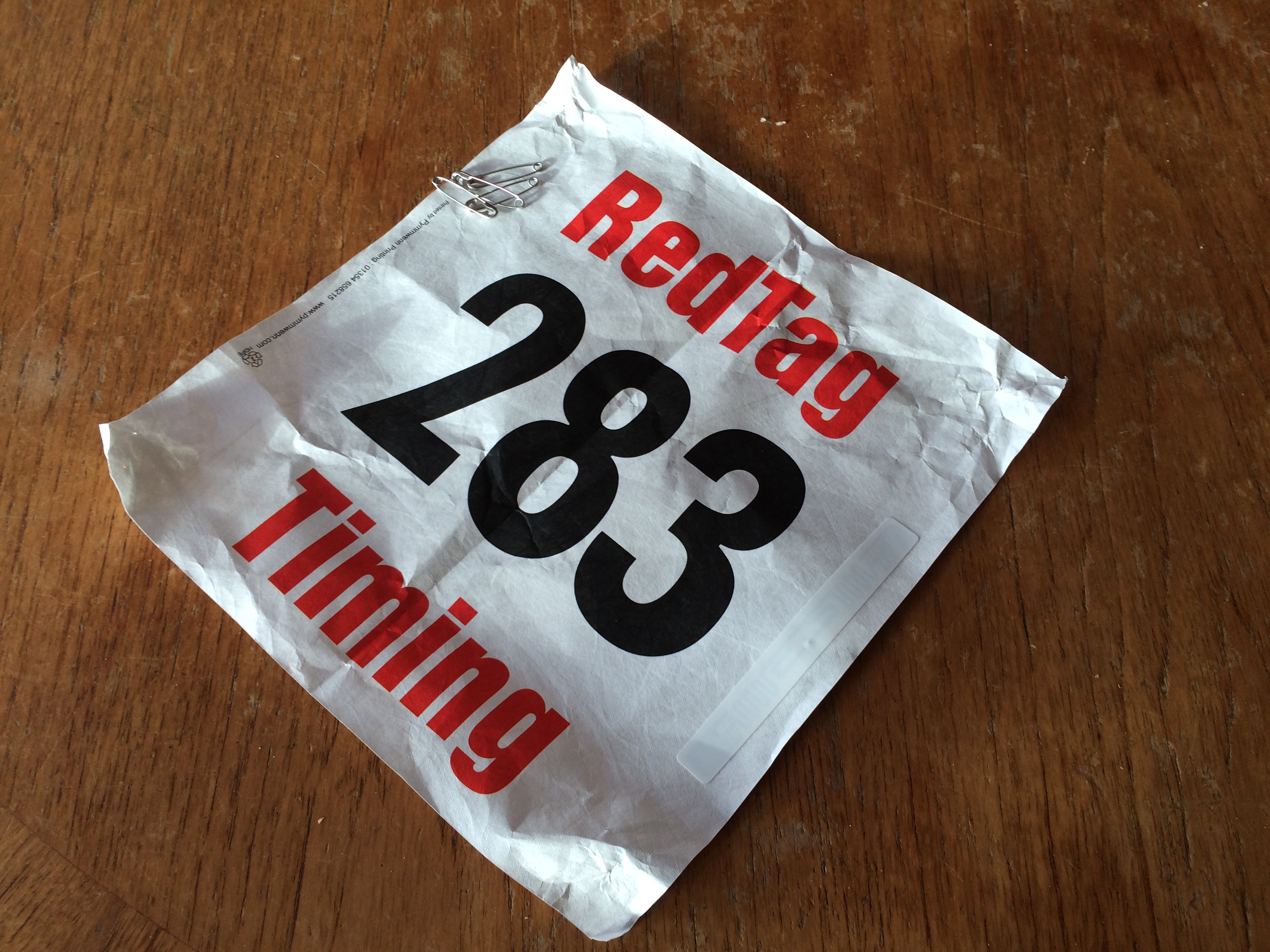
The 9K mark passed the estate where we live, and with the kids to give me a yell of support it was downhill for the last K, a very welcome run home. 50 metres from the end Her Ladyship, who had finished a good way ahead of me, was there to yell to me to sprint for the finish. The legs felt great, the best they’ve felt in years, and I passed over the finish line, at speed, in a time of 57:09.

We then headed up to the hall for teas and buns, to join the huge throng of post-race euphoria. Job done.

As I was enjoying my first beer of the evening with friends, I had an automated text from the race organisers to say that my actual time, since I passed the start mark a little while after the starting gun as the crowds passed through, was 56:17.

The event was superbly organised, as it always is for this event which draws in runners from all over, and very social afterwards. It made the food and drink consumed in celebration that evening all the sweeter. It was also interesting to be a participant rather than a vocal supporter for the last 9 years. I’m sure I cheered louder last year than anyone did for me this year…

2 parting thoughts: first, a little planning gets you a long way towards successfully executing your goals. Second, I may be a better supporter than a runner, though I might also have taken the first few thousands paces towards an annual tradition…

In Part 3 of 7 days to 10K, I outlined my plan to run a practise 10K on the roads and take 2 full days off before the big day, day 7. So you’re probably wondering how I got on? Whether things went according to my somewhat flimsy plan? Did I do the run? Did I finish it? Did the legs give way?

Well, yes and no, as is always the way with planning.

I didn’t run the 10K on day 4, for 2 reasons. Firstly, the weather was utterly foul. Cold, wet and hellishly windy. Storm-force windy. Second, my daughter got sick for a few hours, and I didn’t want to leave her. By the time she was better, it was dark, I’d lost my mojo and the storm hadn’t abated.

I did have a plan B though. My plan B was simply to run on day 5 and suffer 1 less day of recovery. So that’s what I did. My good lady helped me design a route that was never too far from the house that if I pulled up I couldn’t walk home in a reasonable time.

I set off slowly, in milder weather, and felt great for the first 15 minutes, and 25 minutes, and 35 minutes. The only arduous part was about the 35 – 50 minute mark, a long uphill stretch of 1.5K into a strong wind. I tend to run faster uphill, to get the pain over with, and catch my breath on the down phase, so it was hard – but manageable – work.

I made it! The calves were fine, they held up great, and I never doubted the fitness. I completed the 10K in a leisurely 65 minutes, with no after effects. And felt great afterwards. Plenty left in the tank, it was always a question of avoiding injury rather than running out of puff, literally. I stretched, iced and spent the rest of the day eating, drinking and making merry.

Yesterday, I did some final stretches for the legs and back, which was a little tight after such a long time on the move.

So, today’s the day. It’s race day, day 7. The race is around some of the roads I have only just run on. I’m hoping to duck in under the hour mark. I’ve done the prep. I’m cautiously optimistic. Plan for the worst, hope for the best. I’ll let you know how I get on in the final part, part 5 of 7 days to 10K.