IMG_3535Where’s a physical spell checker – otherwise known as a dictionary, which nobody carries any more – when you need one? I remember about 20-some years ago in the US I saw a ticket tout with a sign saying ‘I wont (sic) tickets’.

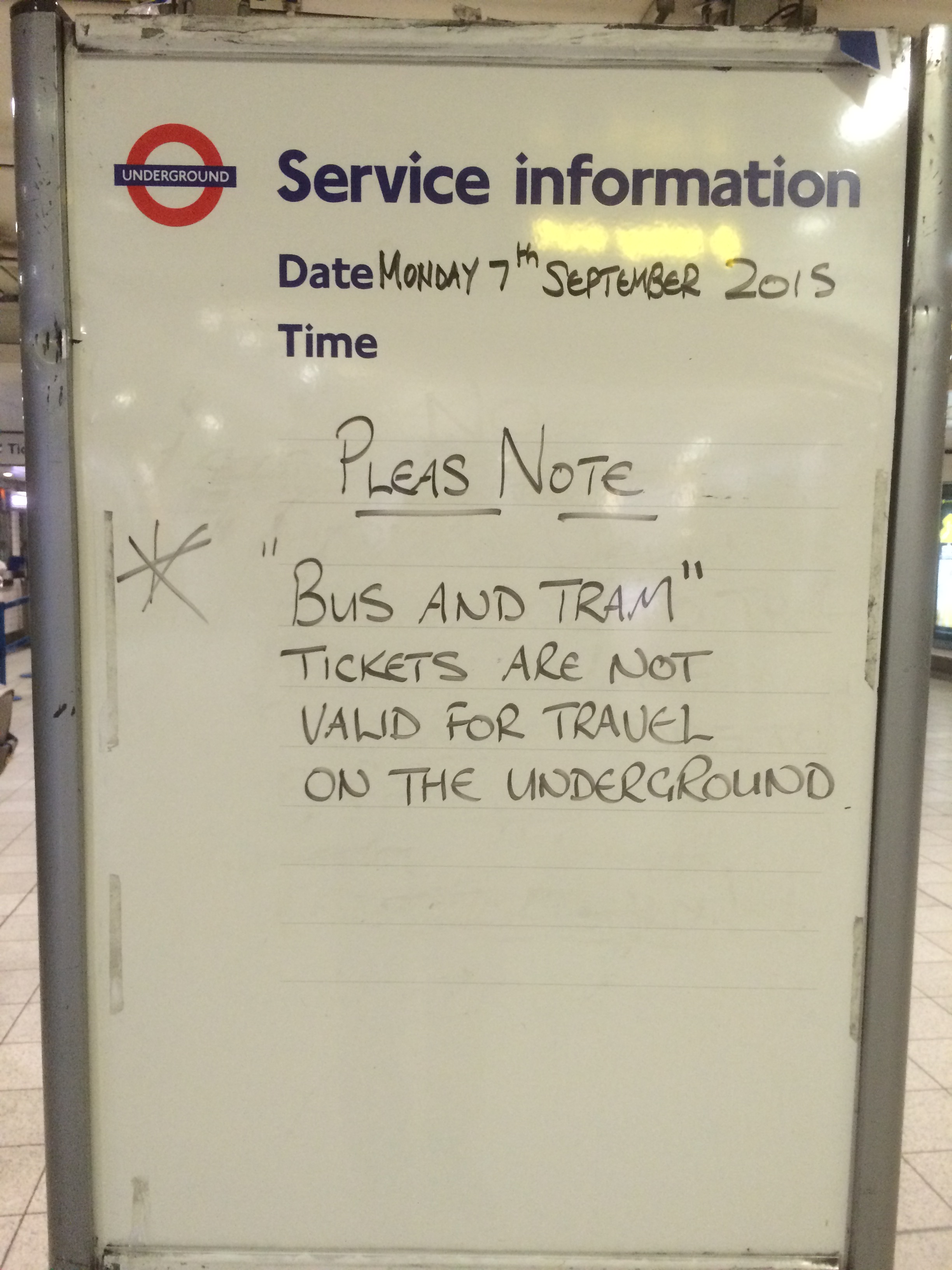
Here’s a picture of a slightly more recent gaffe.

Online spell-checking tools in our email and document creation applications make it easy for us to avoid elementary blunders. They’re like calculators though, they make us lazy with our command of the basic skills of literacy and numeracy.

It’s OK to make these mistakes verbally, because it’s a different language to the written form and no-one can read what you say. Not so when your output is codified for all to see.

We can’t always rely on our friends to put us right on our mistakes. We have to do the work ourselves, or risk being found out.

Screen Shot 2015-08-14 at 08.24.46As a consumer, I’m bombarded by advertising, both targeted or 1:1 and mass or ‘above the line’.

As a marketer, I pay attention to advertising and imagine that I’m subconsciously judging it as well as responding to it as a consumer. You know the metrics; I’m no different and 98% or so of them pass me by for a variety of reasons, some good, some bad.

These days, we’re all conditioned to understand that when an ad for a site we recently visited is presented to us online, this is simply retargeting. Those of us who use webmail are also subjected to a barrage of ads, which is only fair – in my view – for a free app or service.

I use hotmail, amongst others, and see a ton of skyscraper ads to the right of my inbox and emails. I notice them all, but act on almost none.

I do, however, like the one here, that was presented to me a couple of weeks ago. I’m not really in the target demographic, so it won’t have been a retargeting effort, but I liked it all the same. I’ll tell you why:

  •  Squeeze the Day is a fab line! It’s a call to action in its own right, a play on the famous carpe diem phrase, but most importantly it reinforces one of the brand’s key differentiators, namely that kids squeeze the packs to get all the drink out
  • It suggests action, energy, getting important things off your bucket list – and satisfaction, either thirst-quenching or completing something worth doing
  • It’s visually arresting, fun and it’s clear what they’re asking you to do

All in all then, in the opinion of this writer it ticks all the boxes. All the boxes except one – the only critical one – which is whether or not it’s received a successful number of click throughs. That I don’t know.


Want to know what the most important word will be for sales and marketing professionals in 2016?

Engagement.

Well, it’s out there now.

I used to think the key word was ‘resonate’, but that doesn’t go far enough. When what you say resonates with someone, it’s like they’re a string you’ve plucked. You’re on their frequency, to mix a simile and a metaphor. But the string doesn’t vibrate for ever, it fades away, or loses interest and it becomes immovable, in both senses of the word.

No, to succeed we all need to engage our audience. If we work in sales, we have to get our customers engaged so that they will do something with us. If we work in marketing or sales enablement, we also have to engage our sales people, those internal customers who never read an email we send them, or a document we prepare for them. We have to find ways of making them listen and realise that this is what they need, what they have been asking for, what is going to make them more money because they can satisfy more of their customers and prospects.

Sales engagement – and partner engagement for that matter – is a crucially important slice of the pie, but it’s often the slice that gets left to go cold. And no-one likes cold pizza, at least not like they do sizzling warm pizza that engages the senses.

So if engagement is the key word in 2016, what is the key process for us for the rest of this year?

It’s this: the journey to establish and effectively communicate what we have – or what we will need to have – that will truly engage our customer.

I came across a great phrase the other day – unintellectual property. A work colleague says she uses it when she drops a verbal clanger and asks a question or makes a comment an instant before she wishes she had paused and kept her mouth shut.

It got me thinking; what if there was a legal concept called unintellectual property? Not a great idea or process that you want to protect and make your own, but the exact opposite, rather like an ‘anti-idea’.

Who says we can’t profit from the funny and the d’oh moments too, as well as the brilliant ones? I’m sure the winners of the best one-liners at the Edinburgh Fringe festival have thought about it…

I think I’d like to try being a baggage handler. It looks like a fun job, active and physical, if perhaps a little monotonous.

Baggage handlers are a problem for the airlines. Actually, they’re a problem for the airports, but it’s the airlines that feel the problem. Baggage handlers handle baggage onto and off the planes in the full glare of passengers watching from the departure lounges. They are a wonder of economy of physical effort, moving tens of thousands of pounds of luggage every day.

Unfortunately, they also pay scant regard for the contents of bags, and from a customer-oriented point of view this is a problem. I recently spent an idle 20 minutes watching guys loading bags onto a conveyor belt into the plane’s hold. One chap pulls the luggage off the luggage truck, from the top bag down so that each stack falls closer to him, then pivots from the baggage truck 180 degrees behind in and throws each bag onto the belt. Then the chap standing in the door of the hold takes each bag of the belt and launches them left and right over runners in the hold.

The bags take a hell of a beating, to borrow from a well known Norwegian soccer commentator. And that’s just the parts of the process we see plane-side. We don’t see the bags getting onto the trucks outbound and off the trucks inbound. If you don’t have the sturdiest of baggage materials, you risk losing anything that’s remotely brittle or fragile, and that creates a bad impression with the paying punter, at least this one.

I think I’d be a gentler handler if I got the chance. But perhaps I’d be too careful, too slow, too poorly productive, and be relieved of my duties.

We had a power failure the other day, across parts of where I live in the west of Ireland, perhaps affecting – I’m wildly guessing here – 50 to 60,000 people.

In the old days, an electricity power cut as we called it would be a major inconvenience, since all your appliances would be out, and your lights too, which, if it were winter, would mean cold houses and candles.

These days, especially during the working day, a power cut is a disaster. No electricity means – you’ve guessed it – no Internet. In a place with poor mobile signal, it also means you’re effectively off the grid. I couldn’t even vent my frustration adequately on Twitter, since I was reliant on my signal booster box – powered by electricity – to use my mobile phone.

All of which reminded me of how vulnerable we still are to the single point of failure that is our infrastructure and its systems. When a major travel accident results in thousands of travellers being inconvenienced, who compensates them for that? Similarly, when the power goes, who compensates thousands of paying consumers for the loss of productivity, or the loss of money invested in frozen food which thaws during a prolonged outage?

In the Cold War in the UK, we used to say that the Russians would wait for 2 inches of snow before they invaded; the country would be at a standstill. Our traffic infrastructure was – and still is to a degree – our single point of failure.

It still feels like that these days when the rubber bands and string of our major power infrastructures fail.

All of which leads me onto parallels with work. None of us in my opinion should be a single point of failure at work.

I’ve heard it said that you should try to make yourself indispensable, but that leads some people to become islands of information and jealously protect processes that only they know. I used to work with one such guy in a marketing agency and he was called the Mac Mason. My view is that the best staff are the ones who strive to make themselves dispensable, through leadership and innovation. And if your employers are dumb enough or political enough to make this a reason to get rid of you, then you’re better off out of there, they don’t deserve you.

Do you spend as much time working on your health as you do earning, or working on your wealth? No, I didn’t think so, me neither. It’s a luxury of time that not many of us can afford.

It’s still hugely important that you prioritise your health, though. You can have your health without wealth, but if you don’t have your health, then it doesn’t matter how much money you have. You can’t take it with you when you shuffle up your mortal coil.

It’s easy to get sucked into work and family, and then diet, health and exercise take a back seat. Even though we know that a healthy lifestyle makes us work better and live longer, still sometimes weeks or months go by without us doing anything about the yin to our yang of work.

Unless I have a specific game of sport organised, I find it harder to muster the time and energy for exercise the longer the day goes on, which is why I try and get at least some exercise done first thing in the morning. It sets me up for the day and the clever people tell me it increases my metabolism for the day too, meaning I absorb my food better. That’s a win-win for me.

So don’t forget to prioritise your health. You family and work will thank you for it. And you’ll thank yourself that you’ve increased your chances of enjoying your wealth for longer.


If you’re a regular recent reader of this blog, you’ll know that I’ve concluded a series of posts on what I term the 15 steps of B2B marketing, a process that can be applied to pretty much any project, plan or period.

Having built up the 15 steps, I now want to break them up a little.

You may feel that your company, project or plan does not warrant such an exhaustive list of steps. You may also feel that it’s possible to get pretty immediate feedback on your tests and that you might even be able to get stuff out there sooner and iterate your offering while you’re already in the market. A sort of ready-fire-aim approach, if you like.

Indeed, lately, many marketers are starting to borrow from software development and start-up methodologies and talk about ‘agile marketing’, or ‘lean marketing’. Taking a lean approach is a bit like taking a slice of your marketing plan and seeing what it tastes like for customers. This early feedback arms you to improve the next few slices in a series of small improvements, rather than one big cascading marketing push at the end of what might be some untested assumptions and homework.

Lean marketing is not a fad, it’s more a response to the reality that the mechanism of the web makes it much easier for you to very quickly get a steer on whether what you’re doing resonates with those whom you want to relieve of some money. For more on this read here.

In our penultimate B2B marketing step, we iterated our plan as we went, testing the results and tweaking our approach accordingly. And so we come to the final B2B marketing step in any marketing project or plan, the fifteenth step in what I call the 15-step B2B marketing process.

This step will come as no surprise to those who follow this blog and remember the series on stages in the buying process or selling process.

Yes, the fifteenth stage in the B2B marketing process is to ‘rinse and repeat’. The fifteenth step is the first step. It’s back to the beginning, following the tried and trusted best practices that led to the successes of the previous plan or business period.

You have fresh battles to wage, new opportunities to milk, new challenges to address. They’ll all benefit from the same methodical approach I’ve outlined.

I hope you’ve enjoyed the fifteen steps, climbing to the peak that was the eighth stage of crafting strategy and getting down the other side to your destination and your objectives. Feel free to share the 15 steps with others, or with anyone who would benefit from them.

OK, you’ve completed all but 2 of your 15 B2B marketing steps to success. You’ve started executing your B2B marketing project or plan, so you’re pretty much there, right?

Wrong!

You need to test early and test often. Review the activities as you execute them and where possible measure as soon as you can. When a reasonable time has elapsed for each activity to flow through your business, measure the return on the activity and enter the actual results in the last few columns of your activity plan, so that you can see how you stack up against your target results. Then, over time, you can fine-tune your future targets with the benefit of hindsight and increasing experience.

Beware – not many companies close the loop. They do a plan for a project or period, execute, maybe measure the results, but they don’t then learn from the misses and incorporate the learnings into the next plan. Make sure you’re not one of the companies that misses, repeatedly.

Review, measure, learn, adjust and execute again. Until you’re done executing.