Archives for category: Technology

You have this great business idea. You haven’t seen anything like it and you’re convinced you can make a success of your venture. The most pressing question, unless you happened to be prodigiously wealthy – so you already know how to get money and make more of it – is around financing the development and take-off of your idea.

You could bootstrap the business, running it on your own savings until it starts to ‘wash its own face’, but you might need more than you reckon on as these things always take longer than the best laid plans. You could go to friends and family and secure relatively small amounts from a relatively large number of people. At this point you might already need to start giving some of your company away in return for the investment, and by now you’re starting to think about the level of relationships you will have with these investors.

Those who don’t have access to their own funds or the funds of their nearest and dearest need to start playing the dating game with professional lenders, who might be high net worth individuals, institutions, state/semi-state bodies or private investment companies. It’s at this point that you need to develop an understanding of two things, very, very quickly. The first is how investment business and its clandestine terms work: seed this, A round that, mezzanine the other, and so on. The second, arguably even more important, is the type of investment partner you want to work with and who will be good for your business as it grows. Cultural fit is of paramount importance.

If you’re in the third camp, needing to start the dance with someone who lends and makes money for a living, then I can recommend this post for an excellent primer. There are some additional very good links within the post. I don’t know the guy at all, but he writes well and he seems to mean well too. Good luck!
Clusters are good. A cluster of the same type of companies is good for the companies because a critical mass of talent is developed, increasing the local pool of expertise to draw on. Good for the employees because they can get promoted either within their company or in other companies and don’t have to relocate themselves or their families. Both parties have choice and flexibility. There is safety in numbers for both.

A cluster has to start somewhere, however. It has to start with a cluster of one. One company has to take the plunge.

I live about 20 minutes’ drive from Galway in the west coast of Ireland. It has a small software ecosystem, much smaller than Dublin’s, but this ecosystem is being gradually added to as more software companies either start up or base their European Headquarters in this attractive city.

Recently, there was an enormous news story about the world’s most valuable company – at least at the time of writing it is – announcing plans to build a presence in the little town where I live. The land in question is as big as the entire town. As you can imagine, my town was simply agog with the news: the possibility of jobs, the stimulation of the area, the supply-side economy and property prices were all on people’s lips, not to mention the almost planetary magnetism of a world-renowned company coming to town.

The cluster of one has begun. I see the cluster being swelled by several more companies – providing either competing or supply chain services to the first mover – until perhaps in twenty years there is a corridor of similar companies dotted along the 25 kilometres between our town and Galway.

It’s good to move to a cluster. And when one happens to begin on your desktop, well that’s either great planning, great serendipity or great insider knowledge. Having lived here for a good number of years, I can only claim option 2 :-).

A while back, we were doing the rounds of secondary schools with our first born to see where he’d like to pursue the most important decade of his life, educationally speaking. We’re lucky in that we live in a small town but we have 3 secondary schools to choose from, each of them different in their own way.

I asked each one of the about the provision of keyboarding – or typing as it was known to me when I was in secondary school, and back then it was only girls that were allowed to do it… – lessons for kids. Guess how many of them provide such lessons?

None.

I was astounded. I have grown up as the generation who were already passing through or past secondary school when computers came in. We made it up as we went along and after 3 decades of muddling through I can do about 30 words a minute using about half of my available digits. I cross hands and lose millions of split-seconds a year in productivity and effectiveness. I neither have the time nor the inclination to learn to type properly. It would be like a ‘righty’ stopping all work for 3 months and learning to play golf left-handed.

For kids who are 12-18 in today’s era, keyboarding skills are crucial, vital even to productive education and careers. Sure, you can learn online with software and commitment, but these skills are best taught by disciplined, patient teachers. Sure, the qwerty keyboard might be replaced by something revolutionary and probably ‘swipey’ at some point, but right now, it’s what we have and I want my kids being taught a key life-skill at school.

It’s madness I tell you, madness…

There is a term in sales remuneration called OTE. It’s a three-letter acronym – aka TLA 🙂 – naturally. OTE stands for On Target Earnings or On Track Earnings, though I prefer Opportunity to Earn myself. In sales jobs you can have a base salary element and a commission element that together give you your OTE if you hit your sales quota.

In a previous post I talked about the importance of having a product/market fit. Once you have that, then you need to scale your business so that you can capitalise on your potential. Your ‘opportunity to earn’, therefore, is to be found quite literally in the word ‘promote.’ To attract the right customers in the right numbers, you need to effectively promote your business.

If you’re a business owner/manager with a successful product, you want to take your business to the next level and you think the key is something to do with this marketing lark, here are some things to think about.

– Do you know your market? Can you profile it, describe it, and define it, tightly?

– What slices or segments make up your market? Remember that you can slice the market ‘pie’ according to things like region, industry, size etc, but also according to what is important or needed by customers. How you segment your market is crucial.

– Which segments of the market do you want to sell to? Even though you want to grow, you can’t be all things to all people. Well, you can, but not for long.

– What are these buyers like? What are the buyer ‘personas’? How do they prefer to buy?

– How will you position yourself to these segments? Positioning is the third leg of the segment-target-position stool on which will sit much of your go to market plan. By ‘position’ I mean your messaging, or how you describe your value to customers.

– Does your brand truly reflect where you’re going, not where you are or where you’ve been?

If any of this is alien to you, invest in someone to help you figure it out. It’s the key to unlocking the OTE at the end of promote.

The one thing you need for a successful business is this (no drum roll necessary) …

Product/Market Fit.

You’d be surprised – actually you might not be surprised at all – how many product-based companies don’t have it, or can’t get it.

Product/Market Fit is this, put simply: people want your stuff. A lot of people. In fact, they don’t simply want your stuff, they need your stuff, and a good number of them would be up the creek without a paddle if you took it away from them.

You need Product/Market Fit for your business to grow, and people won’t invest in your business unless you can demonstrate you have it. Conversely, if you’re looking to join a successful company, and this is perhaps the most obvious thing you’ll read this month, join the one that you’re sure is shifting product.

If there’s no market for what you sell, or plan to sell, there’s no business for you. Too many companies find this out too late, usually after they’ve built their product. “Now, who can I sell this to?” In other words, do the marketing first, not afterwards.


What’s the number one rule for the home page of your website? It’s a pretty obvious one, but you’d be surprised at how many websites fail when tested against it.

When you go to a website for the first time, you want to know one thing: What do you do?

In other words:

– who are you?

– what do you do?

– how will this benefit me or my company?

This should not be difficult for you to address, regardless of your business.

Put it in a prominent place on your home page – or your landing page for whatever demand generation exercise you’re doing – so people can form a quick opinion as to whether what you have can help them. Otherwise they’ll leave frustrated. Why else do you think people typically abandon a home page way more than 50% of the time?

Don’t forget that you know your company well; how could people not know what you do? But you haven’t seen the website for the first time in a long time…

“Meetings, Bloody meetings!” So goes the refrain – and the heading – in the hilarious management training videos from John Cleese’s company in the 1970’s. A well-run meeting is a rare and beautiful thing. A poorly run meeting – well that’s the norm in most companies. They become a forum for delaying or avoiding decisions rather than arriving at them.

In the sales world good, well-qualified meetings with customers and prospects who have budget, the power to make decisions, a need for your product and a timeframe for making a change are worth their weight in gold. Poor meetings are a waste of your time and their time – and time is the most precious resource. They’re not even good practice.

Many managers work off the principle that the more qualified meetings you have, the more deals you’ll close. It’s largely right of course. Take two sales people with identical abilities, identical opportunities, but one with twice the opportunities of the other, and one will close 12 deals and the other will close 6. The more calls you put in, the more conversations you have, the more meetings you make, the more quotes or proposals you submit, the more deals you win, as long as you’re following a defined sales process.

It’s not only about working harder to be more successful though. It’s about working smarter, and coaching people to work smarter.  If you want your team to be more effective – ie more successful – and you’ve identified that your team needs more meetings, there are a number of things you can do to increase the performance of your sales team without having to add to your sales team. Here are ten of them:

– Is a face-to-face meeting necessary? Would a (video)conference call do? Could we do a web-based meeting?

– what’s the travel time like to meetings, from meetings, between meetings? Could it be better organised?

– could our sales team be better split geographically to optimise the number of meetings?

– is our team properly prepared for the meetings, so that they can close deals with the minimum number of meetings?

– what are the behaviours that drive more meetings? Better leads, better telephone work, better sales skills, better emails and collateral?

– who’s doing well at meetings that we can celebrate so that others can learn from their best practice?

– who needs coaching or other support to get more meetings?

– what sales technology can we use to help us manage the sales process?

– what sales technology can we use to optimise meeting routes and geographical clustering?

– what sales technology reports on meeting productivity can gives us insight to make improvements and correct poor behaviours early?

Maximising your customer contact and minimising your non-contact activities help you maximise your sales success. If your business is relatively high deal volume and small deal size, you need to make this your mantra. Meetings, blessed meetings!


In a perfectly connected world, where we are all devices and / or IP addresses on the Internet in the so-called ‘Internet of things’, there would be less arguing, fewer disputes methinks.

“Oh, so you think you’ve been doing the dishes more often than me and you put the kids to bed the last 3 nights, do you? Well let’s take a look at the dashboard, shall we? Look, here we can see that I have clearly washed up the last 5 times, and in fact you put the kids to bed the last 2 nights, not 3, and I did the 4 nights before that – hah! Total domestic activities are 561 minutes for you since the start of the week, and 974 for me. You’ve done 1274 parenting minutes, I’ve done 1478, so there!”

I think we’re a long way away from Minority Report and the Department of Pre-Crime, but total 24/7/365 transparency of what we have done must be within the lifetime of at least someone’s reading this. We should be able to report on everything that happens in the past. This will have huge ramifications for society and things like big data. For example a region would know that 1,825 cases of rape were reported, but a further 6,467 cases occurred but were not reported.

This must lead to a safer, truer society, but at what cost?


When we look back on our lives or our careers and contemplate some of the decisions we made that didn’t go according to plan, we have a tendency to rationalise them and explain them away. It makes us feel better. “Yep, that didn’t work out, but at least I know that industry’s not for me.” “Shouldn’t have bought that car, I’ll put that down to a learning experience.”

I use this ‘backward justification’ approach myself, by reasoning that every decision we make in life is a good one. It was good for some reasons, not good for others, and at least it was better than not making a decision at all, wasting precious time stuck in a rut. It’s better to have been proactive and have thought through the permutations and ramifications before deciding, but sometimes you just have to go.

In the marketing context this back-to-front way of thinking is similar to what we call ‘reverse segmentation’, and in business it can be very costly indeed. Segmentation is of course a really important part of plotting your own brand of world domination. It’s part of the ‘S-T-P’ holy trinity of marketing, namely segmentation, targeting, positioning. You segment your defined market, choose the segment or segments you want to target, and present yourself in the best light to those chosen segments.

How you segment is the $64,000 question. According to what criteria do you segment? If you’re going to segment along two key axes and plot your market or audience on a matrix, you had better get the two key criteria right, otherwise you might as well segment according to favourite type of pop music and preferred colour of pyjamas – unless you’re in the musical pyjama business. Lots of businesses, however, are not market-focused. They’re generally product focused. They develop a product which they think is great, then they try and find a market for it. This is also called a solution looking for a problem.

When you already have your product, it’s really hard to come up with objective segmentation criteria that don’t play directly to your strengths. This, dear reader, is reverse segmentation, and you might as well put your cart in front of your horse. It gives you an erroneous picture of where your market is heading and of your likely success. You’d be amazed how many companies do it!

One of my most fun projects over the last year or so has been to help a company in the ecommerce business with a few product marketing challenges. As a result of writing and blogging on their behalf, I’ve come to know the industry pretty well.

One of the factors that really drives the industry is customer service. This is because everything revolves around the buyer experience, so that people can find what you’re selling, select it, pay for it, receive it, consume it and come back for more as often as possible. Competing on price can often become a race to the bottom and a loss-making business, so your chief competitive weapon is continuous customer delight.

This sounds pretty simple. It gets less simple when you want to sell your product in more marketplaces, because then you have more portals to manage stock levels for, and more places to manage your customer service communications from. Technology comes to the rescue in the form of software platforms that allow you to centralise your stock control, orders, shipments and most important of all customer communications, in one place.

Interestingly, the vast majority of us all are also online consumers, so at an anecdotal level we know what it’s like to be on the end of exemplary or excremental service. Which brings me to the reason for this post.

About three months ago I succumbed to a Living Social bulletin advertising, of all things, dental floss heads at a ludicrous discount. In Ireland, these offers tend to be from UK companies, so you then have to stump up for the shipping as well. Except, it’s not so straightforward. Sometimes, you contract with Living Social to buy the product, then with your special code you then go through to the vendor’s website to arrange and pay for postage directly with them. The first time I couldn’t get the website to accept any of my credit cards, so I had to raise a ticket with them and Living Social, who referred me back to the vendor. Two weeks later, I managed to get the website to accept my credit card and take the requisite amount.

A month later, no floss heads. I sent a pithy email to their support centre to say that I had never received them.

How Not to Do Customer Service

How Not to Do Customer Service

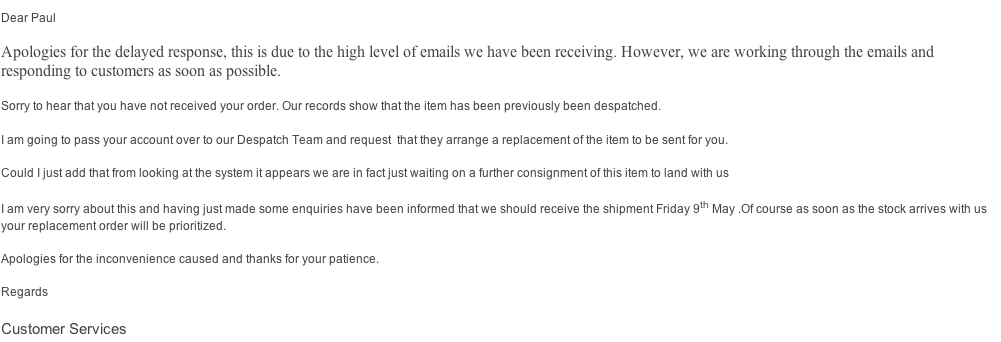
This is what I got back. A loose collection of standard responses and qualifying comments pasted and patched together in different typefaces, masquerading as a considered reply to my problem. I didn’t hold out much hope. They’re either appalling at customer service, or too busy correcting hundreds of undelivered orders, or both, with one being a consequence of the other. Suffice to say, I haven’t got my floss heads yet. These days though, being woeful – or woegious as my Irish friends say, one of my top ten new words of the last decade – is a very dangerous game, because it’s easy for buyers to rate their experiences and influence other buyers. We all know that folk don’t ask vendors for a recommendation, they ask their peers, and the online world makes this a breeze.

I’m too nice, and too tolerant to make a big fuss. But that’s about to change. They have my money and Mr Nice is about to become Mr Nasty. The online pen is far mightier than the sword :-).