Archives for category: General

This is my 50th post, and I’m dedicating it to my postman.

I don’t know his name, but he’s been delivering the mail in the 6-plus years that I’ve lived here, and probably 30 years before that in my adopted home town. Always good natured, he’s as reliable as the bad weather that he cycles through to get the stuff delivered. I think he does half the town.

It’s almost like he’s from another age, part of the scenery, known to all and respected by all in the same way as every village’s PC Plod used to be.

I remember reading a book by Rob Parsons called The Heart of Success a few years ago. I’m going to quote you a slice of it:

“One night when my father was getting ready for work I interrupted him: ‘Don’t you ever get bored of just pushing letters through doors?’

“If I hurt him he didn’t show it. He said, ‘Son, your father delivers the Royal Mail.’ He made it sound like the Queen herself had asked him to do it. ‘People rely on me – businesses, armies and police forces, friends and relatives from overseas – I deliver all their letters. You should come with me some day and see somebody waiting at their door to see if I’ve got a letter for them. It may be about a job they’ve been hoping for or from a daughter they haven’t heard from for a while, or perhaps just a birthday card. No, son, I don’t get bored.'”

I reckon my postman has hand-delivered 1,000 letters and parcels to me in the last year. The postal service has already been paid for every single delivery he makes, before he delivers it. He still does it well, and with a smile on his face.

That’s why I tip my postman. Merry Christmas.

At this time of thankfulness and good cheer – yes, we non-Americans sometimes do our thanking, and thinking, at Christmas rather than late November – I want to reflect on the importance of teachers, guides and guardians who complement our parents in helping to shape who we are in our formative years.

I was not one of those brilliant kids who had it all figured out. I needed adults to show me the way and make me aware of how I could become a better person. A lot of the people I’m calling out are a generation older than me – obviously – and since I’m no spring chicken there’s a good chance they are pretty elderly. Perhaps, therefore, this isn’t the best medium for doing it, but certainly one of the easier ones.

So, in kind of chronological order, here are the teachers and influencers I would like to thank. In most cases I only list their surnames, because I only knew their surnames.

– Mrs Batty, my primary school teacher who set me up to pass my 11-plus exam.  Mrs B hardly ever lost her temper with me, which is no mean achievement. I last saw her about 5 years go, and even though she must be about 234 years old by now, she remembered me and still had that twinkle in her eye.

– Mr Thomas, my maths teacher, who allowed my parents to prevail upon him that even though I hadn’t scored well enough to get into the fast stream for O levels, I was worth a shot. Teachers, take note: it’s good to be flexible and bend the rules once in a while.

– Mr Jeffries, my fast stream maths teacher, who made maths easy, again no mean achievement.  He also played in the same table tennis team as me, which made him Mr Jeffries by day and Tony in the evening. He once entered the classroom as I was getting to the punchline of a ‘bottom’ joke involving the planet Uranus and effortlessly eased into a comment that we should all sit down on the other polite word for our rear ends.  My American friends: in England we pronounce the planet with the accent on the second syllable.  When you’re 14/15, this is about as funny as it gets.

– Mr Harvey, my table tennis coach, who sacrificed perhaps 1,000 hours over a decade teaching me the finer points of competitive sport. For any sport to thrive, you need great facilities and great coaches.  He was a great coach, and a Wolverhampton Wanderers fan too. Legend.

– Pete Knight, my table tennis tennis team mate, manager, driver and mentor. Always Pete, sometimes Pedro, or Pietro. I dread to think how many cups of tea he and his lovely wife Jan have made me over the years. I think it’s around 1,135. They are the only 2 people in my home town I stay in touch with.

– Mr Carter and Mr McNeill, my two Latin and Greek A level teachers. The 3rd member of the classics teaching triumvirate was Mr Taylor, who had left in the summer after my A levels for another school. I stayed on an extra term after A levels to study for and sit the Cambridge entrance exams. Messrs Carter and McNeill gave me extra, unscheduled hours every week to help prepare me. Yes, I know, for those of you under 40, teachers did put in extra hours for their students’ edification back then. Unthinkable now.

– Mr CR Whittaker, Dick to his students, my Director of Studies at Churchill College. Sadly no longer with us, and appropriately remembered by his peers and former students at a dinner a few years ago. Tolerant of my appalling abilities in Roman history, in which he was a world authority, and of my frequent minimal studying due to the demands of being student union president of the college, he still managed to steer me to an over-achieving 2.1 degree, and all of it with a smile that would have put a crocodile to shame.

To those who made a difference to my life, I thank you, in the rather inadequate form of a blog post. You all made a difference, a good one, and I would like to remind you that as teachers and mentors you are incredibly influential in terms of the paths we take in life.  I literally wouldn’t be where I am today without you.

Some of you made a bad difference. You were old school, with pun intended, and you don’t get a mention.

I have nothing but admiration for those who professionally or voluntarily put other people before themselves and their families. It takes a special type of person to make a success of being in a caring profession. I don’t think I could do it.

I wonder why it is that governments tend to come down particularly hard on the public sector caring professions. Maybe it’s because there are so many of them, composed largely of young people and women, that successive administrations think they can get away with non-existent – or derisory improvements in pay and conditions.

The bodies, like the NHS and the various individual trusts in the UK, and the HSE in Ireland, are often pilloried for being bungling, bureaucratic and buck-passing. The individuals that are employed by them, are usually exemplary.

I’ve had the misfortune to be admitted to hospital a few times on either side of the Irish Sea. On every occasion the staff have been fantastic, plain and simple. Professional, responsive, assuring, the list goes on.

For me, caring professionals fulfil the most important role in society and this is one of the tenets by which I think a life should be lived, and a society should be governed.

It’s all about levelling the playing field.

Everyone should get a fair chance and those that fall on hard times or simple bad luck should where possible be restored to parity to take that chance again. It’s what community and the tribe is all about.

I am lucky to be associated with another area of the caring profession, namely charity.  COPE Galway is a charity that addresses homelessness, domestic violence, and care of the elderly.  Is is all about ‘quality of life in a home of your own’. As you can imagine, at this time of year their work is particularly important.

Last month I got a tour of the various facilities that the charity operates.  No surprise, then, that I found the staff to be fantastic, plain and simple.  Doing important work that benefits the most vulnerable people in our community. If you had a few units of your currency to spare, they could certainly put them to good use.

It’s really important to me and it’s my blog, so I say this again: whatever you do in life, try and make it fairer for all by levelling the playing field.

I’m a huge fan of human endeavour in the ‘pure’ sports. Pure in the sense that they are just us against each other, without the use of equipment – sticks, racquets, machines. I’m talking about boxing, running, that sort of thing. ‘Chariots of Fire’ is my favourite film of all time.

In these sports, it’s down to our genetic inheritance, our training and our dedication. The track part of track and field athletics has always captivated me, along with millions of others. I guess that’s what makes the 100 metres the attraction it is, the ‘citius’ part of the ‘citius altius fortius’ Olympic motto.

Sir Roger Bannister breaking the 4-minute mile in 1954 is for me one of those man-on-the-moon moments. It was back in the day when these Renaissance men strove to be the best in the world while also playing a full-time trade.

I had the good fortune to meet Sir Roger in the mid-1980’s. I use ‘meet’ in the loosest sense.  I was captain of the university table tennis team for my final year of studies. The annual varsity games weekend hosted a bunch of sports between Oxford and Cambridge. Some of the sports were very prestigious, attracting ‘full blue’ status for those that represented their University at it. Other sports were not as prestigious, and even though you might have been the world’s best, all you could hope for was ‘half-blue’, thanks to the stuffy, sports caste system that existed. I sound bitter, and in fact I contradict myself, because the pure sports belonged in the full blue camp. Table tennis did not.

That year Sir Roger was the VIP on hand to present the trophies to each captain of the University that had won their sports varsity match. My team had squeaked through 6-4. All sports had a trophy. All sports, that is, except table tennis. As the trophies were handed out one at a time, I debated what to do. When the turn of table tennis came, I walked up, as Sir Rog looked to the table on his left for a trophy that did not exist. He looked back at me in a somewhat confused state, then smiled a big avuncular smile. We shook hands, made eye contact, and that was it.

It was good to brush shoulders – or hands – with true greatness for a brief moment.

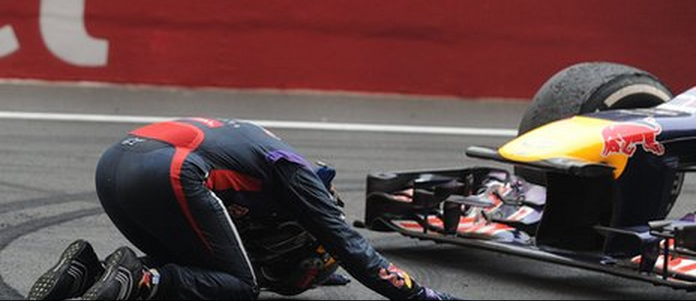
Vettel bows before his championship-winning Red Bull F1 car

Vettel bows before his championship-winning Red Bull F1 car

The role of technology is to make our lives easier.  To help us make better decisions.  To make us look good – and take that in any way you like.

Is it us or the systems? The more modest among us say: ‘Thanks, but we made a great investment in this software, I know how to get the best out of it, and it does all the work for me.” The less modest among us share only the middle clause in the quote.

The truth lies in the middle.  We have selected the right technology because we defined carefully what it needed to do for us. We took the time to learn how to use it properly and fine-tune it for our uses. We tried to be ruthlessly consistent with the inputs so that we could trust the conclusions we were making from the inputs. We tested, reviewed, tweaked and improved as we went. (Wo)man and machine, in perfect harmony.

Establishing exactly where in the middle the truth lies is really difficult.  It’s a constant source of debate in Formula 1 motor racing.

Talk about a deeply philosophical title.  I dread to think how many people will be drawn to the title on Google thinking they’ve stumbled on some astronomical treasure trove.

What I’m referring to here is how much time is wasted interacting with our fellow humans. Calling round to empty homes, voicemails, occupied signs, over-running meetings, traffic delays, busy signals. If only we could align ourselves better for the common good – and not pull rank or status to short cut getting to who we need – then we will all benefit.

Of course, with the human a particularly competitive race this is never going to become a reality, and I have touched on why this is the case in part in a previous post. The best we can do is consider who it is we’re trying to interact with and make it as easy as possible for them to do that with us, and so that they have a net benefit to reward their effort.

One thing is for sure: the connected economy is slowly but surely reducing inefficiencies, rounding off corners, and make our world less imperfect due to its economies of scale, its immediacy, and its convenience. And that can only be good.

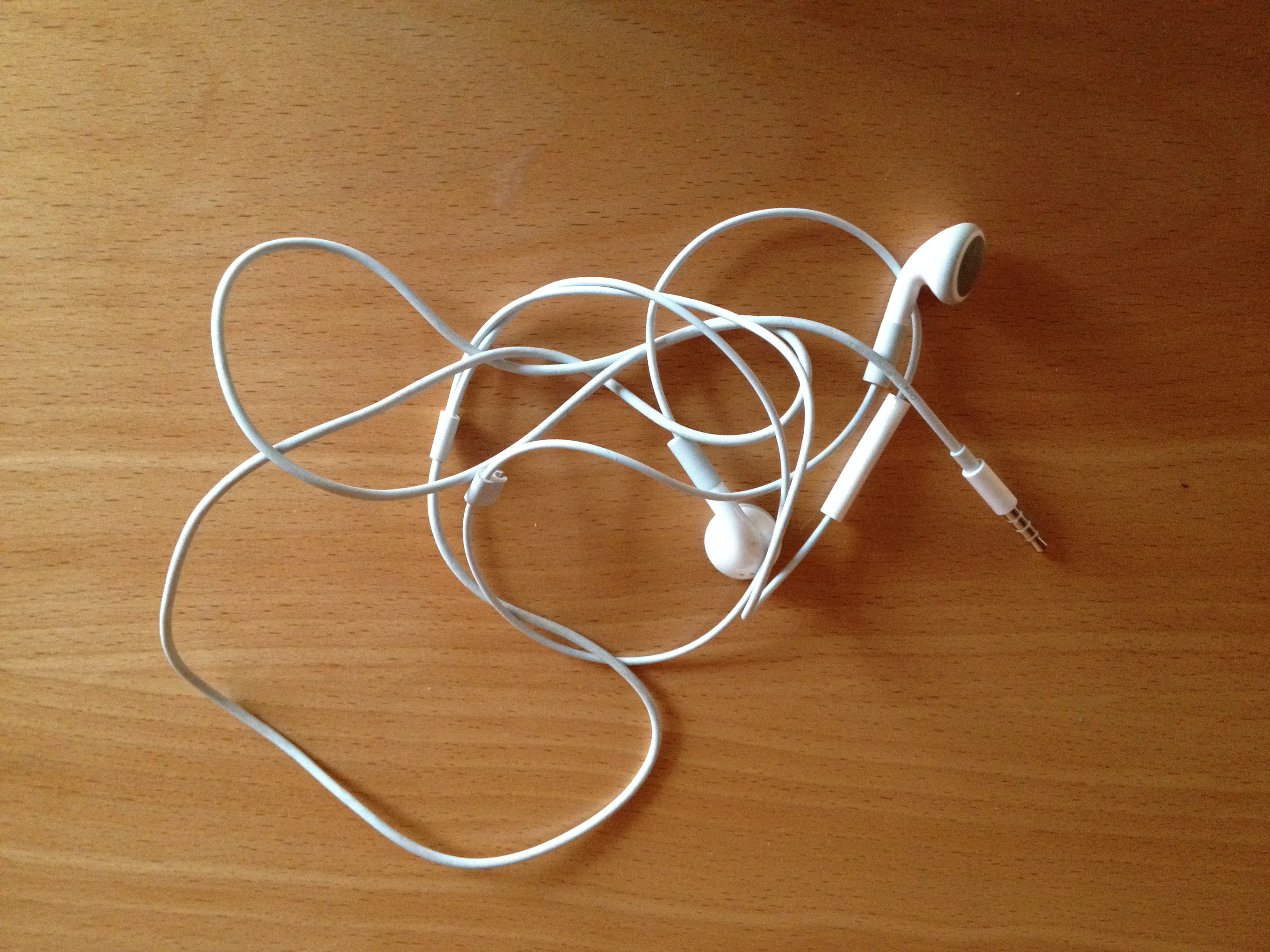
Tangled flex landscape

I’m as big a fan of beautifully engineered products as the next guy. I want to argue, however, that the device cable is part of the customer experience, part of the product, and needs some fairly urgent design attention.

I’ve a MacBook Air and an iPhone.  Not the latest versions of them, but pretty recent, let’s say the last 12 months. They’re lovely, and lovely to work with. The cable for my iphone has a mic, volume control, ear buds, all the usual stuff. So what’s the but, I hear you say? Well, it’s always getting tangled, and takes a while to get untangled, before I can use it, in that fiddly sort of way that inanimate objects have of turning me from mild-mannered man into raging psychopath in a matter of seconds.

If you calculated the total time lost globally from messing around getting cables and wires sorted, the productivity losses would be staggering. Yet it shouldn’t be that way.  I remember being round at a girlfriend’s apartment many moons ago, before cordless phones became mainstream, and marvelling at the cord on her telephone.  It was immense, and enabled her to potter round the sizeable apartment with the phone cradled between chin and shoulder. More impressive though, was that it had been engineered in some way to be tangle-proof.  It never got twisted up.

Even now with today’s phones you have to lift up the cord every once in a while and let the suspended handset helicopter itself back into a state of ‘untwistiness’.  Surely we shouldn’t have to put up with this nonsense in 2013? If the materials and the capability was there a quarter of a century ago, you can’t tell me it’s not important any more.

We need to start encouraging device makers to focus as much on the peripherals as the core device, as both contribute to the collective user experience.

I’m almost a week into my fourth Movember campaign. There’s always been something oddly horrifying about a moustache, at least in the last 20 years or so. You just don’t see them in business, and you almost never see the middle classes sporting one, which is probably the same thing.

The only colour you can get away with for a genuinely ‘free standing’ moustache is grey. Ideally you need also be a retired army colonel. Otherwise people look at you funny, or assume you’re from out of town, or both.

I’ll tell you what’s so attractive about the Movember campaign. It’s the easiest way to raise money. You simply don’t shave a particular area of your face for a month.  In fact, when you look at it that way, do you less work and you raise money. It certainly beats running a marathon.

You also get a certain frisson wearing a moustache in public, since you are effectively absolved – and even lauded – for looking ridiculous.

A few years ago I was getting ready for a sales meeting in London with a senior guy and a couple of colleagues.  It was mid-November and I decided the right thing to do was to shave it off for the meeting and start again mid-month.  My colleagues said ‘Hey, where’s your mo?’ When I explained, they were in adamant agreement that I should have left it on, as it would have been a good ice-breaker and isn’t that the whole idea of Movember anyway? They were right of course. You’re drawing attention to something you feel strongly about.

I’m off to think of a business idea that’s as easy as growing a muzzer for chiridee…

If you’re a healthy person trying to get fitter, or indeed an unhealthy person looking to get healthy – and you’re serious about it, I have one piece of advice for you.

Being in good shape is of course a complex blend of lifestyle, genetics, circumstances and so on. This is not the advice part by the way. Some of these things are beyond our control, but we can to a large extent get or stay in shape by managing our diet and exercise.

It seems to be that you need to do both. We’re subject to a basic calculation: calories in and calories out.  In that sense we’re a bit like cars, taking in fuel and using it up to do work.  The more we exercise, the more we can eat, put in an over-simplified way. If you burn less calories than you absorb, you gain weight.  If you burn more, you lose weight. You could do 100’s of sit-ups a week, but if you can’t cut out the rubbish, you won’t see the benefit.

Now I’m partial to rubbish. Very partial. Cakes, sweets, biscuits, chocolates – these are the 4 basis food groups as far as I’m concerned. Added to that, I’m not as sprightly as I used to be, and nor’s my metabolism. So this is only going to end one way if I’m not more careful.

Here’s where I get to my advice, which if course I already gave you in the heading. Keep a food diary. I have kept one for the last 5 years, recording in general terms what I’ve been eating. It’s not particularly scientific, but what I do find is that it helps me acknowledge exactly what I’m eating, and that for me is half the battle. If you ate 4 chocolate biscuits after your tofu salad, then record them. I also try to record how much water I drink (I can’t stand water; it’s an effort for me to drink it) as well as tea and coffee. Finally, I also record any exercise I do that’s more strenuous than a walk around the block.  Any day without any exercise is recorded as ‘Black Day’.

Recording exactly what you eat reminds you of exactly what you eat. When you’re monitoring it, you’re effectively measuring it. And as the business gurus will tell you, if you can measure it, you can manage it.

Most people will give you a recommended reading list, books they’ve read and think are worth you reading as well.

Here’s a list of 13 important books I wish could finish, not because they’re hard work but because I don’t have the time to get through them. I have at some point either started these books, or read a recommendation to read them. They all currently reside on my bedside table.

You’ll notice I describe them as important. I think I could make the time to read them, but they’re either very long, or they’re a complex, detailed read, or they present within them a challenge to me that I’m not ready to address yet. Here we go:

– The Intelligent Investor, by Benjamin Graham. One of the original – and still one of the best – books on how to invest wisely.

– The Golf of Your Dreams, by Bob Rotella. How to plan to improve your golf game by one of the sport’s great thinkers.

– Teach Your Child How to Think, by Edward de Bono. The creator of Lateral Thinking helps you get out of the ‘my child’s at school and that’s all the thinking s/he needs’ mindset

– D-Day – The Battle for Normandy, by Anthony Beevor. A super detailed and researched account of one of the key events shaping the second half of the twentieth century.

– Visions of England, by Roy Strong. How people historically viewed England through other people’s view of it, like in paintings.

– Seven Deadly Sins – My Pursuit of Lance Armstrong, by David Walsh. One of the ‘told you so’ books mopping up the aftermath of one of the largest bubbles to burst.

– Pick Four, by Seth Godin. Zig Ziglar’s legendary goals program, updated and simplified by his Lordship.

– 101 Irish Records You Must Hear Before You Die, by Tony Clayton-Lea. More of a ‘dip in and buy the album’ read.

– Dreams From My Father, by Barack Obama. Yep, you’ve probably already read it.

– Hurling – The Warrior Game, by Diarmuid O’Flynn. The definitive guide to one of Ireland’s two national games.

– Steve Jobs, by Walter Isaacson. Yep, you’ve probably already read it.

– The Calendar, by David Ewing Duncan. The authoritative account of how people have fought – and how we have taken for granted – to measure the passage of time, which I also touch on here.

– How to Win Friends and Influence People, by Dale Carnegie. The word ‘seminal’ is overused, but certainly justified here.

Yes, I know, it is a pretty robust bedside table.