Archives for category: Customers

How good are your sales people? How do they manage the sales opportunities and their existing accounts? You won’t be surprised to know that sales people need skills for the whole customer journey.

Here are the first 12 aspects that come to mind when selling to a new customer:

  • How they prospect
  • How they qualify
  • How they prepare
  • How they manage the calls, meetings, presentations and demonstrations
  • How they challenge the customer and manage objections
  • How they strategise on the opportunity and the competition
  • How they navigate the customer organisation
  • How they stay focused
  • How they win the customer
  • How they negotiate
  • How they close
  • How they hand over to implementation, support and account management

Within account management, the business of selling to existing customers, another half dozen aspects emerge:

  • How they grow the account
  • How they ask for referrals within the customer’s business and outside it
  • How they make the customer an advocate for the organisation
  • How they renew the customer’s business
  • How they do account planning for their key accounts
  • How they do account planning for their other accounts

Command of these different areas corresponds directly to the trust that the sales person establishes with their customers and the esteem with which they are held in the organisation and their industry.
Brand is the summation of everything we feel when we come into contact with an organisation, a product, a service or even a person. It’s a function of what we, see, hear, feel and consume. As such, brand is more than a logo. It is everything that helps form the customer or stakeholder experience. It manifests itself in its people, its products and services, and its interactions with you, the customer.

Profile is a function of how the brand is packaged and presented to the public domain. Public relations departments and agencies are responsible for managing and controlling profile in a way that’s consistent with the organisation’s mission. Here are a few things you should think about if you’re planning a launch or refresh of your brand and profile in the marketplace:

  • The vision for your organisation
  • Your mission to get you there
  • Your visual identity and accompanying strapline
  • The design guidelines around your identity and its products, services, promotional materials and documentation
  • Your current profile
  • Your desired profile
  • The activities you need to have in place to achieve your desired profile
  • Budget and timeframes for executing on the plan

This is also a great shopping list to take with you when working with a brand or image expert.

I carried out a detailed study in pubic transport the other day. Actually, it wasn’t that detailed, it was a data point of one, one journey.

I went to visit my mother, who lives near Bristol in England. I live near in Galway in Ireland. It’s perhaps 300 miles as the crow flies, if even a crow can fly that far, except that there’s the Irish Sea in the way.

I had decided to go via public transport, rather than a car. Normally I would drive to the departing airport and hire a car from the destination airport. The public transport option was cheaper and better for the planet. It would simply cost more of my time, a very precious commodity as far as I’m concerned, but there you go.

These were the legs of the journey:

  • Walk to local train station, 10 minutes
  • Train to Galway, arriving 45 minutes before coach trip to airport
  • Coach from train station to airport, supposed to take 95 minutes, but took nearer 120
  • Arrived at departing airport 2 hours before flight
  • Flight to Bristol airport (1 hour)
  • Bus to Bristol city centre (wait 10 mins, 30 minutes journey)
  • Bus to my mother’s neck of the woods (no wait, 45 minutes journey)
  • 10 minute walk to mother’s house

Total elapsed time via public transport: 10 hours exactly

Total elapsed time if I was driving both ends: around 5 hours

I think 10 hours is far too much to travel from one neighbouring country to another. So do most other people I guess, judging by the amount of people who, if they have access to a car, take one.


It’s the start of a new half year! Where better to begin than with the job of figuring out what makes your ideal buyer tick? A customer or buyer persona is a collection of the characteristics common to buyer types in your target organisation. Figuring out your personas allows you to market to many like-minded individuals with the same messaging. This is in stark contrast to when you have a specific customer in mind – effectively a market of one organisation – because then you can message directly to that person, rather than to the persona construct.

Crucially, there may be more than one buyer persona you need to engage with in your target customer: lifestyle people; money-makers, corporate ladder-climbers; business heads, finance people, procurement. These personas may well fulfil multiple or different roles in the decision-making unit of your target organisation: decision-makers, budget-holders, influencers, users, and other staff.

You should gear all of your marketing and messaging to your personas, and adapt it to each persona. Framing your personas comes from research, which might be based on quantitative or qualitative information. Where to go for that information? It’s what you already know, it can come from interviews, calls, or meetings, from your sales teams, or from your customer database.

I’ve found the following list of headings to be useful when building a persona:

  • About them: gender, age profile, education, family, job role, experience?
  • Personality: approachable or aloof, prefers emails to calls, passionate, dispassionate?
  • Goals: commercial, personal, emotional?
  • Challenges: resources, politics, regulation, competition?
  • Hangouts: where do they go for their information? Websites, social media? You need to be where they are…
  • What can you do for them? Help them hit which goals, meet which challenges, be recognised?
  • Objections: what might stop them working with you? Time-pressured? Locked in to a supplier?
  • Message: how might you best message to them? Productivity, growth, compliance, morale?

Giving each persona a name, even a picture, and hanging their profile on a wall will keep them front and centre.

Sample customer journey

A sample customer journey

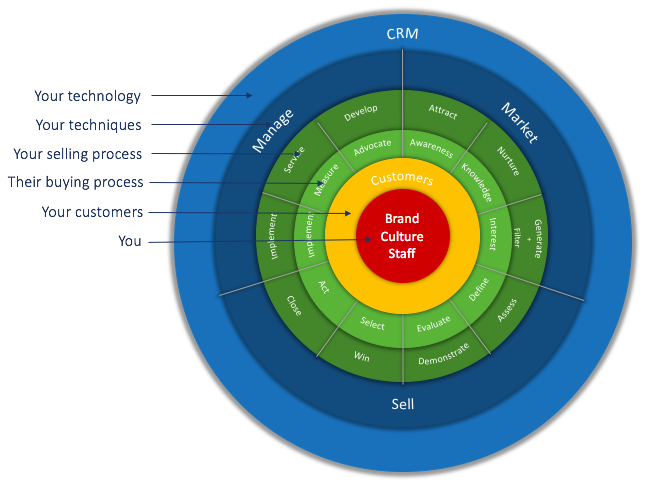
Great sales and marketing execution starts with strategy, defining the ideal customer journey from prospect through to delighted customer advocate, and then mapping your own selling organisation’s processes to that journey.

You can think about optimising your organisation for the ideal customer journey as a function of 3 things. It’s about people, process and ‘tech’. It all starts with your people at the centre, as they are the living, breathing caretakers of your culture and brand. If you have great people, they will acquire and take care of great customers.

Your target customers have a staged process they will want to follow to evaluate, invest in and hopefully review your offerings. You need to understand this, define it, and get some friendly customers to validate it for you. You need to design your own process stages around this 360-degree customer view. Finally, you need your marketing, sales and management techniques to deliver on this process, all of which you embed in your CRM technology, which becomes your online manual, reporting mechanism and data record for the various customer journeys happening all the time.

I find this diagram useful because it puts people at the middle of the picture and gets organisations thinking about the resources, activities and skills they need in place to manage the lifecycle of their target customers.

Are you in the 90% or the 10%? 90% of the organisations I’ve worked with were focused on their organisation and their products and services. In their calls, meetings and presentations they led with themselves and what they do. This is the wrong way round. Your prospects and customers are not interested in you, or what they do. They are interested in solving their problems and capitalising on their opportunities. What’s in for them? That’s your guiding star. When you start with yourself, it’s too hard for them to see the return on this investment of their time.

10% of organisations are market-led. Everything they do stems from the markets they’re serving and the target customers they’re trying to sell to. They earn the right to tell customers about themselves once they have demonstrated their knowledge of the market and their experience making similar organisations more successful. They lead with the market and the customer, and follow up with why they make organisations better. In their calls, meetings and presentations they start with their customers, and finish with themselves and how they can make the difference.

Customers are organisations filled with people like you and me. How you define and segment your market, your organisation’s business model and its routes to market are governed by the personas or specific people you’re targeting. They drive everything you do and you must maintain this mind-set – and stay in the 10% – to stay close to why your organisation exists.

The TLA – the three letter acronym which of course is itself a TLA – is shorthand, jargon that we can use in good ways and bad ways. It saves us time and effort, but is also something to hide behind and can exclude others.

I think how we use the term TLA varies between the spoken and written word. If the first letter of the TLA starts with a vowel sound, and is a consonant like the F of FAQ, we’re more likely to say ‘an FAQ’ when we’re talking. It’s easier and sounds better.

If we use a TLA in the written word, like in a report, then we’re likely not to use ‘an’ before a vowel-sounding TLA, as in ‘If you have a FAQ, please consult the FAQ section.’ Or are we?

This is where it gets ambiguous, when you’re in the realm of email, which is kind of written but kind of spoken too, or at least is the chattier form of the written word.

Essentially you as the writer are signalling to the reader whether you want them to read it as a TLA in their head or read it as the expanded phrase the TLA refers to. For example, the other day I received an emailed that closed with ‘… a MNC’, where MNC is a multinational company. For me the reader wants me to think ‘a multinational company’. If he had written an MNC, I think he would want me to think MNC, which also means multinational company.

Geddit? Too deep? Neither relevant nor interesting? To answer the title of the post, if you want your vowel-sounding TLA to be read as a TLA, use the ‘an’, otherwise don’t.

Then there’s the vowel-sounding TLA which begins with an actual vowel, like an OTC drug, which is a whole lot easier!

In this last post in the series on scaling a business, we look at the checklist of ’10 Rockefeller habits’. Once more I borrow from the Growth Institute in this fascinating piece on how the 10 habits of the fabled businessman are the only framework you need to scale your business.

Working from the principle that success comes from the combination of goals and discipline, and you must have both, rather like strategy and execution, the article provides a detailed description of the 10-item Rockefeller habits checklist, which I summarise here:

  1. The executive team is healthy and aligned
  2. Everyone is aligned with the #1 thing that needs to be accomplished this quarter to move the company forward
  3. Communication rhythm is established and information moves through the organisation quickly
  4. Every facet of the organisation has a person assigned with accountability for ensuring goals are met
  5. Ongoing employee input is collected to identify obstacles and opportunities
  6. Reporting and analysis of customer feedback data is as frequent and accurate as financial data
  7. Core values and purpose are “alive” in the organisation
  8. Employees can articulate the key components of the company’s strategy accurately
  9. All employees can answer quantitatively whether they had a good day or week
  10. The company’s plans and performance are visible to everyone

These habits only truly come alive when you read the narrative and case studies that amplify them, so refer to here for the valuable detail. You’ll get the how to implement and who should implement that will send you on your way to scaling a business successfully.


This post continues the series on scaling a business, this time defining the exponential organisation. An exponential organisation is a company that scales rather than grows. In other words it grows at an exponential rate – d’oh!

Jacob Morgan covers how to create an exponential organisation and why you would want to in this excellent piece. He leans heavily on the work of the innovator Samil Ismail, one of those lucky souls who can find his first name in his last name…

Ismail’s research into exponential organisations leads him to identify ten commonalities in companies successfully hitting the stratosphere.  Five factors are external, and five are internal.

The five external factors equal the word SCALE:

  • S, staff on demand
  • C, community and crowd
  • A, algorithms
  • L, leased assets
  • E, engagement

The five internal factors spell the word IDEAS:

  • I, interfaces
  • D, dashboard
  • E, experimentation
  • A, autonomy
  • S, social

To find out more about each factor, and what combination of them would suit your ambitions, have a deeper look at the article.


In this second in the series of posts exploring scaling the business, let’s look the differences between growing the business versus scaling the business. What better source of authoritative information than this piece from the Growth Institute.

There are some fantastic insights in this piece. Here are just three of them:

  • Companies that scale successfully don’t set out to grow their business, they build it for scale from the outset
  • A scaling company grows at twice the industry average but its expenses are roughly the same
  • When I was at business school, a company’s growth was a series of steps, where you go through a plateau period before you slingshot up the next level. Nowadays the scaling curve is a series of ‘valleys of death’ through which each company must pass in order to dominate its industry

The Growth Institute identifies four scaling stages:

The percentages of companies that make it through each of these stages are horrifically small, so if you’ve got scale-up ambitions it’s important to go in eyes wide open, and also read the Growth Institute piece, and the ‘how to navigate’ guide, in more detail.