Archives for category: Customers

Does anyone read any long articles on the web these days?

Me, I love reading books. I like reading thrillers and crime stuff last thing at night before I turn out the light. These are physical books too, with the added thrills to the senses of smell and turning real pages.

I’m only just getting used to reading books electronically. This is in part because a couple of friends have taken the self-publishing plunge and opted for Kindle only, so otherwise I wouldn’t get the chance. In part it’s also because my screen-based reading habits have changed.

Don’t get me wrong, I still read long documents for work, but I don’t read long articles on the web any more. I prefer to read small, pithy stuff and when I see web content that looks long, I give it a skip, or else try and glean the high points.

It’s also why I prefer to blog in small chunks, rather than those who only blog about once a week or fortnight and it’s a War and Peace job. Who has time for that these days? Who has the attention span for it?

The web is primarily for us to glean information, knowledge or insight, and for that we want it immediately, authoritatively and expeditiously.


I wrote in a previous post about the differences between writing for the US and UK markets. Of course, an increasingly popular medium for marketeers is the movie, where the verbal side of the equation – as opposed to the written – comes to the fore.

Those of you in sales will have of course wrestled with the verbal side of accents, be they regional, national or spoken as a second language, from the wealth of face-to-face meetings you’ve had. Getting on with someone verbally is the ‘sine qua non’ of sales success.

As consumers and business-to-business people we’re well used to forming an opinion of someone from their voice and they way they use it, and this is arguably more important in the movie medium where often, in the case of voiceovers, you can hear the person but not see them.

Again, as with writing, it’s important to figure out what your key market is, and how disposed they are to either a regional accent, a domestic accent or a non-domestic one. Statistically speaking, some accents have more of an allure, a cachet, and some are a turn-off. It is what it is.

One of the companies I worked for considered the US its major market and the UK its secondary market. It produced collateral that favoured the US format, spelling and phrasing. For one of its more prestigious videos, it adopted a ‘mid-atlantic’ accent developed with a professional (and quite well-known) actor. Compromise which pleases no-one or sensible one-accent-fits-all approach? It depends, of course :-).

“Two countries separated by a common language.” This well-known phrase, attributed to quite a few people, is not really an issue, at least to this writer, who has spent a few years writing business content for the UK and US markets.

A few key points will serve you well when it comes to writing for other markets who speak a version of English. Firstly, you should decide whether you are going to maintain two discrete versions of your content: two different websites, two youtube channels, two versions of collateral for each piece of content, and so on. I’ve worked for some companies that kept two versions, and other companies who simply decided which was their main market and wrote one version of everything which favoured that market. A third way is to settle on a ‘MidAtlantic’ version which takes from both, as long as it does so consistently. It depends on the relative importance of the markets and how ‘precious’ your audiences are about content which they feel is commoditised and does not put them first.

Secondly, formats. As is often the case with formats and measurements, the US and UK have gone down different directions with their formats. UK A4 is 297mm by 210mm, whereas US Letter is 11 inches by 8 1/2 inches. This makes US letter a bit shorter and fatter than its UK counterpart. I didn’t realise this until I was doing my MBA in the US and printed off copies of my resume for the MBA office files and they wouldn’t fit properly in the filing cabinets. This is also true of digital versions of all your content. So if you live by downloadable pdf documents, then you need to make a call on format size, or else incur the ire of those people who try and print them, only to find they don’t fit so good.

Thirdly, and perhaps most obviously, spelling and vocabulary vary between the two tongues. I won’t go into exhaustive detail here, but I’m sure you’re aware that in the US the ‘favoured’ from the second paragraph of this post would be minus the ‘u’. Also, the US tend to go in for a lot of ‘ization’, so the realization should set in early that you need to watch this area too. Then there are the much more nuanced differences. For example, one would tend to write ‘despatch’ in the UK, but ‘dispatch’ in the US, ‘programme’ in the UK and ‘program’ in the US. Vocabulary is more standardised for business, with us following the US lead, but common or garden situations can still trip you up, with hood vs bonnet, trunk vs boot, retainer vs braces, suspenders vs braces and garter vs suspenders, to use some examples from cars – Americans, read automobiles! – and personal appearance.

Fourthly, phrasing. This is the area that can catch you out if even if you have good familiarity with what I’ve included so far. This is the kind of knowledge you pick up over time, by making mistakes, or by osmosis, or by sensibly looking for feedback from your US colleagues on your drafts – and even we in the UK write drafts over draughts these days. In the US, one would probably say ‘when are you going to write me?’, eschewing the preposition beloved of the folks across the water. Furthermore, if you wrote ‘our software has built-in intelligence’ in the UK, a US audience would expect to write and read ‘our software has in-built intelligence.’ Finally on this, the US audience has a slightly more relaxed acquaintance with adverbs, so at the end of paragraph three a UK person would write ‘so well’ over ‘so good’, wheres a US person might consider themselves ‘real smart’ rather than ‘really smart’.

You can’t really do justice to a subject so vast in one post, especially since I’ve not even mentioned writing styles and we’ve barely scratched the surface of the other areas, so perhaps we’ll return to this another time.

That’s my view, period, I mean full stop, oh never mind…

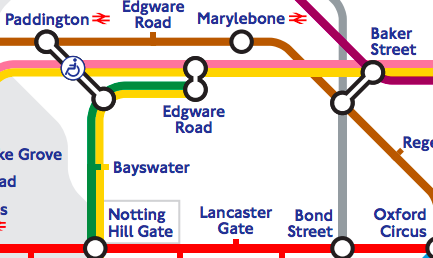
Snippet of the London Underground map

London Underground map

I’m rather enjoying this trip down memory lane, revisiting some of the interesting things I remember from my graphic design days, though I was always more of a ‘suit’ than a ‘roll neck’. I hope you are too, because I’m about to continue in this vein.

One of the great things about typography is the detail. We take the printed word and fonts for granted, so much so that we forget that someone very gifted actually invented each of them, drawing each letter out, labouring over every contour and fighting for them to get popular so that printers would design the blocks to print stuff using them.

One such someone was Eric Gill, a superb artist and – as it has emerged many years after his death – a complex, pretty disturbed individual. He did, however, give his talents and his name to one of the most recognisable typefaces around. You see, the eponymous Gill Sans typeface is the one used to this day on the London Underground, an infrastructure and system so brilliantly signposted and easy to follow that you’re only reminded of this when you try and navigate the systems of other world cities. It was also adopted by many of the UK regional railway bodies and graced advertising posters up and down the country for generations.

A long time ago, I wrote a corporate brochure using the Leitmotif of ‘renowned art’. As well as a Henry Moore statue, the Chrysler Building and a few others, I also featured Mr Gill and his Gill Sans typeface. Worthy company for an inspirational typeface I think.

Speak of graphic design, there are some handy words from the world of typography that are good to know if you are in any way responsible for marketing end products like websites or brochures. Design used to be this black art that creative types used to jealously guard like masons. Now, with the advent of technology, everyone can turn their hand to design and everyone in turn can contribute to the creative process.

First, the typeface. Typeface means the same as font as far as I’m concerned. The typeface is the generic family of font style used for letters. For example, Arial is a typeface and you can have variations of it, like bold, italic, and so on. OK, that was easy.

Next, we have pointsize, or more accurately, point size. Otherwise known as – yes, you’ve guessed it – font size, the pointsize is the size of the typeface measured in the number of points high, a point being kind of a full stop. So, standard document lettering might be Arial regular, 12-point, for example.

When you get a bunch of letters forming a paragraph, then you have more choice around how you present those letters, for visual attractiveness or readability. For example, how close together should the letters be together, horizontally or vertically?

The leading is the distance between the lines, or more accurately the between the bottoms of the lines. It has the similar effect to the ‘line spacing’ in Microsoft® Word, so the greater your leading, the more white space between your lines and the more readable and less dense it it. The word is pronouncing ‘ledding’ and harks back to the heavily metallic engineering days of printing. A designer is able to adjust the leading by minute amounts using design software, which can often buy an extra line on a page to help with layout.

Finally, and most obscurely in today’s post, we have kerning. Kerning is the spacing between the letters. Again, this allows the designer to cheat slightly by adjusting the kerning in a few words to avoid unsightly widows or orphans.

Handy, eh?


Graphic design is the art of making stuff look good with images, text and the use of the areas around the images and text, ie nothing. I worked for a number of years in a marketing and design agency and acquired a considerable respect for the craft of the designer.

I am a writer. The text part is my thing.  I am not a designer and I will always defer to a designer to concentrate on what they do best, which is the presentation of my content. I also have a degree of awareness about design, so there are a few things I’d like to share with you that will go some way to making the text look better in your important documents like collateral and proposals, without necessarily changing the content.

First of all, widows and orphans. A widow is a single word that appears on its own on the last line when your paragraph is laid out. It doesn’t look good. Do what you can to avoid widows by editing your ‘para’, up or down. An orphan is when the single word at the end of your para is stranded on its own at the beginning of the next page. It looks worse than a widow and you should remedy it as you would remedy a widow.

Secondly, use ‘white space’ wherever you can. White space is the areas around your paras and your text. It is your friend and lets your content breathe, makes it look better, makes it more readable and increases the chances of someone reading it and acting on what you want them to act on. Use white space liberally, more is definitely more here.

Thirdly, typefaces, otherwise known as fonts. There are hundreds of different typefaces, but two ‘families’ of typefaces. One is called ‘serif’, where the ends of the letters are pointy. It’s more traditional looking and is suited to long form content like documents, newspapers, magazines, brochures and books. The other is called ‘sans serif’ and being without the pointy bits is more blocky, modern-looking and better suited to headings and short form content. You’re reading sans serif right now. It works nicely to have some variety and use both types in your longer documents, typically with the headings a particular sans serif and the body of content a particular serif.

Fourthly, be ruthlessly consistent in your hierarchy of headings. Make sure your main headings are all the same style and size, your sub-headings are all the same style and size (but a different style and size to your main headings) and so on down to your para headings. Headings signpost your reader through your ‘doc’ and there are few things more frustrating than getting lost in a document.

I realise I’m taking subjects that would fill shelves of books and reducing them to a few paras. That said, a little awareness can goes a long way, which is the purpose of this post.

Caveat no.2: you will see widows in my blog posts. Blogging is an altogether more casual medium, rather like email, so don’t get too hung up on them for your less formal forms of communication.

That’s what they say about imitation and me too products: the sincerest form of flattery.

I’m sure it rankles with the pioneers in a category when the giant comes in second with the massive resources and does it cheaper, better and more effectively. There has long between tension between the western markets who have laws in place to protect certain forms of imitation, copying and plagiarism, and the eastern markets where copying is considered normal. ‘Oh, we’re not copying your product, we’re improving it.’

I’ve noticed this tactic become much more prevalent with the German supermarket giants Lidl and Aldi, or Lidly Aldi as they’re sometimes rather hilariously known in Irish musical wag circles. They take a well known product and either call it exactly the same name, like Fruit & Fibre cereal of Kellogg’s fame, or make a very small adjustment so that you’re in no doubt as to what they’re ripping off, then sell it for about half the price of the branded version.

There are lots of examples of these marginally renamed products, but the one that sticks in my mind is the branded Angel’s Delight, that lovely fluffy dessert from our childhood, renamed in a German stylee as Heavenly Delight, with packaging so redolent of the pioneer product you wonder how on earth they get away with it.

What always strikes me as amusing though is that Lidl and Aldi are themselves, for me, completely interchangeable. I can never remember which one is which, which one I’m in when I’m in it and whose product is whose. It’s like the scene from Love Actually where the Bill Nighy character is interviewed by Ant & Dec, and replies to them as ‘Ant or Dec.’

They don’t really imitate each other. They are practically the same. Watch the song in the link above and you’ll empathise.

There is one type of thing in business where it’s good to see the words ‘religiously’ and ‘vicariously’ in the same sentence.

Normally they might be words of questionable credibility. After all, ‘religiousness’ can sometimes be confused with over zealousness, fanaticism even. Then there’s the notion of living through someone else, like you sometimes hear being levelled at a parent who ‘lives vicariously through her daughter’s sporting achievements’, for example.

When it comes to marketing, however, especially areas of digital marketing like email marketing and web marketing, where conversions via landing pages or listing pages are what counts, there’s an excuse for both the religious and the vicarious. And that excuse is testing.

If you’re lucky enough to be in a volume business where you can see immediately the effects of a change in the customer journey, then you can test practically everything. The subject lines, lengths, action buttons and calls to action of your emails. The headings, processes and wording on your landing pages, product pages, listing pages and detail pages.

All your testing should be through the eyes of your customers, living the awareness-interest-decision-action journey through them, hence the vicarious part.

This is where ‘a/b’ testing comes into its own, where you can test 2 different versions of something like a heading, leave everything the same and see what the response or conversion is like. You can a/b test relentlessly on every element of your communication until you’re happy it’s as good as it can be, by which time you’re probably onto your next communication.

If you’re not in a volume business, then your results can be slower to come around and are not always statistically significant. Your testing has to be more anecdotal, more qualitative. But it can still be regular and rigorous.

Testing is like voting in corrupt countries. Test early and test often. Your business will thank you for it.

In a previous post I talked about the Leitmotiv, the guiding theme or concept that can help be the glue for the persuasive story you’re trying to tell.

The one thing you need to guard against with the Leitmotiv is excess. When your theme tries too hard, or is too clever for its own good, it detracts from your message rather than reinforcing it, and you don’t want that.

A good way to tell if you’re stretching things too much is if your reader has to work too hard to see the link between your theme and your message. If the link is lost, your objective is lost too. I saw this recently with some excellent copywriting done on a brochure. The Leitmotiv was a good one, it was a musical one, using the idea of a conductor who coordinates all the different elements of an orchestra into something beautiful.

The tone was good, but the language was too musical, too specialist, and so the link was lost. Toning down the language – if you pardon the pun – reestablished the link and made it more powerful.

As with many things, it was about getting the balance right, the fit right. Make sure your Leitmotif gets it right too.