Archives for posts with tag: time

A sense of urgency is the secret weapon of the self-starter. A self-starter adopts a sense of urgency because he or she understands that time is the most precious commodity, and wasted time can never be won back.

I try to instil this in my kids, with almost unwaveringly poor results. Whenever they’re asked to do anything around the house, or to get ready for school, they seem to head into a neutral gear, returning the aside I made to them once: ‘yes Dad, I’m on a sponsored go slow…’ They don’t buy into the concept of the sooner you start something and the quicker you do it, the quicker you can get onto something else. Either that, or they fly through jobs in a slap-dash fashion that necessitates a rework and the accompanying retort: ‘if only you’d done it right the first time, you’d be done by now…’

It’s all about balance. A sense of urgency – in work or play – combined with the right level of quality gets things done in the most effective way. Emptying a dishwasher, putting everything in the right place with no breakages and a sense of urgency gets the job done correctly in the least amount of time. This sense of urgency, using the dishwasher example, pushes us to group items for the same cupboard or shelf into one trip, so that we minimise aggregate journey time.

Of course, I’m not suggesting we fly around our daily work and house tasks like people possessed all day. Everyone needs downtime. Don’t get me wrong, I love to relax, and taking time out from work and play is key. But you can still relax well, relax effectively :-).

‘Yep, give me 2 minutes, I’ll be right with you.’

Except that it never is 2 minutes. In Ireland, a couple minutes really does mean somewhere between 2 and 7, since the Irish world ‘cupla’ means ‘few’. When an Irish person says I’ll be a coupla minutes, you know what – and when – they mean.

In England we don’t have that luxury, so when someone says two minutes, or a couple of minutes, or 2 seconds, or 2 ticks, they never mean that, which is frustrating to the recipient because you feel like something else is more important than you, and you’re being put off because your priority is not theirs, when sometimes you need them for 10 seconds.

I used to work for a guy who made a point of being over precise in his expectation setting. He would say things like, ‘I’ll come back to you in 17 minutes,’ ‘I’ll be back at the hotel in 12 minutes, please order me a Cab Sauv.’ or such like. When he said it there was a hint of irony, but it served a useful purpose. More often than not he was there within a minute of the expected time he’d set. He would especially do this if he knew or picked up that you were pressured with one of your own priorities.

And do you know what? The useful purpose this ploy served was that it helped you, in turn, manage your time better.

It’s not always possible in the heat of battle, but it really helps others when you set a clear idea of when you’re available for someone who needs you. And if you can beat that time, thereby over-delivering on your promise, everybody wins.

Hindsight is a wonderful thing, or so they say. What seemed so unfathomable before it happened is the blindingly obvious conclusion now that it’s happened. And don’t we just love it when people say ‘well I could have told you that would happen.’?

Here’s my take on this. When we look at what happened with the benefit of hindsight, we see a linear connection of causal events. It’s a straight line going backwards.

When we’re faced with what’s about to happen, it’s not linear. It’s multi-linear. It can go a number of ways, and it’s unclear which way will turn out best for us. Maybe all of them will, maybe some, maybe even none. The multiplicity of choices we face with every passing second is the constant. We’re lucky we have the freedom and the intelligence to make them.

We’ll always have hindsight, and sometimes we feel like we have insight and even a bit of foresight. But you can’t turn time back and give it another go. With every fresh project you have to keep moving forward. Consider the information, make your best decision, and go.

Those of you who subscribe to my posts and who have a good memory – already that feels like a tiny subset of our sentient race – will know that I’m a big fan of Parkinson’s Law, which states that works expands to fill the time available.

There’s also the uniquely British cock-up theory, which generally attributes things going wrong to a combination of happenstance and plain old human error. My good friend Gaz is a firm believer in the theory and indeed you can argue that some major – not to say seismic – events are the result of what might more euphemistically be called Hanlon’s Razor, or as the Americans would say, “stuff happens.”

This leads me on to suggest that there might perhaps be a variant or additional tenet to Parkinson’s Law, which goes as follows.

“The closer one gets to a deadline for the completion of work, the higher the probability of something going wrong.”

This I believe to be an inescapable truth. As we approach the finishing line for a piece of work, the chance of something going askew – the printer not working, the Internet connection dropping, the mobile signal flaking, the application crashing, a key person we need to reach urgently to confirm or approve something being unavailable – seems to increase exponentially.

What is it, that that causes this phenomenon? Is it simply the case that, as we approach the end of something, and attempt to bring all of the disparate elements or threads together, those threads get caught up in knots?

Greater people than I have wrestled with this problem, I’m sure, and come up with much more convincing explanations than I ever could. Nevertheless, I think it has real validity for us all.


Of all the laws and sayings that govern the world of work and play, I think it’s Parkinson’s Law that resonates the most with me.

‘Work expands to fill the time available for its completion,’ or words to that effect. It occurs to me that it also contracts to fit the time available for completion as well.

I was reminded of this recently when a project that had been running for months and had a deadline of 11:59pm on a Friday used up literally all its available time, and a few minutes the other side of the watershed too. We were in good shape mid-week, then a few extra review rounds got wedged in, and before you knew it we were under the gun.

The key thing is this: nothing’s perfect, ever. You can always find another tweak, something that constitutes a micro-improvement. This is especially true of a long, detailed document. The possibilities for a typo, a punctuation error or a stylistic inconsistency are limitless.

Which is why we have deadlines, why we impose limits.

You always have to do your best work, nor settle for mediocre. But, you gotta stop at some point.


Those of you who follow or stumble upon this blog from time to time – future pun intended – will know that I’m often going on about what a precious resource time is. The most precious resource there is in my opinion. Here is a previous post on the subject.

Even two thousand years ago when the pace of life must have been a little slower, despite the drastically shorter life expectancy, those Romans knew a thing or two when they said ‘tempus fugit.’ We generally translate this as ‘time flies’.

Except that the truer translation is actually ‘time flees’, which gives a much better sense of how the resource disappears. It escapes, it runs away from us. It can’t get away fast enough.

That’s why we must work hard to make the most of it, not to waste it. That doesn’t mean we shouldn’t enjoy some free time. Far from it in fact. Ever noticed how much faster time seems to pass when you’re having fun? Do you want to be miserable so it goes slower?

Most meetings over-run. Why is that? Two reasons spring to mind. Firstly, they’re not properly managed. Secondly, we always try and pack way too much into them.

It’s not just meetings, it’s the same with presentations, anything involving an agenda, business or travel itinerary. We get too ambitious, want to cover too much and we don’t allow enough time for each item. As I’m fond of saying, we’re trying to stuff 10 pounds of dung into a 5 pound bag, with ugly and unsatisfying results.

Sometimes we deal with an item more quickly than we thought we would, but more often than not we take longer than we planned. It’s human nature, we’re social beings. With a modest amount of experience you can see straight away if an agenda is going to over-run, it’s not rocket science. I like to allow more time than I think I need for a meeting, because then I aim to finish early and give people some of their day back, rather than the other way with most meetings. It’s the temporal equivalent of under-promising and over-delivering. Then you start to garner a reputation as someone who can properly manage meetings. “I’ll go to his meeting, I’ll get something out of it and I won’t be chasing my tail for the rest of the day.”

It’s all about finding the right productivity balance between an agenda that’s too long, and one that’s too short, which then becomes prey to Parkinson’s Law. In my view though, it’s better to have a meeting with a light agenda where you get some useful discussion and some firm decisions, over a heavy agenda where you end up having to park everything and the time invested is wasted.

I wrote recently about the so-called Circle of Life, and how it relates to our working lives in a ‘cradle to grave’ stylee.

It occurs to me that within this ‘macro’ trend there are lots of mini cycles, rather like an agile development flow if you’re from a software background.

These cycles can be weekly, monthly, yearly or pretty much any length, but before you know it they link up into a mega trend that defines us.

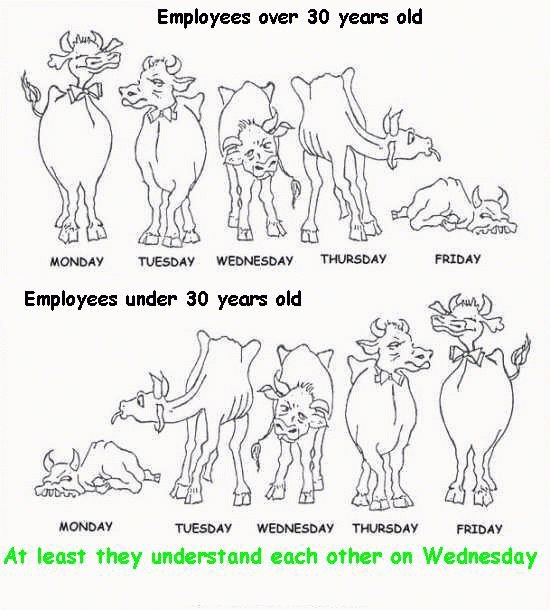
Here’s an image which pretty well sums up the converse ebbs and flow of the working week for younger and older workers. I hope you can relate to it 🙂

I must admit to a certain frisson of pleasure at the closing of things. Mundane, inconsequential things.

Let me give you examples. That feeling when you load up the dishwasher – surely the single greatest invention of all time – put the cleaning tab in, hit the ‘on’ button and close up the lid. So satisfying.

It’s same when you close the heated oven door after carefully preparing your dish for cooking. Here’s two more for you: Closing and locking the house front door at the end of a day, ideally a Friday, when everyone’s home, last thing at night. Closing the car door when all the family is inside after a long walk somewhere, ready for the drive home.

I know, the last ones have serious womb syndrome about them, but you see parallels in the working world. Submitting that final report, either paper-based or electronically, is a rush too. Signing off on an initiative, a project, a job even, come on, you must feel it too. Sales people – closing a deal! How good is that feeling?!

Perhaps the ultimate work-related frisson of closure is the day you fully retire, as long as what you have lined up after it is better. This post harks back to a recent post about the circle of life, which makes them both all the more valid I think.

The circle of life has a truth and completeness about it. We come into the world, we need help, support, guidance so that we can learn the ropes and participate as independent people, until its our own turn to do the same for the next generation.

Then we gradually fizzle out and eventually reach a similar stage of dependence on others, until we exit, stage left.

This got me thinking about our working lives as well, how we start not knowing anything – about a new career, new job, new company and their products and services – reliant on others to show us the way, give us the knowledge and the inside track until we can work alone, be trusted, and contribute productively.

My rule of thumb was 12 months. I felt it was a full 12 months before people were genuinely up to speed and actively leading or contributing. Then their experience of having seen a full 4 quarters play out allows them to build on the previous calendar year and improve the business. Some people think that after the second period of 12 months you start to stagnate and should move to a fresh challenge, but that has always seemed premature to me. Sure, I’ll give a new career or move 2 years, but will stay longer if I’m enjoying it and enhancing the business.

We improve as working individuals and start to climb the corporate ladder in our 30’s and 40’s, but does there come a time when we start to lose our creativity and the well starts to run dry? Do we step back a little and look to the next wave of high achievers to come up with the fresh ideas that we can help execute and bring to fruition?

I think there’s some truth to it, but conversely there are plenty of people making huge contributions well into their 6th decade of working, and a good proportion of them are at the very top of their profession, and their company.

The body may weaken over time, but the mind, the experience, and the ability to delegate the heavy lifting – literally and figuratively – to others goes the other way. As long as we have the mental energy and the curious mind to go with it.