Why do people blog? There must be a myriad reasons. When someone likes a post of mine I check out their profile, and a lot of them are travelling the world and chasing the dream, using their blog as a way of communicating with peple, recording their activities, or even raising money for their lifestyle by advertising their lifestyle. Blog your way around the world! Make money blogging to fund your travel ! That kind of thing.

Here are four reasons why I blog:

– I enjoy writing

– It gives me the discipline of having to create content regularly and to deadlines

– I like the format and the 2-way, web 2.0 nature of the medium. Everyone needs a little dialogue in their life

– It gives me the platform from which to put my slant on the world as I see it, how I think it works, and how I think it could be improved

I hope you get something out of it. If you don’t, then I guess you won’t tune in. Quite right too. Your time is precious.

Pulling Out All the Stops

Pulling Out All the Stops

I was lucky enough to be invited together with my son to an organ recital recently.  It was a casual affair where you grabbed a tea and some cake and sat down for the recital cabaret style.

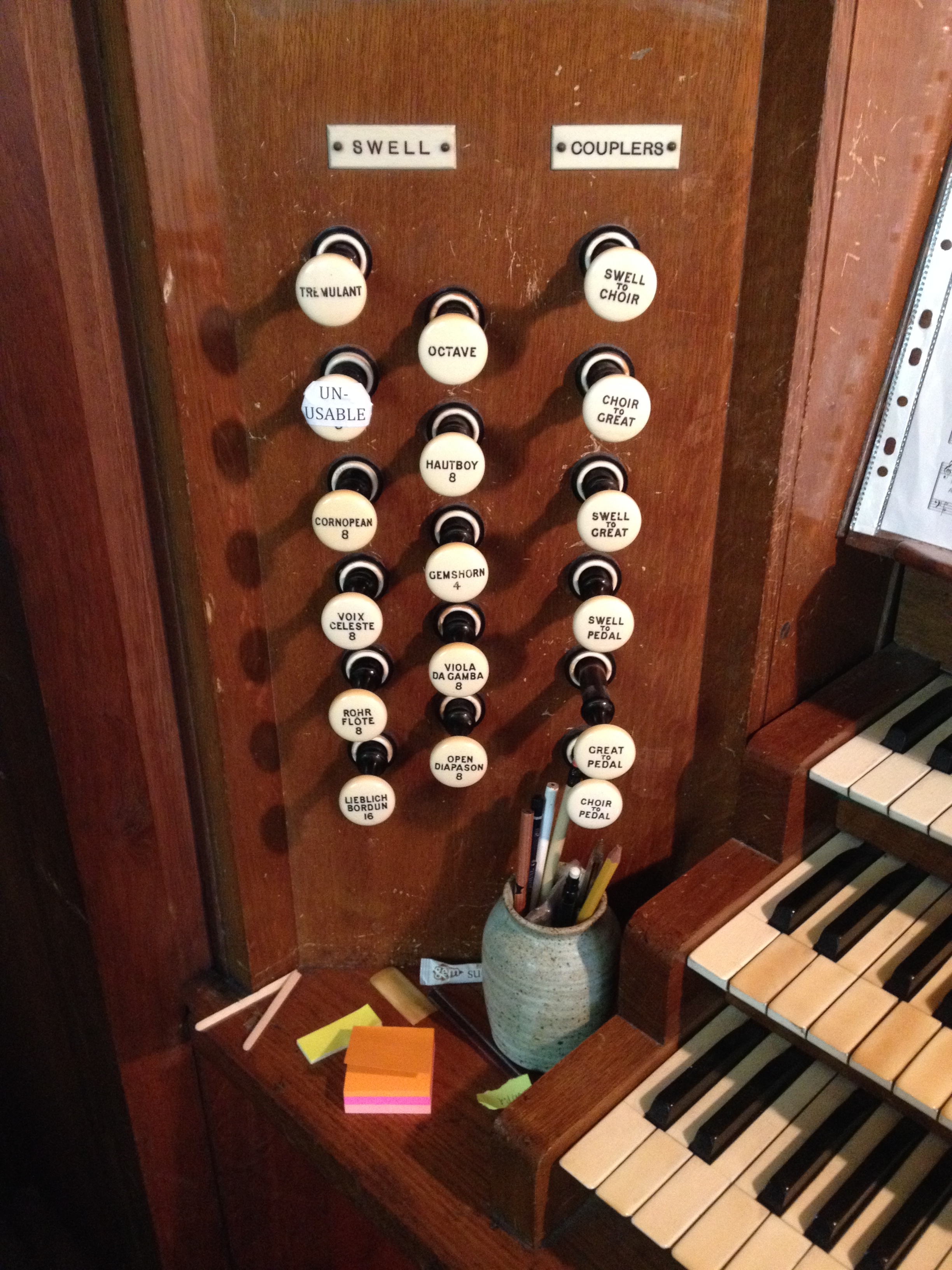
We turned up a little late and there were no tables left. All that was left was a row of seats about 10 feet – 3 metres my continental chums – directly behind the organist and his assistant. This afforded us an amazing view of all the work they had to do to pull off the rendition. There were three keyboard rows, a couple dozen pedals, and music papers everywhere that marked which organ stops had to be out for which piece of music. The more stops you have out – presumably; I’m no musician – the greater the range of different sound effects.

This got me thinking of the phrase ‘pulling out all the stops’ and how it relates to business. Pulling out all the stops means marshalling all the resources in your command and doing everything in your power to achieve something. If you’re in sales, there should only be one person you’re pulling out all the stops for.  It’s not you, and it’s not your boss. It’s your customer.

I know that sounds contradictory, but if you’re rooting for your customer and you’re their biggest advocate in your company, you will win big in the long run.

As a postscript, I accidentally published this post before the due date and a disappointed reader, met with a 404, sagely opined that perhaps I had pulled out too many stops. This is also true, you can pull out too many stops and put too much effort in for a sales opportunity. You need to balance the investment-reward equation.

In the high octane world of large deal size, long and complex sales cycles involving many buyers and influencers, there’s an awful lot to think about and an awful lot of work to do. It seems unfortunate, then, that forecasting such deals remains a black art, despite the technology in place focused on helping this tricky area. This is because the technology is simply the delivery mechanism, and if your data and discipline is weak, what it delivers is weak.

Many hours get taken up in forecast calls and meetings, with jargon like ‘drop dead’, ‘best guess’ and ‘upside’ permeating them and generally obfuscating the truth, or as close to the truth as we can manage. There’s a much bandied about statistic that forecasts are about 50% accurate. That means you might as well forget your forecast calls and flip a coin.

That doesn’t stop sales organisations around the world doing forecasts. Since your pipeline is really just an extension of your forecast, looking further into your future, it follows that for many organisations the pipeline really is a pipedream, a funnel full of fantasy.

Outside the world of complex sales – and who knows what proportion of all sales that is, maybe 80% – there are hundreds of thousands of sales organisations that don’t do forecasts or count pipeline. They don’t set quotas or targets, they might not pay commission, they don’t do deal reviews. They have folk out there selling and what comes in, comes in.

I don’t know how they can run their business with any confidence at all, especially in tough times. I think in general it’s a function of sales being so late to the top table in business. It’s something people have always done based on their intuition. Up until recently you couldn’t study sales at University or College. There was a marked absence of methodology, theory, training and formal structure. Compare this with the much newer profession of marketing which has the best part of a century’s curricular preparation under its belt.

So here, dear reader, are my top 6 pointers for a sales pipeline that means something to your business and that you can plan around:

1) Define what a sales opportunity is for your business. An opportunity is more than a lead. An opportunity is a lead + BANT, where your prospect has identified there is Budget, you’re speaking to the person with Authority, they have shared a Need for what you can deliver, and there is a Time by when they need to act. If it’s not an opportunity, it shouldn’t be in your pipeline. It’s not real enough and it clogs your pipeline with uncertainty and inaccuracy

2) Get a sales process. A sales process is a series of buying stages your customers go through to buy your stuff.  You might need a separate process for each group of customers buying a product or service from you. Lumping all your prospects into one sales process – unless you’re very lucky – will cloud and average out your data, which is not good

3) Define each stage. What needs to be in place on the customer’s side for the deal to be at that stage? Examples might be: the customer has agreed to an exploratory meeting; the customer has shared the BANT criteria; the customer has confirmed your price is acceptable

4) Get your reps’ to buy in to what you’re doing, so they contribute to refining the process and see the benefits of following and recording it

5) Make sure you have consistency across the business.  If your sales stages mean exactly the same to each rep – and they record their progress that way – you have consistent, reliable objective data in the forecast and pipeline

6) Make the technology easy to use, so it gives more back than your reps have to put in. You want to achieve the following virtuous circle: the more I use it – the better my information – the more deals I close – the more progress or money I make – the more I use it.  Hint: spreadsheets are not the answer, you need to use something browser-based so that there’s always a single up-to-date version.  It’s way too tedious for everyone otherwise

An accurate pipeline helps you plan for success and get early warnings of potential problems ahead. But you gotta get the basics right first.

I was chatting with an old mate of mine the other day. By old, I mean both his age and the length of time he’s been a mate, which as I write this is into its fourth decade. We got talking about films and he shared with me his all-time top 5. Describing it as an alternative top 5 film list is doing it a disservice. It’s not even iconoclastic, it’s just plain, well, odd. Maverick let’s say.

We’re both huge fans of the path less trodden in life, and this list certainly epitomises that path. I asked Baz – for that is his name – to expand his list to 10 and send it to me. I should stress at this point the genuineness of this list. Baz added: “I’d like to emphasise that these really are my favourite 10 films. Not for me the temptation to fill the list with ‘film noir’ and French language piffle I’ve never actually watched.”

Here for you, dear reader, is that list in descending order of favour, complete with helpful annotations. Brace yourself…

“1) This Is Spinal Tap (nuff said – Plato’s Form of a flawless film)
2) Chitty Chitty Bang Bang (still have nightmares about the Childcatcher)
3) ABBA: the Movie (a thing of wonder, and I’m not just talking about Agnetha’s derriere)
4) Robin Hood: Prince of Thieves (everything’s so wrong about this, it’s right!)
5) Murder on the Orient Express (I’m actually word perfect on this one)
6) Brimstone & Treacle (best soundtrack ever and Sting’s actually good!)
7) The Da Vinci Code (the perfect nonsense romp – who cares about the plot holes?)
8) The Wicker Man (the original, not the dreadful remake – plus Ingrid Pitt in a state of undress!)
9) Sink the Bismarck! (I won’t tell you how it ends…)
10) And Soon the Darkness (original 1970 version and the reason I sold my bike)

Citizen Kane was an unlucky four hundred and fifty seventh.”

Now that’s a list. You should acquaint yourself with its contents. I know I plan to, I’ve only half of it done.

I can’t explain it either, but it’s fascinating.

Why is St Patrick’s Day celebrated in such style and with such fervour in so many places around the world? Ireland boasts a diaspora of 70 million people, but that can’t be anywhere near the largest. Only the Chinese New Year comes close, and we’re talking about a national powerhouse of 1.4bn souls, fully 350 times Ireland’s population.

Paddy’s Day – and that’s not a pejorative term by the way, not is it ever St Patty’s Day, my American friends – doesn’t even occur on the weekend most of the time, yet still hundreds of thousands of Americans take a holiday to celebrate it and their Irish ancestry.

Ireland – and I’m talking about the Republic here; I’m mildly embarrassed to admit I don’t know much about Northern Ireland, except that it has great tourism advertising – seems to have cultivated the art of charming the pants off you while taking ever so small liberties. For example:

– a corporate tax rate that is the envy of most countries except the ‘offshore’ ones and the bane of the EU’s life

– peaceful nation status with a peace-keeping force, for the best of both worlds

– a genuinely warm welcome unless you’re English (an 800-year reversal of fortunes, let’s not go there) and then if you are it’s a genuinely warm welcome until they know you better

– the high wire act of leveraging a world renowned stout without getting bogged down by unhelpful links to alcohol and its abuse

– genuinely friendly and talkative while also using swear words like definite articles

– cutting edge in areas of business like IT, and antediluvian in its tolerance and memory of shady business and political practices

– great on innovation and entrepreneurship, less so on infrastructure and healthcare

– lovely scenery, without ever being out-of-this-world lovely as boasted by other countries 

For all these reasons Ireland is the most transportable of brands and punches way above its weight in cultural and touristic terms. How this translates into the global transplanting of Paddy’s Day once a year – beats me. I do love living here though…

I had occasion, dear reader, to go to France and Italy a few weekends ago. It was a bit of a road trip – with some planes and trains thrown in for good measure – and one of the earlier legs was the Eurotunnel from Folkstone to Calais. I’ve been on the Eurostar from London to Paris, but never the car-train thingy.

I didn’t know what to expect. I hadn’t booked the tickets as it was a surprise held in my dubious honour, so I hadn’t gone onto the website to see what it was all about. I was going in cold, which is always interesting from a marketeer’s perspective. It is always incredibly valuable to experience the customer journey through your product or service for the first time, because once you’ve got your feet under the table and you know where to look, what to do and what to expect, you can’t help first-time visitors navigate big idea any more.

I was expecting something like a cross between the car ferry and the Eurostar. Drive on, dump the car, chill for a couple hours, drive off. So, imagine my surprise when we drove onto a ‘carriage’ that houses about 3 or 4 cars and sat there. You can either sit in your car and feel mildly seasick as the train speeds through the tunnel, or you can get out of your car and walk up and down the side. There’s an emergency loo, but no cafeteria, no entertainment, no view, nothing.

I examined the inside of the carriage. There were lots of emergency notices and information about what you can’t do. What I didn’t know was that the journey is only 35 minutes long and there’s not much you can do.

One thing that struck me was that there was nothing to manage expectations for the first time traveller. You have to find stuff out for yourself, when it’s too late.

How hard would it be to produce a 3-minute video that runs in the terminal and the carriages to give you more information on the customer experience? It would put you at ease, enhance the experience and make you spend more money in the terminal, knowing that you would be without food and drink for the best part of an hour.

I’m not saying Le Shuttle is Le Shittle, far from it. It’s a massive investment and a huge time and money saver. It’s no nonsense, not quite ‘quick and dirty’ but certainly at the functional end of travel. What I am saying is that they need to work on the customer experience. And, when they do, everybody wins.

A while back I wrote a post on how a sound can instantly bring you back to a time gone by. It can evoke a feeling in much the same way as a distinctive smell can.

The other day, I was watching the Champions League footie on the television and they were having some sound issues. The noise cancelling function of the commentators mike wasn’t working, so it was picking up crowd white noise as well.

The weird thing was this: it sounded just like the football commentaries of world cup games in the 60’s and 70’s. I was spirited back to a time of David Coleman or Kenneth Wolstenholme and those legendary voices that sounded slightly dislocated, strangled almost.

I guess that’s why music is so good at evoking a feeling or a certain period in our lives. It makes ‘guess the year’ on the radio so much more penetrable.

We’re used to hearing music on marketing videos. Perhaps it is the next great ploy to be exploited via the browser and web sites…

Even though I live in the Republic of Ireland, my browser home page is always set to the BBC. It really is a very good website indeed. The broadcasting institution has undergone quite a few changes of late, but if you’re British it’s an inescapable and vital part of your life.

Here are 7 reasons why the BBC rocks:

– No ads.  Even though I’m in marketing, I love watching television on the BBC because you’re guaranteed uninterrupted coverage and no falsely imposed breaks of flow or thought.  You get ads on the BBC website if you view it from overseas, but who cares? That’s routine behaviour on the web

– Great value for money with the license fee. The quality of programming is still peerless. In Ireland you pay a similar license fee – and you still get ads. With Sky you pay a monthly subscription – quite a high one – and amazingly you still get ads, which I would find infuriating and a bit of a con

– Accessible to people in Ireland under a range of subscription arrangements, so us expats don’t have to go without

– Fantastic music montages. No-one caps off a televised event with a montage as good as the BBC’s

– Still the best documentaries around.  History, music, you name it

– Superb natural history content. OK, so I’m biased here and my brother does work in this area, but it’s still superb

– Flawless sports coverage and camera work. Think 6 Nations, the British Open, Wimbers…

They’re not perfect, but my they’re pretty close to it.

I do have a gripe that on the website you can’t see certain sporting footage because of licensing arrangements and you get the ‘UK viewers only’ message, but it’s a small gripe.

The phrase ‘thanks to the unique way the BBC is funded’ is sometimes used as a stick to beat the Beeb with. Not by me. We don’t know how lucky we are.

One of the several things that I really like about where I live is that people say hello to you in the street. People you don’t know. Strangers.

I live in a small town – it would be considered a village in my native country – in the west of Ireland. It’s quite normal to say hello, smile, nod or exchange a view on the weather with people you don’t know a few times during a walk through the town. I really like it.

People are familiar with the friendly welcome of the Irish – cead mile failte, or a hundred thousand welcomes and all that – but I suspect you get this level of friendliness in all small places.

You don’t get this in a big city, at least in not a single one I’ve ever been to, and I’ve probably only been to a couple hundred in my life. People don’t make eye contact, their body language is self-protecting, they avoid making any kind of acknowledgement of your presence. Maybe this is because it feels like everything is transient, unsafe, or unfamiliar in a seething population, but to me it’s a pity. We’re social animals after all, and interaction with fellow humans improves our mood, most of the time.

Next time you’re out and about in a city, try saying hello to a couple of passers-by. Better still, when you’re in a city with an underground system, strike up a conversation with someone across from you, across the central walkway I call ‘the well of souls’. The looks you get can be hilarious:

‘What are you doing, talking to me? You’re breaking the code!”

‘What code?’

‘The unwritten code of the city. No talking to anyone you don’t know. Loser!’

Give me the kindness of strangers in small places any time.

The majority of sales organisations and sales people intuitively distinguish between two types of sales person and sales role. The hunter is the new business person who gets the deal with the new customer in the door and then moves on to the next. The farmer is the account manager who develops that account and nurtures the relationship.

The received wisdom is that each role is suited to a particular type of character. Some folk are suited to the rough and tumble of closing the deal, others are better at deepening the rapport.

Then there is another view, propounded principally by companies like The TAS Group who are behind the Target Account Selling methodology. They argue that the best, most strategic and most successful sales people are those who strategise on target accounts, figure out where the need is, develop the opportunity for a sale and then close the opportunity themselves.

Where do you stand on this? Are opportunity management and account management dedicated, specialised roles that should stay separate, or should they be part of a combined, more strategic role? The answer, of course, is that it depends, but I’d be interested in your views on the matter.