The Power of Personalisation

The Power of Personalisation

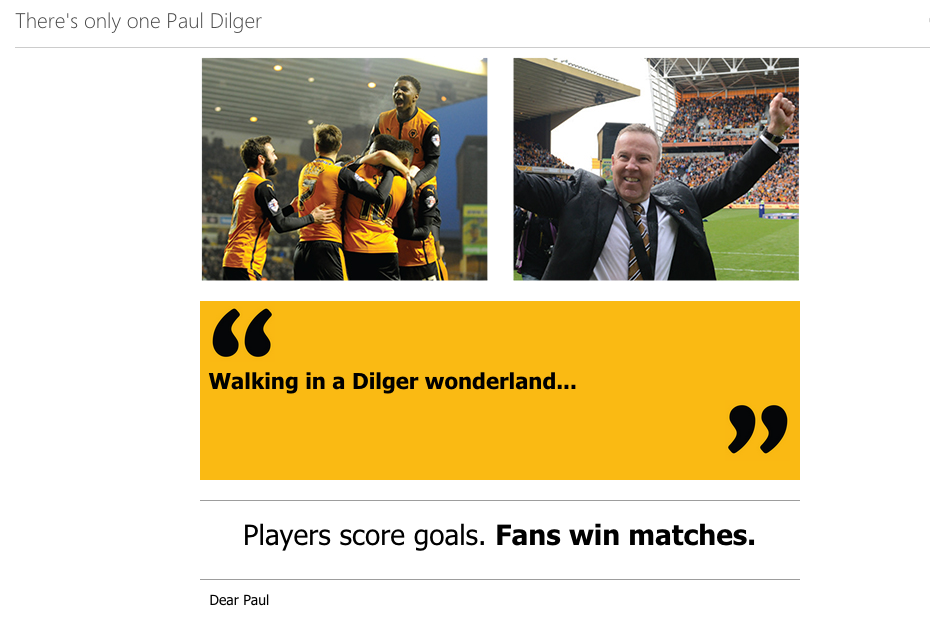
I received this email in my web mail inbox the other day – and I loved it, both as an individual recipient and consumer of email and as a marketer.

There’s nothing new in it, and I won’t be able to convert my interest in action as I live in another country and can’t easily attend games.

That said, for me it epitomises the power of personalisation. Both the subject line and the quoted phrase are redolent of sporting chants, as well as pandering to my ego. The email is visually appealing, the strapline appeals to me as a fan – and a customer – who can make the telling contribution to success, and the ask is a simple one: we’d like you as a season ticket holder.

Superb stuff. Of course, I don’t know how the email turned out. I don’t know too much about the target demographic. I am willing to bet, however, that it performed particularly well against target.

There is a certain time that kills your productivity in work and life. I call it the Lemming Time, after the animals that are supposed to jump off cliffs in droves to their deaths.

You know the Lemming Time when you see it. It doesn’t happen every time and it’s hard to predict. You might be driving your car in town and it seems like every few metres a car is trying to turn into your path, a pedestrian is attempting an ill-advised crossing or people’s rushed behaviour turns erratic and mildly dangerous. It’s the time of day when everyone has decided they simply have to get something urgent done, yourself included.

It happens in work as well. A deadline is looming, you’re getting close, and suddenly the replies come in, the phone calls, emails, requests for a quick chat. Everyone else getting to the finish line of their own thing needs a quick interaction or two with someone else before they can put their thing to bed. All of a sudden you’re in a funk, that 3-syllable word that starts in cluster and ends in an anglo-saxon word for sexual coition. Bad for your productivity and peace of mind.

Avoid the Lemming Time. Plan better.


Have you noticed how much in business and pleasure is governed by disingenuous and disrespectful language?

Life is competitive, otherwise it would be pretty dull, but these days we get subjected to so much of this:

– Hype

– ‘Trash talking’

– Misinformation

– Hearsay

– Mind games

The biggest lie is that you only get honesty, sincerity and respect the day after a political election, competition, contest or the death or retirement of an adversary. A day or two after that, the gloves are back on and it’s business as usual.

How much differently and enjoyably would we view the world we work and live in if the way everyone dealt with other people, teams and companies was open and respectful? Politically speaking (with a small ‘p’), if everyone who had a gun shot themselves it would be problem solved, to paraphrase a certain George Harrison

What’s the successful sales manager’s magic word?

Buffer.

Building buffer buys benefits for the sales manager.

I mean buffer in a money sense, not a time sense. Building a buffer into deadlines is always wise, regardless of your profession, to insure against the inevitable slips, trips and falls on the journey.

You should always have a buffer between your team target and the total of your people’s individual targets, because not everyone is going to hit target every month. Even in well-performing companies you might see a third-third-third split between those above target, those around target and those below target.

For example, to keep the maths easy, let’s assume you have 5 sales people on your team, each with a sales quota of $1,000,000 per year. Industry variances aside, your team target should be in the region of $4,000,000. Similarly, your sales director, if they have 3 managers with the same team target reporting into them, should have a sales organisation target of around $10,000,000. And so on, through the roll-up to the top person.

You want your people to hit target, and your Director wants you to hit target. That’s how successful companies retain successful sales professionals, rather than creating a constant need to replace churning staff.

Notice that I’m not talking about forecast buffer here. Building padding into your forecast makes it really difficult for the company to do meaningful measurement and planning.

Commission is the financial incentive you give to sales people to help them meet or surpass the sales targets you set for the business. Many sales people receive a base salary and can earn commission on top of that base by achieving their monthly or sales quota. You want your sales people to hit their sales targets, right? If you do, there are a number of things you need to ensure to keep your sales people – and your company – happy.

Is your commission plan easy to work out? If it’s easy for your sales people to understand the commission they will earn by closing a certain deal, this will make them pre-disposed to do well. If your commission plan is an intricate, esoteric set of formulas requiring an advanced degree in pure maths to fathom, then you’re going to engender confusion and distrust.

Does your commission plan give your sales people a fair chance of achieving target? If the targets are reasonable and your sales people should hit them with a reasonable amount of effort and ability, that’s great. If you know they’re not achievable, then something’s wrong with either your people or – more likely – your business model or the need for your product or service. You need to take a long hard look at the root causes of the failure.

Is your commission plan correctly aligned to the long term goals of the business? You need to make sure your salespeople are chasing the right business for your business. Sales people, quite naturally, will look for the easy wins and the path of least resistance to achieving target. Some products and services are easier to sell than others, and if your people are concentrating on those easier-to-sell items that are not in the strategic interest of your business, you’re building a rod for your back. You need to make sure that your commission plan is structured in a way that is fair to your sales people while also enabling your company to grow in a stable and sustained manner.

Commit to a fair and wise commission plan and your people and the company will commit to you.


It was Tom Peters who said that ‘perception is all there is’. I’ve talked about this quote before, and its importance, but for me there’s something also inviolably true, and it’s a bit like the other side of the coin.

Perspective is all there is, too. Perspective is your perception of the world, and, more importantly, someone else’s or something else’s perspective. I was reminded of this in the most mundane way recently. Having made myself a cup of tea, I was bringing a soggy tea bag over to the bin, supported by a spoon and, under it, my free hand to catch the drips. The spoon looked full of tea in the side I could see, so I tilted it away slightly. As I tilted it away, it dripped tea from the side I couldn’t see, which was obviously fuller, or at least as full, as ‘my’ side. I hadn’t checked the other side.

It always pays to try and understand the perspective of the other person, in a transaction, in politics, in pretty much anything. Once you get their perspective, you get the wisdom to agree with them, or the ammunition to persuade them to agree with you.

There is a big difference between demonstrating how to use something, and selling that thing itself. Yet it’s amazing how many salespeople confuse the two. Either they show everything the thing does in the hope that something will catch the buyer’s eye, or they will say ‘this bit does this, and this button does that, and oh, watch this, it’s quite cool.’

Who cares? When you’re not sure what to show people, it means you haven’t figured out what problem they’re trying to solve. When you’re not sure how to show it to people, then you need to figure out the correct scenario that will best show off how you fix a specific problem better than anyone or anything else.

When you’re selling something, don’t show them how to use it. You will bore, frighten or otherwise deter them. Instead, show them how that something will make them money, save them money, save them time, or help them comply with something that must be done.

Of course, you need to know enough about your something to be able to demonstrate how you help your buyer, so learn the handful or two of user scenarios or ‘use cases’ that your buyers have, and learn how to demonstrate how your something addresses each scenario elegantly and efficiently.

You don’t need to be a power user of what you sell, with a deep understanding of every nook and cranny. You need to know it well enough to show how it solves a range of problems or capitalises on an opportunity.

Do you want to be more successful at B2B sales and marketing? Then you need to do three things.

First, figure out how your customers want to buy from you. What do they want to do, when, in what order? If you don’t know, ask them. If they don’t know, consult with them and help them.

Second, map your roles, processes and systems to how they want to buy, so you can deliver that perfect buying journey for them. Then, adapt your roles, processes and systems accordingly.

Third, involve your people in steps one and two so they understand why it’s in everyone’s interest to adapt and come up with some great suggestions for how they can best get there.

Go map yourself. You’ll be glad you did. But not as glad as your customers. In some cases they may not buy what you have very often, and so you have to listen to what they’re trying to do and guide them through the steps they need to get there.

Change is hard. We all know that, as individuals and companies. People naturally resist any changes that break their routine, especially if they don’t understand or buy into the reasons.

At the same time, you can’t simply draw a line in the sand and expect people to change the way they do things overnight. It’s not in their nature, and it’s not in the interests of their business.

That’s because they have a job to do, objectives to meet, targets to hit, or a business to run. The clock doesn’t stop running while we try something different.

Successfully changing the way people do things is a very delicate balance between small, consumable exposures to the new ways and getting the day job done. That way you can effect a smooth, gradual, and above all measured transition that has a strong chance of being successful. You give people the chance to help shape the new ways and the time to ease into the process. Then the knife edge of change management is cutting for you, not into you.

When you’ve decided to make a change or kick off a project, it’s easy to want to dive straight in and get started. After all, looking ahead is the right way to approach things; you can’t change the past.

I used to work with a company that used to make quarterly marketing plans and against each campaign they’d put the target number of leads, opportunities and revenues. They would do this every quarter, but they would never look back to the previous quarter to see how they actually performed against target. They would sweep things under the carpet and move forwards.

Before you start, you need to measure where you’re starting from. Sounds super obvious, doesn’t it? Yet, not enough companies do it. Sometimes they can’t measure the key things, other times they can’t be bothered.

Knowing where you’re starting from allows you to review and measure how far you’ve come at a later date. Instead of drawing up a plan every quarter, figure out how successful the last quarter really was. Then you have the information you need to learn from it and make a better plan next time.