Ask any business leader what their primary business challenge is and you’ll often hear words like ‘demand’, ‘pipeline’ or ‘more, better leads’. There are very few businesses that can rely on a never-ending stream of inbound enquiries from prospects or customers looking to buy.

Generating demand is generally the domain of the marketing department, although in business-to-business environments it’s not uncommon for the sales people to be expected to find or develop about half of the demand themselves. Many businesses therefore take a well resourced, scientific and automated approach to being in the right places with the right content to engage those people looking to fix a problem or exploit an opportunity.

Despite what you might have read from the minority of practitioners who’ve written or published ‘how to’ books, blogs or videos on the subject, while the principles are straightforward the practice is hard, especially when the business has a relentless demand for high quantity, high quality expressions of interest to keep its costs of acquisition at manageable levels. What often happens is that instead of demand generation you get demand degeneration, by which I mean a lack or shortfall of pipeline for your products and services.

What are the reasons for this? As you might expect, they’re many and varied. Incorrect market sizing, poor segmentation, a lack of understanding of the customer, inferior or inappropriate content, and insufficient or manually dependent activities are some of the common reasons. There’s also a requirement to stay current with trends and technologies in demand generation, since ways of engaging with customers have a natural lifecycle that means they won’t always be productive and will be replaced by new ways.

It takes a relentless drive and relentless inquisitiveness to engender relentless interest in something. That’s a pretty tall order to avoid demand degeneration, and the good business will recognise this and have in place parallel activities like customer advocacy to keep the pump primed.
I have carried out another of my detailed, nay exhaustive, studies into the human condition and have come to another shattering conclusion.

We are an overweight nation. I’ve reached this conclusion after a sustained 2-hour session of people-watching in a provincial airport departure lounge.

I need to qualify this on two fronts. Firstly, I mean the male side of the nation. They were the study. Secondly, it’s not that we’re an overweight nation, it’s that we’re an overweight and under-toned nation. I saw enough men with slight or pronounced paunches that if you gave me a buck for every one of them I could have paid for my return flight.

The men with slight paunches were not overweight as such, it’s simply that the weight was not distributed correctly. We’re talking younger and middle aged men, younger than me, not older men for whom the slowing metabolism and decreasing activity exerts an inexorable toll on their midriffs.

What’s the cause? Modern lifestyle, unquestionably. Modern diets, modern mobility, modern commitments. And the Internet, which now accounts for the working day and a lot of our free time. We’re simply so much more sedentary than we used to me. We can send an email to Susan rather then walking a report over to her desk. Lifestyles have changed quickly and evolution will never be able to catch up.

It takes a lot of effort and time to put aside to stay in shape. If we’re not athletes by profession, we have limited time to devote to it and exercise is usually the first to go when it should really be the last. Look at any former athlete. How many look like they used to? How many are still in shape?

So it’s not just that we’re an overweight nation. We’re an overweight race.


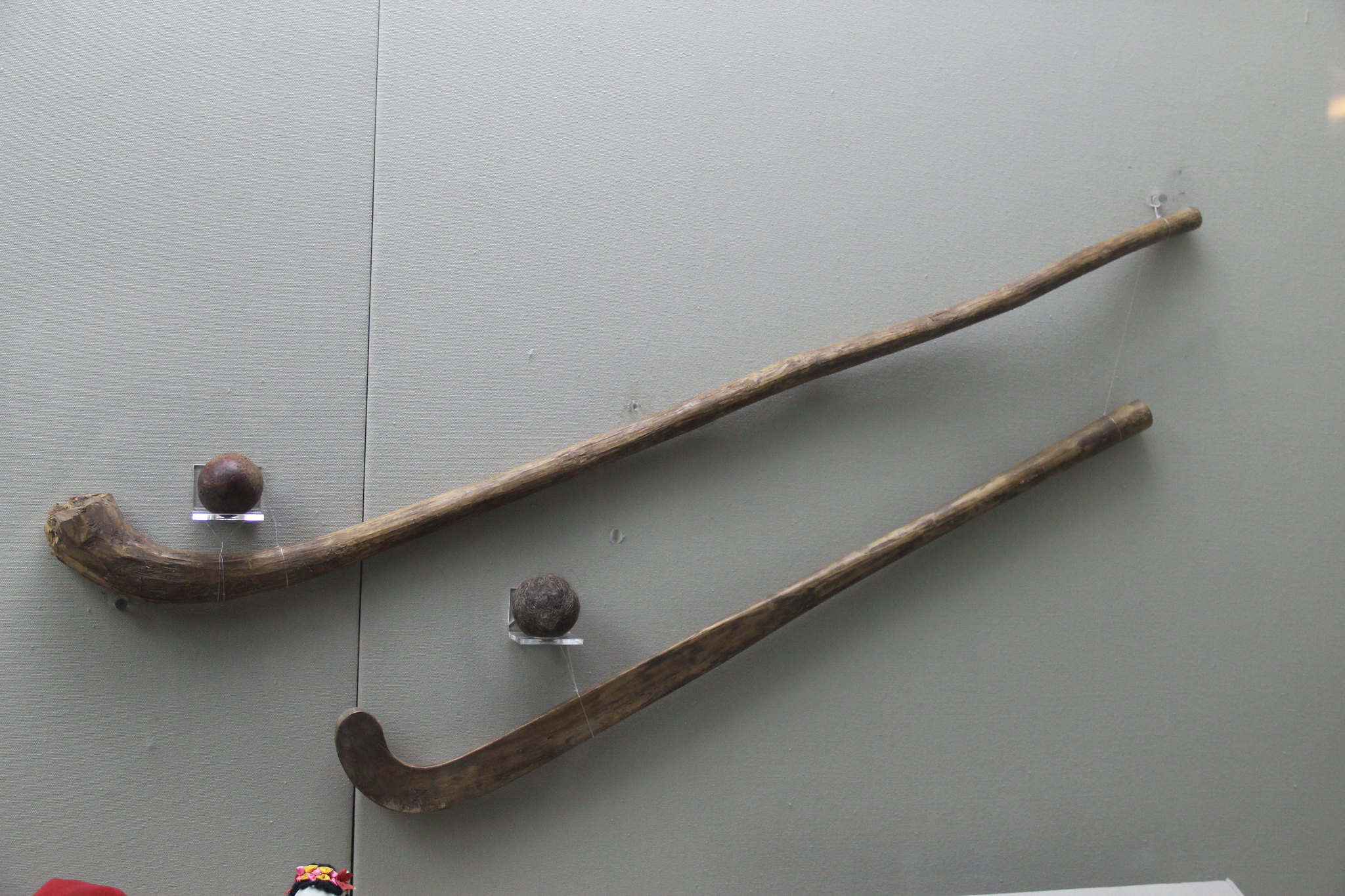
“Daur “Hockey” Sticks” by Gary Lee Todd, Ph.D. is licensed under CC PDM 1.0

I’ve been in business for a good 30 years or so. For most of those years I remained confused about a phrase that a lot of my North American colleagues used.

‘We’re looking for hockey stick growth,’ they would say, ‘that elusive hockey stick growth curve.’ This image always left me flummoxed. After all, who wants to see a massive downturn in growth before you see the upswing? You might not survive the downturn…

I finally realised that I wasn’t thinking about the right hockey stick. In fact I was thinking about the right hockey. Hockey, or ‘Ice Hockey’, to give it its full name, is hugely popular in North America, and has a flat bottom part and then bends up in a straight line, the sort of sales growth envied the world over.

In Europe, hockey is field hockey, not anywhere near as popular in North America, and uses a differently shaped stick with a curved part where you hit the ball. Not the shape you want for sales growth…

Confusion over!

The goal of underlying sales and marketing technology is that it is the slave, not the master, to your organisation. Automating your processes will enable you to embed and reinforce best practices throughout your organisation. The collection and inputting of good data and managing interactions for the complete customer journey will ensure you have visibility into your organisation, give you the insights to do accurate business planning and allow you to demonstrate your compliance.

Customer Relationship Management (‘CRM’) systems fulfil these responsibilities for your organisation. They are the machine to power your business, but are limited by the fuel you give them – in this case the quality and accuracy of information you import, enter and store. You can customise many CRM systems to suit your own business processes. You can also enhance them by integrating additional specialist software from third party organisations.

The CRM industry is extremely cluttered and competitive. There is a vast array of CRM systems, which vary appreciably in cost, functionality, reporting, flexibility, ease of use and size of their third party software ecosystem. It’s important to select the system which offers the best fit to your requirements and the long term vision you have for your organisation.

These 8 aspects will give you a solid structure to define your technology requirements, before shortlisting the alternative providers:

  • Your objectives for the technology
  • The functions within your organisation
  • The tasks you want to automate
  • The information you want to record
  • The metrics you want to measure
  • The users you want to enable
  • Their requirements
  • Your budget to accomplish these things

Think about your requirements as deeply as you can before you take the plunge. Companies often find that once they start using an implemented system there are additional things they didn’t think about that would have further influenced either their choice of system or how they customised and implemented it.

The best sales managers don’t micromanage their staff nor obsess over the numbers all day. The best managers have the right people on their team, all consistently selling the same way. They maximise their teams’ selling time and minimise their paperwork. They do structured deal reviews on key opportunities, offering advice and direction where needed.

They best sales managers focus on the few key metrics that determine success for their business. They champion the right behaviours and values. They call out their top performers and celebrate the example they lead. They forecast accurately and confidently, allowing the organisation to plan accordingly. They have the right technology in place to automate good behaviours and free themselves up to coach their teams.

Here are 8 areas that I think are key to great sales management:

  • How to design sales quotas, sales compensation and resourcing
  • How to do deal reviews
  • Pipeline values, composition and movement
  • Buying process, sales process and how forecasting relates to them both
  • How to define the behaviours and metrics for success
  • Pinpointing areas for improvement in individual sales people
  • How to conduct sales meetings
  • How to plan for growth

I’m sure there are others you’d want to add, but if you can master these 8, you’re well on your way to being the best sales manager.

How good are your sales people? How do they manage the sales opportunities and their existing accounts? You won’t be surprised to know that sales people need skills for the whole customer journey.

Here are the first 12 aspects that come to mind when selling to a new customer:

  • How they prospect
  • How they qualify
  • How they prepare
  • How they manage the calls, meetings, presentations and demonstrations
  • How they challenge the customer and manage objections
  • How they strategise on the opportunity and the competition
  • How they navigate the customer organisation
  • How they stay focused
  • How they win the customer
  • How they negotiate
  • How they close
  • How they hand over to implementation, support and account management

Within account management, the business of selling to existing customers, another half dozen aspects emerge:

  • How they grow the account
  • How they ask for referrals within the customer’s business and outside it
  • How they make the customer an advocate for the organisation
  • How they renew the customer’s business
  • How they do account planning for their key accounts
  • How they do account planning for their other accounts

Command of these different areas corresponds directly to the trust that the sales person establishes with their customers and the esteem with which they are held in the organisation and their industry.

Brand is the summation of everything we feel when we come into contact with an organisation, a product, a service or even a person. It’s a function of what we, see, hear, feel and consume. As such, brand is more than a logo. It is everything that helps form the customer or stakeholder experience. It manifests itself in its people, its products and services, and its interactions with you, the customer.

Profile is a function of how the brand is packaged and presented to the public domain. Public relations departments and agencies are responsible for managing and controlling profile in a way that’s consistent with the organisation’s mission. Here are a few things you should think about if you’re planning a launch or refresh of your brand and profile in the marketplace:

  • The vision for your organisation
  • Your mission to get you there
  • Your visual identity and accompanying strapline
  • The design guidelines around your identity and its products, services, promotional materials and documentation
  • Your current profile
  • Your desired profile
  • The activities you need to have in place to achieve your desired profile
  • Budget and timeframes for executing on the plan

This is also a great shopping list to take with you when working with a brand or image expert.

I carried out a detailed study in pubic transport the other day. Actually, it wasn’t that detailed, it was a data point of one, one journey.

I went to visit my mother, who lives near Bristol in England. I live near in Galway in Ireland. It’s perhaps 300 miles as the crow flies, if even a crow can fly that far, except that there’s the Irish Sea in the way.

I had decided to go via public transport, rather than a car. Normally I would drive to the departing airport and hire a car from the destination airport. The public transport option was cheaper and better for the planet. It would simply cost more of my time, a very precious commodity as far as I’m concerned, but there you go.

These were the legs of the journey:

  • Walk to local train station, 10 minutes
  • Train to Galway, arriving 45 minutes before coach trip to airport
  • Coach from train station to airport, supposed to take 95 minutes, but took nearer 120
  • Arrived at departing airport 2 hours before flight
  • Flight to Bristol airport (1 hour)
  • Bus to Bristol city centre (wait 10 mins, 30 minutes journey)
  • Bus to my mother’s neck of the woods (no wait, 45 minutes journey)
  • 10 minute walk to mother’s house

Total elapsed time via public transport: 10 hours exactly

Total elapsed time if I was driving both ends: around 5 hours

I think 10 hours is far too much to travel from one neighbouring country to another. So do most other people I guess, judging by the amount of people who, if they have access to a car, take one.


‘Age is just a number.’ Don’t you hate it when the gym instructor says that, as you bemoan your general state of feebleness and fragility after a lung bursting effort following the latest ‘here’s a great new exercise for you to try, you’ll love it!’? Or coming from someone looking insufferably youthful?  Yup, I know. Your age is just a number, an inexorably increasing one, until it stops, obviously. Despite the fact we’d love to turn the clock back, almost all the time we’d rather ours went up than stopped, I imagine.

I get that our approach to ageing is often a reflection of our state of mind. It’s a perception thing too, the messages we send out and the way people interpret them.

There is still the raw number itself, however, our actual passport- or birth cert-verified age. When it comes to that, I prefer the odd numbers to the even. Of course 29 is better than 30, but what about 31? Counter-intuitive, no? I think it sounds better, feels better.

I’m not sure why I prefer the odd numbers. It’s illogical and irrational, I know. I just do.

It’s the start of a new half year! Where better to begin than with the job of figuring out what makes your ideal buyer tick? A customer or buyer persona is a collection of the characteristics common to buyer types in your target organisation. Figuring out your personas allows you to market to many like-minded individuals with the same messaging. This is in stark contrast to when you have a specific customer in mind – effectively a market of one organisation – because then you can message directly to that person, rather than to the persona construct.

Crucially, there may be more than one buyer persona you need to engage with in your target customer: lifestyle people; money-makers, corporate ladder-climbers; business heads, finance people, procurement. These personas may well fulfil multiple or different roles in the decision-making unit of your target organisation: decision-makers, budget-holders, influencers, users, and other staff.

You should gear all of your marketing and messaging to your personas, and adapt it to each persona. Framing your personas comes from research, which might be based on quantitative or qualitative information. Where to go for that information? It’s what you already know, it can come from interviews, calls, or meetings, from your sales teams, or from your customer database.

I’ve found the following list of headings to be useful when building a persona:

  • About them: gender, age profile, education, family, job role, experience?
  • Personality: approachable or aloof, prefers emails to calls, passionate, dispassionate?
  • Goals: commercial, personal, emotional?
  • Challenges: resources, politics, regulation, competition?
  • Hangouts: where do they go for their information? Websites, social media? You need to be where they are…
  • What can you do for them? Help them hit which goals, meet which challenges, be recognised?
  • Objections: what might stop them working with you? Time-pressured? Locked in to a supplier?
  • Message: how might you best message to them? Productivity, growth, compliance, morale?

Giving each persona a name, even a picture, and hanging their profile on a wall will keep them front and centre.