Archives for category: Strategy

In business these days, and especially in fast-moving industries, it rarely pays to compromise. Compromise in my view is not BATNA, the Best Alternative To a Negotiated Agreement. No-one’s happy when you compromise. Both parties end up sharing the middle ground – results-wise – of mediocrity and missed opportunities.

Life and work should be about doing your absolute best and not settling for your second best work. What’s the point otherwise? It’s no longer enough to be ‘good enough’, because that’s not going to last ‘long enough’.

I was reminded of this fact the other day when I went to the gym. Three things happened that made me think of the folly of compromise.

Firstly, our gym is on the first floor, on the floor above the changing room and the pool. It’s two flights of stairs, and there is also a lift to the first floor to access the hotel rooms, for elderly, disabled or heavily laden residents. I saw someone about my age taking the lift. Up to the gym, and down again later. Defeating the object of exercise surely?

Secondly, there are two banks of treadmills.  On one treadmill I saw a guy walking slowly. On his mobile. While he was walking, which was pretty slow given how distracted he was. Could he be making less of an effort, short of stopping altogether?

Thirdly, the gym happened to be playing a collection of really good dance tracks, presumably to help with motivation and atmosphere. Except that each track was a cover version, and a pretty poor imitation at that. Talk about ruining the user experience.

If you compromise, on effort for convenience, or on quality for reducing cost, you make it harder to get to your target, which is a happier customer, co-worker, friend or family member. Or a happier you.
Where would we be without lateral thinkers? Nowhere, probably. I would imagine all of the major secrets of the universe – electricity, flight, trigonometry etc – have been unlocked by some dedicated soul, who, having exhausted the 99% perspiration embarks on a ‘gee, I wonder if I approached it from this completely different angle, what might happen?’

Take something that the vast majority of us have the good fortune to take for granted, seeing. I have always considered is something active, that we do to an object to see it. But no, some clever sausage figured out that it’s a passive thing, that the eye absorbs all the visual stimuli, and the retina, rods and cones do the rest.

That ability to genuinely think laterally, to think outside the box as the business world has coined for the last two decades, is a really rare phenomenon. It requires us to consciously abandon the traditional patterns of thought that have governed how we operate in the world since childhood, and come at things from a new direction.

For forty years Edward de Bono has pioneered – and I believe originated the name of – lateral thinking. I remember attending a talk by EdB along with a few hundred other paying guests in Dublin around the turn of the century. By the way, since 14 years have elapsed since the new millennium, I think we’re now at liberty to use the phrase ‘turn of the century’ without appearing overly dramatic. Mr de Bono eschewed the lure of powerpoint and used a rolling film of acetate where he scribbled his line-drawn illustrations before winding each drawing from sight, ready for the next clean canvas and blindingly new example of creative thinking.

This man’s work is nowhere near as theoretical as you might think, and he had dozens of examples of how he and his team had been retained by governments and corporations to solve some problem or other. His solutions were so left field that you were left breathless by the degree to which they put in stark relief how blinkered your own thinking was up until now. One example was a Swiss canton who wanted to solve a town parking problem where they didn’t want to use meters or police the parking, but they didn’t want folk abandoning their cars for hours on end either. The solution? All you had to do when you parked was leave your headlights on.  Come back a couple of hours later and you risked a flat battery. Genius!

The business world has tried to adopt this approach of inspirationally cutting the Gordian Knot, with things like moderated ‘brainstorming’ sessions. With good reason too. We need these lateral thinkers, and these laterally thought out solutions, to keep turning the screw.

In sales, there is a lot of complexity. A lot of moving parts, a lot of scenarios, a lot of things to measure. If you can’t measure, you can’t manage, so how to make sense of the data onslaught and focus on the really important stuff?

I used to work with a company called The TAS Group, who invented something called The Sales Velocity Equation to help with the problem. In this equation, anyone in charge of sales needs to focus on – and measure – just four things to get a sense of how successful their sales efforts are, and whether they are improving or not.

The four levers are the number of qualified opportunities your team works in a given period, the average deal size of the deals you win during that period, your win percentage, and the length of the sales cycle of all qualified deals before you win or lose them.

Your sales velocity – which is a measure of how effectively you sell – is a function of the top three levers multiplied by each other, divided by the all-important factor below the line, the sales cycle length. This gives you a dollars per week, month – however you measure your sales cycle – for a given period.

Consistency is the name of the game with this. You may know that I’m a big fan of consistency. You must be consistent in how you define the period (I recommend looking over at least a quarter) and in how you measure a qualified opportunity, otherwise you’re comparing apples and oranges. If your sales velocity increases from period to period, you’re selling more effectively. If it decreases, less effectively.

The key is to have an iron grip on your sales process and your sales cycles, because time is a killer and that factor below the line can kill all your good work elsewhere.

You can read more about this important topic here and here.

The size of a company seems to be inversely proportional to the quality of service it provides. As markets mature you get consolidation, resulting – in the opinion of this writer – in less choice for the customer and more chance of being lost in the system.

As a case in point I offer you my recent experiences trying to set up online banking for an account I’ve not used in a while. I’ll spare you the details and give you the shorthand. First I had to wait two weeks while they changed one letter – a typo – in the address details they had on file, which of course required a written letter. That done, the website didn’t recognise my bank details so I couldn’t apply online.

So I applied using good old fashioned snail mail, filling in an application form and posting it. A week later, a letter arrived which I expected to be my activation letter. No, it was a letter saying my paper application had been rejected because the address I supplied didn’t match the one on file. Two calls to the bank revealed that – no – the addresses did match, and they would look into it and call me back. The back and forth so far has been between at least 5 different divisions of the bank.

I should mention that this an account I have had for over a decade and which I originally set up over the phone.

Passing my local branch the other day, I decided to pop in and see if they could help. Lo and behold, the system they accessed showed an address that I haven’t lived at for six years, even though I’ve been getting statements to my current address for the entire subsequent period. While the bank hasn’t yet sorted out my online access, my view is that the problem lies with a defunct account I might have had that was with a previously independent bank that the behemoth bank has acquired.

Can you imagine what the back end systems and customer information are like after a generation of M & A activity? It’s hard to imagine how many gremlins are lurking among the mainframes. In this era of multi-channel dealing, where we may choose to interact with suppliers through a variety of media and devices – witness my current issue which I have tried to address by paper, face-to-face, phone, web and chat – they don’t have a cat in hell’s chance of catching up and competing.

When in our business or working lives are we at our most productive?

Is it in our 20’s when we’re single and can travel the world? Is it in our 30’s when we have the energy and the focus? Is it in our 40’s when we have the experience to work smart? What about in our 50’s when we have the seniority and gravitas?

In most working environments we tend to be – or are at the very east hoping to be – tapering our work commitments and efforts in our 60’s, yet as is well documented, a constantly increasing section of the global population is working for longer. As the population shifts and it becomes increasingly unsustainable for the younger working people to support the funds that the older retired people draw from, so the retirement age increases and the state pension reduces.

For my generation, with the exception of those who have won the lotto, hit the jackpot, or robbed a bank, the equation is obvious. Take slightly older parents of kids who will probably go to college, add a couple doses of pension fund and property value collapses, and you have a retirement age of at least 70. Ouch.

As a man whose father retired at 50, it comes to me as something of a shock, I don’t mind telling you.

What this means is that the bell curve of productivity is going to have to move significantly to the right – where age is on the x axis – in order for the macro sums to add up. In terms of our age, just like in business, this means that our personal Q3 is going to have to be a big one. Even our Q4 too, if we live that long. What we have against us of course is our age and our dwindling physical and mental capacities. Failing this fairly crude maths coming up trumps, something fundamental is going to have to change in society and how we work.

I’m not downbeat though. I think technology will continue to help us save time, save energy, and reduce distances. It will change the game, invent new paradigms, banish the old ways of doing things, and any other cliché you can’t think of.

I don’t know how it will, but it will, it has to. If I did know, I’d be retiring in Q2…

In this era of the long tail, it’s never been more easy to find, create, develop and service a niche market.

A niche is a small place that you can defend and protect from bigger competition who either can’t fit in the niche themselves or lever you out of it. Aside from the risk of the long tail niche – there is a gap in the market but is there a market in the gap? – I was reminded of how protectable a niche can be when walking on the beach with family yesterday.

We were collecting empty shells, and on several occasions we saw some limpets sitting in the cracks between rocks. These weren’t limpets stuck to the rocks in the normal way. They were empty shells with their edges were simply resting – or so we thought – between the folds of rocks. The spaces under them were not deep and impenetrable, they were shallow, maybe a centimetre or so of a recess. When we tried to pick them up, however, we couldn’t move them, even by levering a finger and a thumb under the entire limpet.

Even though they appeared to be resting on the rocks, the force of the storms from the last few nights had wedged them in, hard and fast. Added to that, the conical structure of the limpet was such that even though only a few millimetres of the limpet edge were touching the rocks on two sides, it could withstand any human attempt to remove it in one piece.

When we find the perfect niche, and we’re set up the right way, we can be impossible to dislodge.

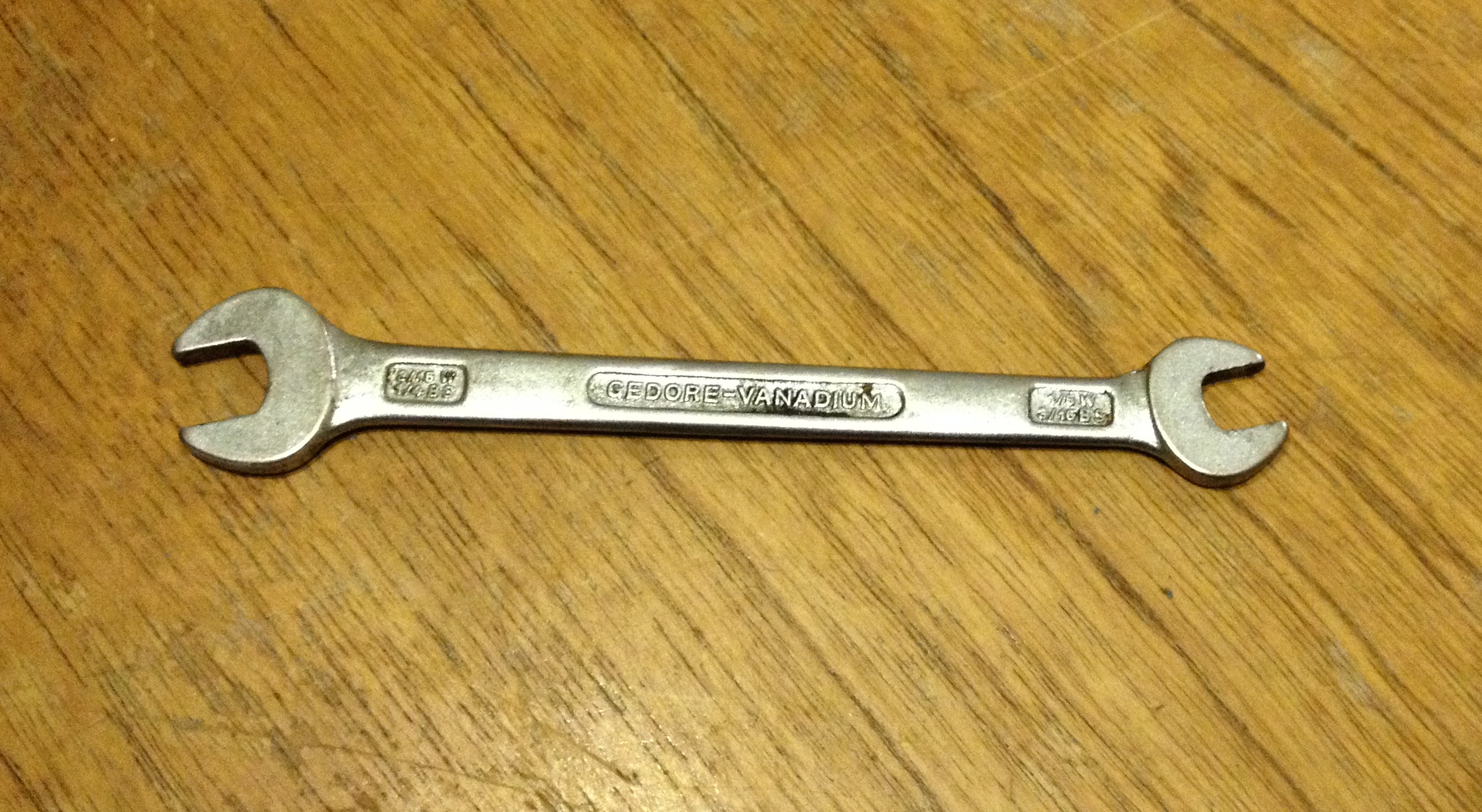
IMG_1509

This is a tool…

A spanner is the British-English word for a wrench, and in Irish when used colloquially means idiot – as in ‘Don’t leave the tap running, you spanner!’

In the British-English sense, a spanner is a specific size of implement that does the job of tightening or holding a bolt. The right size of spanner does exactly the job you require. It’s a tool and belongs in your tool-bag. It’s an essential part of your tool-kit.

If you work for a high tech company and you provide solutions to help companies address their key strategic goals, don’t use the word ‘tool’ to describe your technology – ever. I’ve heard sales people refer to what they sell as a tool when in some cases it’s an entire platform. Here are five reasons why you shouldn’t stoop to use the word ‘tool’.

– it conveys tactical, not strategic.  Tactics are short term and not mission critical.

– it conveys small, not significant.  You want your customers make large, important gains, not get bogged down managing lots of small gains.

– it conveys reactive, not proactive.  A tool fixes a problem, it doesn’t capitalise on a business opportunity.

– it conveys nice to have, not must have.  If you have no ‘must have’, you have no sales opportunity.

– it conveys IT, not business.  Technology solutions solve business problems, not technical problems, at least as far as you should be concerned.

Much better to say platform, resource, technology or even system.  Never call it a tool, please.

Even though business is complicated, it always pay to keep things simple, because this gives us clarity and focus for making decisions. Speaking of which, they used to say that a company had basically three broad strategies to follow.

Either you could focus on customer intimacy, and compete by being super close to your customers.  Think Zappo’s, the celebrated US online shoe retailer now owned by Amazon.  Or, you could go for product leadership, and design and build the best product on the market.  For this you could name Apple.  Lastly, you could major in on operational excellence, and do things much more efficiently than your competitors.  Ryanair would be a good example.

Imagine that each strategy sits at the point of a triangle.  When crafting your strategy you can only move around the outside the triangle.  You pick your strategy, or perhaps you opt for a combination of 2 strategies – a bit of one and a bit of the other.  But you can’t hedge your bets and go inside the triangle, looking for a combination of all three strategies.  That’s no strategy at all, just a big compromised mess.

In this sense it’s just like the holy trinity of delivering software, the price-quality-time conundrum.  If you move in one strategic direction, you lose elements of the other.  For example, focusing on quality has an impact on price and time (to market).  (You’ll also hear people talking about the triangle of cost, time and scope, all of which determine product quality, but you get my point.)

The trouble is, everyone’s starting to realise they HAVE to be customer intimate, regardless of their strategy.  If you’re not customer-focused, it will always come back to bite you.  For a long time I’ve been arguing that Ryanair’s drive towards operational excellence at the expense of customer happiness will rebound.  Charging you excessively to check in a bag reduces weight in the plane, fuel required for transportation, and flight turnaround times.  But your customers resent you.

Interestingly, Ryanair has started to acknowledge that its lack of respect for the customer has to change.  Furthermore, and if you have time, for an altogether funnier take on the resentment people feel that the initial price of a flight is never the final price, this song is well worth a look.

So if customer intimacy should be everyone’s strategy, we now need to think outside of the triangle.