Archives for category: Marketing

There are some jobs where deadlines are constantly present. Journalism for one.

There are also people who can’t seem to work unless they have a deadline in front of them. Are journlists in that category too? Some of them I guess.

The thing that many of us experience with working to deadlines is that the closer the deadline is, the more we get done. When you have to make a deadline you cut through the unnecessary and get to the nub of what your project is all about. This is fine for creating something with words, but when you’re involved with something that has an already defined process, like a complex sales process, one that you can’t bypass or cut short, then you’ve got problems. Then, it’s not your deadline, the end of your sales month for example, that counts, it’s your customer’s deadline.

With the more undefined processes, though, like writing for example, it pays me in my daily work to create deadlines to maximise my productivity. If there aren’t deadlines on a job, or the deadline is a long way from now, create an artificial deadline to work to. Or, split the project up into pieces and create mini-deadlines. For example, can I create two blog posts before lunchtime? Can I get the last page finished before this meeting starts? Can I reach the half way mark before the end of the day?

Of course, the risk you run with this approach is that you’re always producing shoddy, rushed work, work that would have benefitted form a little more time, and a less demanding deadline. That’s the balance between the two that we strive for: the best we can strive for versus the commercial reality imposed by time being money.

If you want to relax on your time off, and simply while away the time in those most luxurious moments when you have the luxury of time, then simply set no targets for the day, no objectives.

As an example, yesterday I set myself the goal of thinking up a blog post topic in the three minutes’ time I had before a call started. I came up with this one, and wrote it today.

Well that’s the 750 up, as we would say in cricketing circles. We wouldn’t say it all that often, as amassing 750 runs in a single innings is a pretty rare occurrence. Well before then, the other team would have got us all out or we’d have declared, which is the cricketing version of ‘we’ve had a good go, let’s see what you can do.’

I guess 750 blog posts is a pretty rare occurrence too. At 3 times a week it’s 250 weeks’ worth of blogging, which is 10 weeks – or 30 posts – short of half a decade of committing thoughts to virtual paper. Put that way, it sounds a lot.

I’m not sure if that puts me in the top 10% of prolific bloggers – and a quick check on google leads me to conclude that it’s not that easy to find out – but it’s a decent quantity. As to the quality, well that’s for others to decide.

When to stop though? All good things must come to an end and I’ve always said that I’ll stop when the fun stops, to borrow a gambling compliance term.

Going completely against that sentiment for a moment, though, 1,000 posts seems like a good number to finish on. I might have run out of things to say by then. There’s also the added bonus of it not being easily divisible by the 3-posts-a-week cadence. We’ll see.


I was talking to a friend of mine the other day, and he was talking about his latest sales opportunity with a big multi-national company. How did they find you, I asked, since his business is quite niche. On Google, he answered. Who’s the customer, I asked. Google, he said.

Now, admittedly, everyone uses Google to find stuff, but this is Google using their own stuff, and it got me thinking about software generally, and those companies that are in the position of using their own software in their daily work.

I’ve worked for a few companies who are in the position of using their own software, and the double-edge sword is this: no-one uses your software more than you, and no-one is using more of your software, in the sense of its full functionality. No-one is using the stuff better than you. You’re designing it, building it, testing it, supporting it, but you’re also a user of it – a consumer of it – yourself too.

It’s useful to remind ourselves in this position that it’s our familiarity with our own stuff that brings this knowledge, so our job is to get our customers using so much of our software, so much of the time, that they approach the same level of familiarity as us and derive the same benefits. After all, with all the different types of software in any business, how much of the full functionality do we usually use? 10%? Less?

It pays us to regularly ask our best customers how they’re using our software too, since they can give us insights and shortcuts about our own stuff that we never knew.

The more of something we use, and the more we use it, the more value we derive.

Extreme retargeting

As someone who’s spent a lot of time in marketing, including digital marketing, I’m used to retargeting campaigns. Websites I’ve visited, having dropped cookies on my device, drop ads into other websites I visit via the display advertising and remarketing platforms.

If I’ve parted with my email address and I don’t complete the shopping or quotation process, I’m also used to the companies emailing me with a link to where I left off and enticing me to get to the finish line.

My free webmail account has recently starting dropping ads into my inbox, made to look like emails, but they’re ads all the same.

This one’s a new one to me though. I was recently researching campsites in France and to my knowledge did not part with my email address. Lo and behold, I get an ad from the campsite company in my webmail inbox, looking like an email, but advertising the exact same campsite I was on last, which I found a bit freaky. It’s extreme retargeting.

I’ve no idea how they’re doing this, but I think it’s rather cool. I may even book the site now I’ve been reminded. Others may find it a little too intrusive, until it too becomes the norm.

By some estimates there are about 2 million books published per year in the world. That’s an awful lot of books. By other estimates it also constitutes a very small percentage of the total number of books written. The publishing bottleneck is such that demand will only ever support the supply of a far smaller proportion of books than the total written.

For every 1,000 books written, perhaps 25 get taken on by a publisher, and perhaps 5 of those get published, and perhaps 1 of those becomes a best-seller. These are the kinds of odds you’re up against as a potential writer of published work. The kinds of odds I’m up against.

Of these 2 million books, maybe half a million are self-published. The writer has written the book, then used a self-publishing platform to typeset, lay out, proof read and publish the work herself or himself, so that the book can be available in both electronic and print-on-demand formats.

Unfortunately, by bypassing the traditional publishing industry, the self-publishing writers also have to market and promote the book themselves, and that’s the rub. Promoting takes time, more work and money. After all the effort of self-publishing, for the vast majority of self-publishers the numbers of books sold – and the consequent revenues accruing – are tiny.

So the publishing bottleneck, and the publishing conundrum, continues for every budding author.


I’ve phoned into lots of sectors over the last couple of decades, doing everything from cold calls to research calls and loss or win analysis calls.

It’s always tough to get hold of people and I’ve found that generally it takes 4 or 5 calls to get through to the person you need. With cold calling, even after an email to tee them up it can be a poorer still average.

I’ve recently spent a few days calling into hotels and restaurants, asking to speak to the head chefs. The media often portrays chefs in TVs and films as moody, broody, harassed individuals who radiate the same kind of angst to their staff.

Not in my opinion, at least from the sample size of the few dozen I’ve been speaking to.

Chefs are nice! In my experience they are polite, happy to take calls, willing to listen, and open to new ideas. Maybe in the social media era they’re more careful to project a polite image to everyone, to avoid the risk of being rubbished or trolled, to the cost of their restaurant. I don’t know, but even when I phoned during meal preparation times, when I could hear the buzz of the kitchen behind them, they took my call.

I can only recall one conversation where the chef sounded harassed and up to his eyes, and he asked me to call back. He wasn’t rude, and he could have been. I think I would have been.

So there you have it. Chefs are nice in my opinion, a welcome break from many other sectors.

The passive should be discouraged…

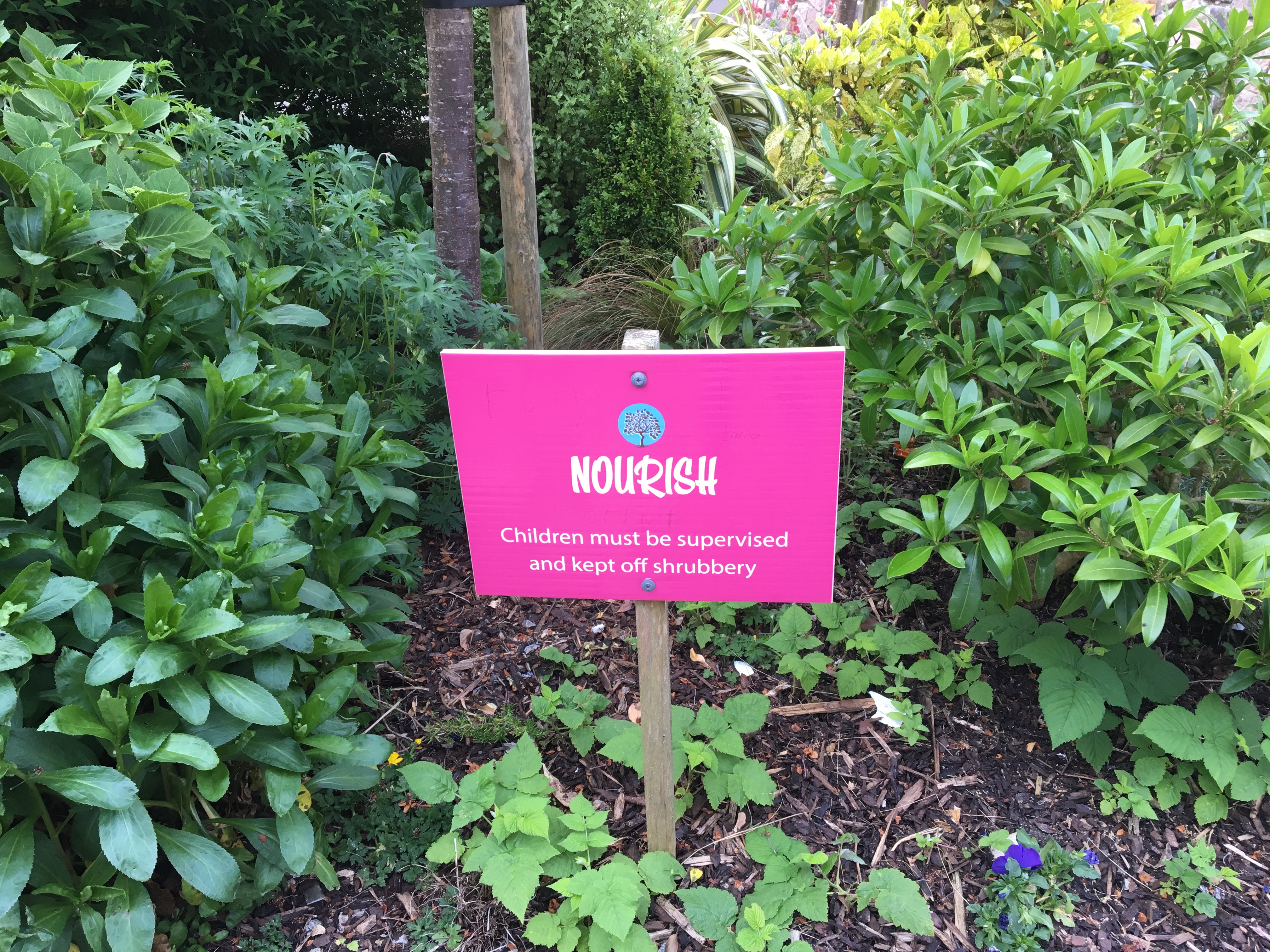
Ah, the passive voice, our default way of writing. Why do we always fall back on the passive? ‘Dogs should be left on a leash,’ ‘mixing is to be encouraged,’ and so on. Notices and documentation seem to be drawn to the passive like moths to the flame.

The passive is impersonal, overly authoritative and stuffy. Which means, from a business point of view, it prevents sales rather than promotes sales. It’s not friendly or engaging.

The active voice is more involving, inviting, influential. That’s why marketers and sales people use it. It encourages action, which is why it’s called the active voice.

In the example above, better to say:

Mind your kids and the shrubbery will mind itself


I’m sure you’ve seen the picture of the adapted Maslow’s hierarchy triangle with wifi and internet added at the bottom. It makes me smile when I look at it.

Back in the late 90’s in Ireland there were vast pockets of no or poor signal, rendering mobiles useless. This was especially noticeable when you left the city for the country.

These days the mobile providers claim coverage in the 90’s per cent. That has to be by population, concentrated in the cities as they are, rather than by geography. In 2018, in the west of Ireland, there are still large swathes of land where you can’t use your mobile. One of them is my house, in fact it’s most of my small town, what you might call a village in the UK. Now I think of it, there are plenty of offices in central London too where you can’t get a signal…

Vodafone can tell you my area has poor coverage, which is why I’ve used their Sure Signal box, plugged into my landline modem, to boost our mobile to a belligerent 5 bars. Lovely.

Except that the box has stopped working, is no longer sold or supported, with no substitute technology solution in the offing.

Which brings me back to Maslow’s pyramid. I work from home a lot, and use my mobile phone a lot, or I used too…

I heard a great phrase the other day, and it’s a very useful reminder of how to cover all the key bases in a business. In any business, especially a small business, you need 3 types of role: the finder, the minder and the grinder.

The finder is the prospector. The finder finds customers, partners and even investors. They are the public face of the company, the chief evangelist.

The minder minds the company. The minder looks after the cash. Their responsibility is finance, legals, compliance, looking after the company and making sure it’s meeting its various obligations.

The grinder is the one who delivers. They are operational, with their shoulder to the wheel and on the factory floor – literally or metaphorically. They execute what has been promised by the finder and charged for by the minder.

All of these roles are important, and you need each role working in synergy, recognising each other’s strengths and skills, rather than complaining that they do all the work while the others sit around.

In a sole tradership, of course, one person needs to fulfil all 3 roles, or else contract out some of the other roles profitably or productively. In a partnership you see the 3 roles being divided across the two people. Sometimes they take one role each and share the other. As any business scales it really needs one person dedicated to each role, eventually building to a team for each function.

I live in a country that has, supposedly, mobile coverage in the 90s per cent. That must be by population I imagine, since out of the cities and in the country there are plenty of pockets of poor signal.

One such pocket is my house, where our home and home office have enjoyed appalling mobile coverage for the last decade. All was not lost however, because several years ago we bought a mobile phone signal booster that connects to the landline broadband and is programmed by our mobile numbers for 5 luscious reception bars every time.

Except that 3 months ago the booster box broke and I discovered to my chagrin that the box is no longer sold or supported by Vodafone. Wifi calling is promised, which will solve the problem of poor mobile reception, but I’ve been working in tech long enough to know that roadmaps aren’t worth listening to at all.

I went onto the Vodafone community to look for discussion threads on the topic and found one, to which I wanted to comment and voice my disapproval. I had to log in to do that, and I was invited to do so either my mobile or landline account login. That was fine, but after I’d logged in I was taken to a general community page, and not straight back to the specific thread that I was on, as you would expect 9 times out of 10.

I then had to search for the thread again, and still it wouldn’t let me contribute. By this stage I was wise to the process and copied my contribution content in case I’d lost it.

After a couple more tries I gave up, since I got messages that it wouldn’t post. I returned back to the thread and my post was there, published.

Vodafone don’t seem to make it easy for you to post to their community portal. It’s almost like they’d prefer if you didn’t, rather like in the good old days in England when you could claim unemployment benefit between terms at University but the form was longer than War and Peace…