When we look back on our lives or our careers and contemplate some of the decisions we made that didn’t go according to plan, we have a tendency to rationalise them and explain them away. It makes us feel better. “Yep, that didn’t work out, but at least I know that industry’s not for me.” “Shouldn’t have bought that car, I’ll put that down to a learning experience.”

I use this ‘backward justification’ approach myself, by reasoning that every decision we make in life is a good one. It was good for some reasons, not good for others, and at least it was better than not making a decision at all, wasting precious time stuck in a rut. It’s better to have been proactive and have thought through the permutations and ramifications before deciding, but sometimes you just have to go.

In the marketing context this back-to-front way of thinking is similar to what we call ‘reverse segmentation’, and in business it can be very costly indeed. Segmentation is of course a really important part of plotting your own brand of world domination. It’s part of the ‘S-T-P’ holy trinity of marketing, namely segmentation, targeting, positioning. You segment your defined market, choose the segment or segments you want to target, and present yourself in the best light to those chosen segments.

How you segment is the $64,000 question. According to what criteria do you segment? If you’re going to segment along two key axes and plot your market or audience on a matrix, you had better get the two key criteria right, otherwise you might as well segment according to favourite type of pop music and preferred colour of pyjamas – unless you’re in the musical pyjama business. Lots of businesses, however, are not market-focused. They’re generally product focused. They develop a product which they think is great, then they try and find a market for it. This is also called a solution looking for a problem.

When you already have your product, it’s really hard to come up with objective segmentation criteria that don’t play directly to your strengths. This, dear reader, is reverse segmentation, and you might as well put your cart in front of your horse. It gives you an erroneous picture of where your market is heading and of your likely success. You’d be amazed how many companies do it!
When you learn how to write a press release, you’re taught to get the 5 W’s into the first para, because those short-attention-span journalists may not read any further if they don’t get drawn into your story. The 5 W’s are Who, What, When, Where and Why.

It’s still a great guiding principle if you write for the web, as the online world has driven all people’s attention spans down to the length of a journalist’s, with the result that someone else’s content is always a click away.

Of all the W’s, the last one is the most important. On balance, it’s the only one that really matters. The ‘why’ explains the connection.

Consider these questions in the customer context:

  • What’s in it for me?
  • Why should I care?
  • Where is my order? This is otherwise known as WISMO in ecommerce.
  • How could you pull that stunt?

Despite what you might think, these are all why questions. Your customers are not interested in the ‘how’, because that’s generally about you, and that’s not a major concern to them. They generally don’t want to know how you made the meal, or how you built the aeroplane they’re riding in, or how you came to design the software to work that way. They want to know why they’re being charged extra, why the release is late, or why they can’t have it in blue.

I was coming back from the UK the other day on a Ryanair flight. It wasn’t one of those flights in the 93% that arrive on time. It wasn’t close to being on time, it was horrendously late. In fact it was one of the 1% of their flights that was over an hour late. Now this is very unusual for Ryanair, and the first time in probably 50 flights I had been seriously delayed, but it was late on a Thursday evening, the last flight out, and I was tired and irritable.

The trouble was, Ryanair kept delaying the departure time and not saying why. Even an apologetic text to each passenger did not say why the flight was delayed, so you start getting frustrated, and these days that frustration can boil over onto social media so easily. When you trade on your punctuality and you don’t deliver punctuality, you’re a bad flight away from losing a frequent flyer, at least if they have a choice of airlines, which of course is not always the case. Monopolies and near-monopolies in small and developing countries is a topic for another post.

When we finally got into the plane, the pilot came on the intercom to apologise for the plane running 1 hour and 35 minutes late.  This was because – and ‘because’ is the corollary to the ‘why’ question as you know, dear reader – that the previous plane developed a fault that couldn’t be fixed so they had to despatch a replacement aircraft from Dublin over to the UK to bring us back to Ireland. Well, that’s fair enough, I thought, it happens from time to time, that’s pretty much unavoidable. The frustration soon dissipated after that.

But why on earth did they not come clean with the why sooner? You owe it to your customers to always be transparent and give them the why whenever you can. Early and often is the golden rule, rather like voting in corrupt countries. Your customers will continue to love you for it.

Idiom is great, isn’t it? The kind of collection of words that don’t translate directly into anything meaningful in another language.

There are loads of examples of course. One of my favourites is ‘off by heart’, as in ‘I learnt it off by heart’. Strange that we would choose to say that rather than off by head, brain or memory!

Apparently, those ancient Greeks felt the heart was the home of intelligence. Odd, then, that this phrase seems to have survived a translation into another language, completely discrediting my definition…

This is a topic I’ve written on before, but it’s one I find really interesting and rewarding. One of the things that for me separates us from the rest of the animal kingdom is that people we don’t even know will help us out or do us a favour. Often when we least expect it.

My first proper job after college was in Liverpool, where I was a graduate trainee with an insurance company. A bunch of us had started out at the same time, and so we had a ready made social group which tended to make us burn the candle at both ends.

I was taking the local train home one evening, after a particularly long week of ‘word hard, play hard’. Across from me was a bearded man, rough looking and shabby, with a beanie on. The kind of chap you might not sit down next to if faced with a choice of empty seats.

My regular train ride home was about 20 minutes, so I risked a tiny bit of shut-eye, as I’m a very light sleeper. The next thing I knew, I got a tap on the knee from the guy across from me, who I was convinced I had never seen before.

“I think this is your stop mate.” I look out the window, and indeed it was. I thanked him and bolted out of the carriage, without asking him how on earth he knew. I’m a terrible one for forming an opinion on someone from appearances, and yet again I was proved wrong. Now there’s probably a 1 in 10,000 chance he was a stalker, and a 9,999/10,000 chance he was a stranger doing someone else a favour and paying it forward.

It kind of restores your faith in humanity for a while. Rather like a story I heard today about a bus full of lads travelling from Dublin to an Irish-speaking hurling tournament in Connemara. They passed an ‘auld fellah’ cutting turf and faced with a field of turf bricks that needed turning up and leaning into each other in wigwam-type shapes for drying. All 40 of them got out and turned the turf in 10 minutes, before getting back on the bus and resuming their journey.

Love that kind of thing :-).

One of my most fun projects over the last year or so has been to help a company in the ecommerce business with a few product marketing challenges. As a result of writing and blogging on their behalf, I’ve come to know the industry pretty well.

One of the factors that really drives the industry is customer service. This is because everything revolves around the buyer experience, so that people can find what you’re selling, select it, pay for it, receive it, consume it and come back for more as often as possible. Competing on price can often become a race to the bottom and a loss-making business, so your chief competitive weapon is continuous customer delight.

This sounds pretty simple. It gets less simple when you want to sell your product in more marketplaces, because then you have more portals to manage stock levels for, and more places to manage your customer service communications from. Technology comes to the rescue in the form of software platforms that allow you to centralise your stock control, orders, shipments and most important of all customer communications, in one place.

Interestingly, the vast majority of us all are also online consumers, so at an anecdotal level we know what it’s like to be on the end of exemplary or excremental service. Which brings me to the reason for this post.

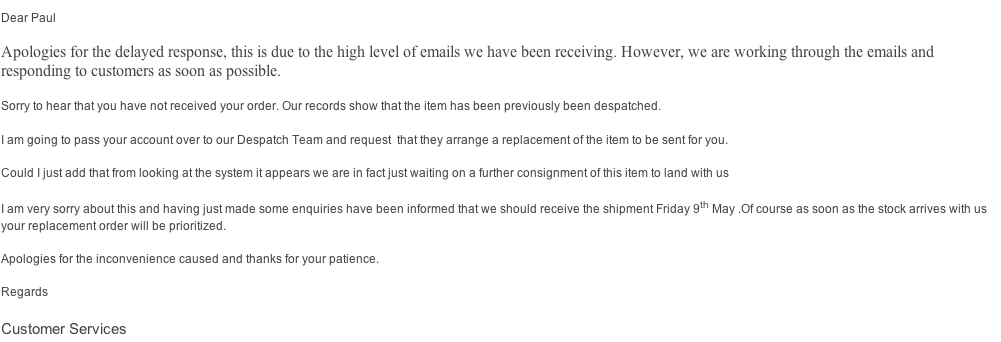
About three months ago I succumbed to a Living Social bulletin advertising, of all things, dental floss heads at a ludicrous discount. In Ireland, these offers tend to be from UK companies, so you then have to stump up for the shipping as well. Except, it’s not so straightforward. Sometimes, you contract with Living Social to buy the product, then with your special code you then go through to the vendor’s website to arrange and pay for postage directly with them. The first time I couldn’t get the website to accept any of my credit cards, so I had to raise a ticket with them and Living Social, who referred me back to the vendor. Two weeks later, I managed to get the website to accept my credit card and take the requisite amount.

A month later, no floss heads. I sent a pithy email to their support centre to say that I had never received them.

How Not to Do Customer Service

How Not to Do Customer Service

This is what I got back. A loose collection of standard responses and qualifying comments pasted and patched together in different typefaces, masquerading as a considered reply to my problem. I didn’t hold out much hope. They’re either appalling at customer service, or too busy correcting hundreds of undelivered orders, or both, with one being a consequence of the other. Suffice to say, I haven’t got my floss heads yet. These days though, being woeful – or woegious as my Irish friends say, one of my top ten new words of the last decade – is a very dangerous game, because it’s easy for buyers to rate their experiences and influence other buyers. We all know that folk don’t ask vendors for a recommendation, they ask their peers, and the online world makes this a breeze.

I’m too nice, and too tolerant to make a big fuss. But that’s about to change. They have my money and Mr Nice is about to become Mr Nasty. The online pen is far mightier than the sword :-).


Your index finger is an amazing device. Is there a more important digit? I don’t know. I guess that’s why sports people and sports fans who want to stress their hegemony in their league or group simply hold up their index finger, perhaps also mouthing the words ‘number one, baby!’

When I’m driving in the west of Ireland, especially the wild, very west of Ireland – also known as Connemara – I enjoy the silent language of mutual acknowledgement as two cars pass each other.

As the car approaches there is a casual check of the car to see if it’s someone you know – for Ireland is a village, and you’d be surprised how often you bump into someone you know, even for a ‘blow-in’ like me – then a check of of the registration plate to see if it sports the letter ‘G’ for County Galway. If it’s a local car, then the index finger of one of the hands at the ‘ten to two’ position on the steering wheels raises slightly, almost imperceptibly. Nine times of ten it is seen and acknowledged in the same way.

Such is the way in the land of a hundred thousand welcomes, from the tip of your index finger.


Whether you’d rather be a comma than a full stop, or vice versa, it’s important to understand these two most common punctuation marks so that you can wield the correct power over your reader.

Aside from their functions in punctuation, using them is a signpost to your reader of when – and for how long – you want them to pause.

When people don’t use them properly, or not enough, their prose – or indeed poetry – doesn’t flow properly and can be frustrating to wade through.

When I insert a comma, I want you to pause at the end of that clause, at that precise point, so that you can begin the next.  When I insert a full stop, I want you to pause a little longer. That’s because I might want to start a new sentence or a new train of thought.

Which is easier to read? a) The cat, which has a name but that’s not important, sat on the mat. b) The cat which has a name but that’s not important sat on the mat. c) The cat which has a name but that’s not important, sat on the mat. Why, a) of course!

I’ve seen folk write: The cat, sat on the mat. Why would anyone either want you to pause there or think it’s correct punctuation to put a comma right after the subject, unless you’re introducing a clause which stands on its own right – witness option a) above?

When you know where to put your comma, your reader knows how to read your stuff, simple as that. Full stop.


A Home Office

A Home Office

These days many, many people are fortunate enough to be able to divide their working hours between the office or customer and home, or to devote 100% of their time to working from their home office. For some people, working from home is tricky, demanding the discipline to avoid ‘sherking from home’ and the will-power to stay away from the fridge and the food cupboards. They prefer an office setting, mixing with fellow professionals and away from their home setting. If this is you, this post is probably not for you. Certain jobs lend themselves to a home-based solution, where the technological advances mean that everything that needs to be done can be done in calls, web meetings, and video conferences. Nothing beats a face-to-face meeting, but we are getting much better at managing them so that we can maximise our productivity, minimise our travel, reduce our footprint, all without getting cabin fever and going stark raving mad from isolation. For those of us lucky enough both to enjoy and thrive in a home office arrangement, the set-up is important. Here’s a picture of my home office. I thought it would be interesting to share a few thoughts on what I think is important. Most of this might be duh-obvious to some of you, to others less so. Technology first. Reliable broadband has to be a given. Invest in a decent phone with good quality audio and a good quality headset. This means you can be hands free and more productive, while not sounding distant, preoccupied or disrespectful to the other person. My phone in a previous job was not good enough and so when we went to record the webinars I was chairing, I had to drive 150 miles to the office to use a decent phone or else I had to pick up the phone and tie up one hand for the webinar’s duration. Furniture second. Again, a good, comfortable chair at the right height is key. I’m not a shining example of ergonomic best practice, but this is another area worth investing in so that you don’t get sore shoulders, wrists and so on.  We also had custom desks and shelving designed for our office – that’s me and Mrs D – since space is at a premium in this rather small room. It cost us a small fortune, but has paid us back comfortably, pun intended. Light third. Natural light is always preferable, and a decent view out of the window for when you need to draw breath or dream about your 5-year plan. As you can just about see from the reflection in the monitor, the window to my back garden is to the right, so I can keep an eye on the dogs, guinea pigs and chickens that frequent it at different times of the year. You can also see how the light has faded the spaces round the pictures of my previous wall collage. Mementos fourth. Speaking of collages, I like to surround myself with pictures of family, stuff my kids have made for me, tickets from significant shows or sporting events, as well as keepsakes from my earlier days, to remind me how lucky I am as a person and also in my work/life balance. The previous pictures have only come down in the last couple of months and now I’m starting to build up the next 3- or 4-year chapter of my life with stuff that’s important to me. Fifth, tidiness. I don’t know if an untidy office equals a disorganised mind, but I can’t work in a sea of clutter, so I always tidy up before I start working or writing. Sixth and last, books. So much of the written word is in electronic format these days, yet I still find it good to thumb through a marketing reference manual or check a diagram. I also keep my last few ‘day books’ where I religiously record everything of import that I hear on calls or in meetings. They’re so handy for going back to, to remind yourself of exactly what was said, or what you thought was said. I’m sure this post is more about my home office than your home office and says more about who I am as a person. In any event it has served me well for the guts of the last decade, so I hope the observations are useful to you too.

I like this post mainly for its title. It panders to what I optimistically think of as my slightly unconventional sense of humour.  Apart from the assonance there’s the hint of a play there.

There is a more serious message to the subject though. It’s important to distinguish between the two in my view. The Ampersand – or & – sometimes gets rendered slightly oddly in browsers, due, I imagine, to its non-alphanumeric nature. It is not to be used as a substitute or short-hand  for ‘and’, especially in formal business communications. It looks sloppy, in the view of this blogger anyway.

Ampersand should be used to link two words or concepts that naturally and habitually sit next to each other, such that they have become one, almost to the extent that they look a little odd on their own. An example: A & R, the artist and repertoire reps in the music industry. Research & Development is another, as are Home & Garden and Clothing Shoes & Accessories, categories from the retail space.

And can be used pretty much universally, even to replace a genuine ampersand. And one more thing, you shouldn’t really begin a sentence with such a conjunction, although I like to :-).

Men, dear reader, are supposed to be allotted three score years and ten before they shuffle off their mortal coil. Maybe four score or more if they play their cards judiciously. That doesn’t sound too bad.  It’s a fair old innings, as we say in England. 70 years I could live with, pun intended. 70 christmases, 70 birthdays, 70 Wimbledons, it’s not too bad.

It’s only when you think of it in terms of months that it doesn’t seem very long that we get to rent a cubic metre of space on the planet. 840 months is not very long at all.

A month can go past in what seems like the blink of an eye. And what have we achieved since the beginning of the month? Not much I bet. And suddenly there goes another one.

Time marches on relentlessly, and thinking about our lifespan in terms of months helps us to not waste a single day if we can help it.