Archives for category: Strategy

When you’ve decided to make a change or kick off a project, it’s easy to want to dive straight in and get started. After all, looking ahead is the right way to approach things; you can’t change the past.

I used to work with a company that used to make quarterly marketing plans and against each campaign they’d put the target number of leads, opportunities and revenues. They would do this every quarter, but they would never look back to the previous quarter to see how they actually performed against target. They would sweep things under the carpet and move forwards.

Before you start, you need to measure where you’re starting from. Sounds super obvious, doesn’t it? Yet, not enough companies do it. Sometimes they can’t measure the key things, other times they can’t be bothered.

Knowing where you’re starting from allows you to review and measure how far you’ve come at a later date. Instead of drawing up a plan every quarter, figure out how successful the last quarter really was. Then you have the information you need to learn from it and make a better plan next time.

It’s easy for us to think we’re doing a great job of staying close to our customers or our staff. We’re sending regular emails, having regular meetings, touching base as often as we can.

We tend to forget one simple, inalienable fact. Communication does not equal engagement.

Your customers are not buying from you because they’re not engaged.

Your staff are not changing the way they do things because they’re not engaged.

It’s a question of commitment. Think of eating your egg and bacon. The chicken was involved, but the pig was committed…

Communication does not equal engagement, and engagement is what you need, if you want to achieve or change something. You need to start involving people earlier, getting their buy in, and asking them the why questions, starting with why they’re not engaged, why they’re not committed.

You used to hear the phrase ‘analysis paralysis’ all the time in business. The inability to make a decision in favour of hiding behind a surfeit of analysis was a common attribute of poor operational business.

You tend not to hear the aphorism that much these days, at least not in the last 5 years or so. Now we’re all about big data. We have more data, but we have better analysis since we can corral computing power, sometimes from global networks and forces, to crunch a monumental amount of inputs and come up with meaningful, helpful outputs.

Now we’re all about analysis catalysis. Since we’re only as good as our data, our ability to maintain a high quality of it and interrogate it in the right ways is the catalyst for solid, informed decisions. Sure, we can still rely on our gut from time to time, but now we can test repeatedly and get extremely fast feedback on our hunches.

Analysis used to cause inertia. Now it causes energy.

You know the phrase, ‘square peg, round hole. It’s used to describe a lack of fit between a person and their role. It’s a good image, both visual and memorable. The thing can’t or won’t fit – if you allow the poetic license that the peg must be of a similar size to or larger than the hole.

Fit is important. Cultural fit is hugely important, and fit to the functional demands of the role is relatively important too.

So should you be looking to fill all the round hole in your business with round pegs? Of course not! Round holes and round pegs are boring, predictable and there’s no room for innovation and thinking outside of the box – or the hole in this case.

When you have some round pegs in square holes, you create space for expansion into the corners. You provide some wiggle room, some room for manoeuvre, development and growth. You’ll get something extra from your people, something unexpected, something unplanned.

Square hole, round peg. Try it sometime.


Opening a bank account in 21st century Ireland is a tortuous exercise. Let me put this another way: starting a relationship where you are trying to be a customer of a financial institution and give them your money so that they can make interest off it in return for a meagre few services is a tortuous exercise.

I know there are money-laundering regulations to be complied with, and processes to go through, but come on, there has to be a better way. I won’t tell you which bank, but they’re all pretty much the same. I was recommended by my accountant to go with a specific one, which I did, but these were some of the hoops you have to go through to become a paying customer. As someone who advises companies on how to work hard to attract companies to you, I’m always boggled by how difficult life is made for someone who wants to become your customer.

I suppose it’s because they’re all as bad as each other, and they’re pretty set in their ways, but if there’s one industry that’s prime for disruption, this is it. Anyway, here are some of the things I find amazing:

– You can’t apply for a business bank account online. The lady I spoke with in the bank said there’s more paper involved these days than there ever was

– You can’t take the application form out of the branch

– You have to make an appointment to apply in person (I’m not making this up)

– If it’s a limited company, all of the directors need to attend in person, to be verified in person for ID and address. For small companies who have maybe two directors, one of which is a spouse working somewhere else, this means they need to take a holiday to get to the bank, for the next reason

– The bank’s opening house are 10am til 12:30pm, and 1:30pm til 4pm. On Mondays they push the boat out and stay open til 5pm

– Once you’ve negotiated the application process, which has to be done in real time, your time, with the bank person, they send it off to head office, where it takes two weeks – yes, two weeks – to process

As the Irish would say, it’s mad isn’t it? Except the Irish simply shrug and get on with things.

As I said, ripe for change, this industry…


Most companies talk about the importance of win/loss analysis, yet few of them do it. Win/loss analysis is the business of analysing the deals you won and those you lost. Setting up a formal call with your customer to analyse why they bought from you is a very useful exercise, as it builds both a qualitative and quantitative picture of what makes you successful.

Setting up a formal call with a non-customer, or an existing customer who didn’t give you the new business, to analyse why they didn’t buy from you is even more successful, since – yes you’ve guessed it – you can learn what contributed to your being unsuccessful so that you can improve your approach and win more business.

Even fewer companies do the loss analysis than the win analysis, and there are lots of human reasons for this. You can learn so much from a lost customer, however, so here are some things I’ve found useful when doing them:

– Get someone not in sales to do the call. It’s easier to get the call, and less confrontational, so it’s easier for them to open up. Sometimes they simply didn’t like the sales person

– Offer to arrange an appointed time for the call, but ask them if now is a bad time, as you only need a maximum of 10 minutes and then you might get to do the call right then

– To secure the call, emphasise that it will be a short call, you’re not trying to reopen the business – though that might happen if you do a stellar job on the call – and that it will help you improve your service in future bids

– Have your questions in writing before the call. If the person is a touch monosyllabic in their answers you can use the questions as prompts to avoid an embarrassingly short call

– Have some suggested answers to some of the questions that can also be used as prompts. For example, for ‘what was it about our proposal you didn’t like’, you might prompt with price, service, track record, solution fit, project management and so on

– Sometimes they prefer to fill something in than speak to you, so be prepared to send in a form with your questions on it, and be prepared to chase to get it back

– Ask them to be as honest as possible in their assessment of why you were unsuccessful. You will get subjective answers and objective ones. Your job is to figure out if they’re giving you a different answer to the true answer. Probe if you have to

– Try to distinguish between personal and subjective answers that you can’t do much about – like ‘we didn’t get on’ – and more objective answers that you can feed back into the business or use for coaching. Example of these include: ‘I felt she was unprofessional’, ‘I didn’t like his approach’, ‘she didn’t understand my business’ and ‘they were too pushy, I wasn’t ready to buy’

– It’s not that high a priority for the person you’re calling, so be prepared for them not to pick up the phone at the appointed time. Be persistent and polite

– After the call, send the person a hand-written note or a small gift thanking them for the feedback, mentioning how valuable their feedback was

When you’re interviewing for a new job, there is in my view one type of question you should parry. That question is anything to do with being in the role you’re interviewing for.

The question is sometimes phrased along the lines of:

‘Can you describe what your typical day might be if you took this job?’ or

‘What would your priorities be coming into this role?’

You might be tempted to blurt out ‘how the heck do I know? I don’t work here, I don’t know the company, the people, the products, services, challenges, objectives or anything else well enough to answer that. I need to assess the situation first before I decide anything. Alternatively, I can share with you some vacuous generalities if you like…’ Assuming you want to work here, I don’t recommend quite such a confrontational approach to what is an unfair question.

Rather than attempting to answer the 64-thousand-dollar question, it’s much better to parry it with ‘It depends‘ and illustrate the approach you would take to learning the role so that you’d be best placed to answer the question with the knowledge, experience and authority of having lived it for a couple of weeks. After all, that’s what you did in previous roles and look how well they turned out, right?


Here’s what I’ve learned about applying for jobs over the years, and I think this information is pretty current. It’s also pretty obvious, so excuse this if it comes across as full of platitudes. My hope is that it will save you time and increase your success rate.

Firstly, if you don’t know a single person in or associated with the company you’ve seen a job ad for, think very hard before applying. It’s like getting an unsolicited invitation to tender for business, your success rate is 0 to 5%.  This sounds defeatist, but you have to go with the numbers and the politics.

One Job, Several Interlopers

One Job, Several Interlopers

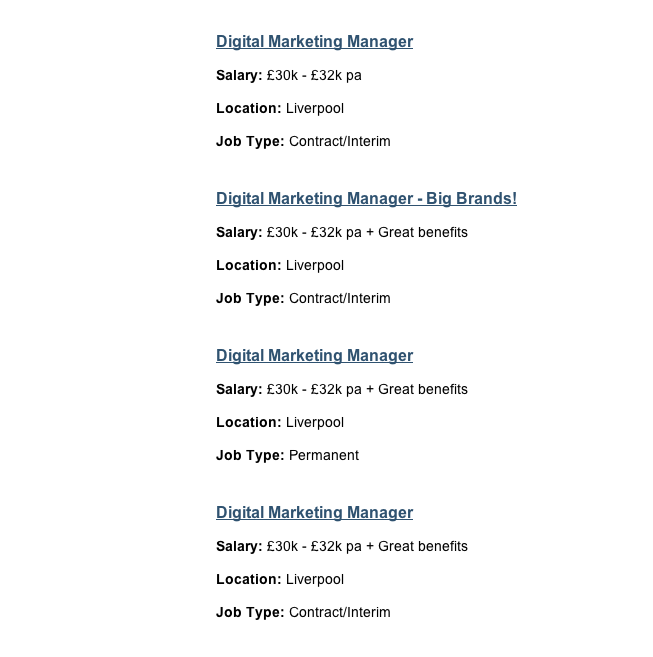
Secondly, you can set up all the job alerts in the world, but it’s waste of your time to apply for the role if you don’t know who the company is. If you don’t know who the company is, you can’t consult your network to find out who you know who works there or with the company. You have to hope it’s a recruitment company that has the exclusive right to the role and is not simply trawling for CVs. Guess who’s in control there? The picture here is from a few years ago, and is clearly 4 different recruitment companies looking to hit the firm with candidates for the same role.

Thirdly, if someone reaches out to you, asking you if you’re interested in applying, this is a good sign. You’ve pulled them to you, rather than pushed yourself to them. Now you have some measure of control, because you know they’ve done the research and you look like a good fit.

Fourthly, and perhaps most transparently, it’s not what you know, it’s who you know, perhaps more so these days. Your network of contacts and experiences is unique to you and it’s an asset that should be secured and used to help yourself and other people you value.

In a previous post, one of the 3 things I discussed that you need to satisfy in an interview scenario is ‘can this person do the job?’ If you want the job, and the company culture is right for you, how do you persuade the company that you’re worth the risk if you haven’t got the experience?

Every successful line manager, Director or CXO at some point was a first-time line manager, Director or CXO – the X of CXO meaning any C-Suite role, like CEO, CFO or COO. Someone had to give them their first shot.

If you’re interviewing for a sales manager role, and the company is looking for experience of having led a multi-million dollar sales team, and you don’t have it, it’s very hard to argue your case. What generally happens is that those people were top performers in that team and graduated to become the team manager, even though the skill-set required for a manager is completely different to that of a ‘sole contributor.’

When I look back at the jobs I’ve had, I’ve switched around quite a lot, and in quite a few cases my boss at the time decided I was worth the risk and – to adapt a well-known ABBA song – took a punt on me. Happily, I paid them back on their decision.

When you need someone to take a punt on you, you need to fall back on things that will make you successful in a new role, evidencing your adaptability, perseverance, commitment and enthusiasm, while drawing parallels from your career where you made similar leaps. Then, when you’ve presented your best case, relax, you’ve done all you can. They will or they won’t.

You did your prep, you were well presented, you answered all the questions. Congrats, you nailed the interview! That’s great, it’s a hard thing to do. You should be delighted, even if you don’t end up getting the offer.

Either you will get the offer, or you won’t. If the offer doesn’t come your way, that’s the way the cookie crumbles. You did your best, you couldn’t have done more. Here are the four reasons you didn’t get the job.

1) It was already someone else’s. The company was going through the motions or through the necessary compliance process of looking at a couple of other candidates. In fairness, you could have tried to find this out during the interview. There’s nothing cheeky in asking about the other candidates so that you can sell against them.

2) Someone else better than you got the job. Don’t beat yourself up, you did your best and it took a truly exceptional candidate to edge you out. As the Desiderata says, there’s no point comparing yourself to others. There will always better and lesser folk than you. The important thing is that you did your best.

3) You wouldn’t fit in. This is a blessing in disguise and the company is doing you a favour. If the cultural fit wasn’t right for you, you would have been miserable in the job.

4) There was no job. The company was having a look around, or decided not to appoint a candidate. These are the worst types of companies. They’re true time-wasters and your time is valuable so you’re better off where you are.