Archives for category: Sales

You could argue that the subject of this post could be a motto for life, not just for business writing. After all, it’s better to effect things than be affected by them. It gives you more control over your destiny, more flexibility in your choices.

In business writing, it’s also better to be active than passive, especially if you are writing ‘persuasive’ documents like business cases or sales proposals. As an example, look at the previous paragraph. The active ‘voice’ is more powerful at effecting something, whereas the passive voice governs being affected by something.

Try and avoid phrases like ‘the ROI calculation can be found below.’ It sounds stuffy and conservative, but also weak and, well, passive. You’re writing this document, you’re in charge of it, so take control. Better to say ‘The ROI calculation below shows the value of our service to your business.’

The active voice is to do with action, and when it comes to your business writing, it’s action you want your reader to take, otherwise why take the time to write at all?
When you’re interviewing for a new job, there is in my view one type of question you should parry. That question is anything to do with being in the role you’re interviewing for.

The question is sometimes phrased along the lines of:

‘Can you describe what your typical day might be if you took this job?’ or

‘What would your priorities be coming into this role?’

You might be tempted to blurt out ‘how the heck do I know? I don’t work here, I don’t know the company, the people, the products, services, challenges, objectives or anything else well enough to answer that. I need to assess the situation first before I decide anything. Alternatively, I can share with you some vacuous generalities if you like…’ Assuming you want to work here, I don’t recommend quite such a confrontational approach to what is an unfair question.

Rather than attempting to answer the 64-thousand-dollar question, it’s much better to parry it with ‘It depends‘ and illustrate the approach you would take to learning the role so that you’d be best placed to answer the question with the knowledge, experience and authority of having lived it for a couple of weeks. After all, that’s what you did in previous roles and look how well they turned out, right?


Here’s what I’ve learned about applying for jobs over the years, and I think this information is pretty current. It’s also pretty obvious, so excuse this if it comes across as full of platitudes. My hope is that it will save you time and increase your success rate.

Firstly, if you don’t know a single person in or associated with the company you’ve seen a job ad for, think very hard before applying. It’s like getting an unsolicited invitation to tender for business, your success rate is 0 to 5%.  This sounds defeatist, but you have to go with the numbers and the politics.

One Job, Several Interlopers

One Job, Several Interlopers

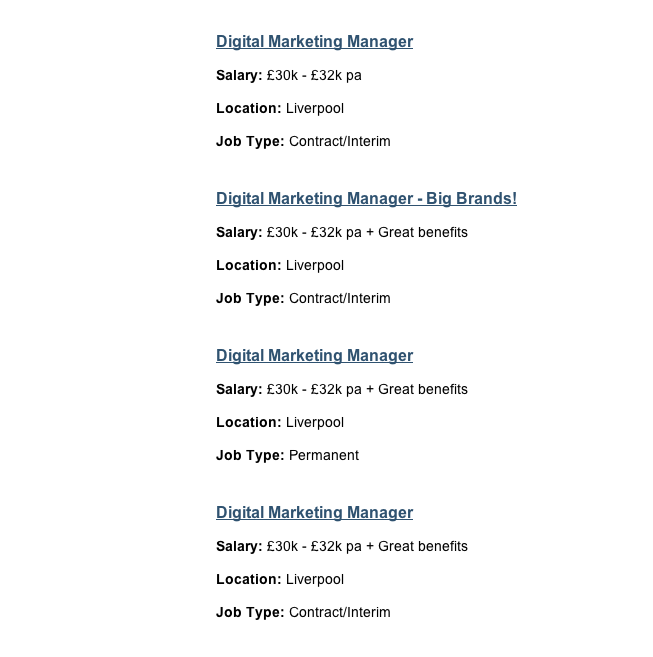
Secondly, you can set up all the job alerts in the world, but it’s waste of your time to apply for the role if you don’t know who the company is. If you don’t know who the company is, you can’t consult your network to find out who you know who works there or with the company. You have to hope it’s a recruitment company that has the exclusive right to the role and is not simply trawling for CVs. Guess who’s in control there? The picture here is from a few years ago, and is clearly 4 different recruitment companies looking to hit the firm with candidates for the same role.

Thirdly, if someone reaches out to you, asking you if you’re interested in applying, this is a good sign. You’ve pulled them to you, rather than pushed yourself to them. Now you have some measure of control, because you know they’ve done the research and you look like a good fit.

Fourthly, and perhaps most transparently, it’s not what you know, it’s who you know, perhaps more so these days. Your network of contacts and experiences is unique to you and it’s an asset that should be secured and used to help yourself and other people you value.

In a previous post, one of the 3 things I discussed that you need to satisfy in an interview scenario is ‘can this person do the job?’ If you want the job, and the company culture is right for you, how do you persuade the company that you’re worth the risk if you haven’t got the experience?

Every successful line manager, Director or CXO at some point was a first-time line manager, Director or CXO – the X of CXO meaning any C-Suite role, like CEO, CFO or COO. Someone had to give them their first shot.

If you’re interviewing for a sales manager role, and the company is looking for experience of having led a multi-million dollar sales team, and you don’t have it, it’s very hard to argue your case. What generally happens is that those people were top performers in that team and graduated to become the team manager, even though the skill-set required for a manager is completely different to that of a ‘sole contributor.’

When I look back at the jobs I’ve had, I’ve switched around quite a lot, and in quite a few cases my boss at the time decided I was worth the risk and – to adapt a well-known ABBA song – took a punt on me. Happily, I paid them back on their decision.

When you need someone to take a punt on you, you need to fall back on things that will make you successful in a new role, evidencing your adaptability, perseverance, commitment and enthusiasm, while drawing parallels from your career where you made similar leaps. Then, when you’ve presented your best case, relax, you’ve done all you can. They will or they won’t.

You did your prep, you were well presented, you answered all the questions. Congrats, you nailed the interview! That’s great, it’s a hard thing to do. You should be delighted, even if you don’t end up getting the offer.

Either you will get the offer, or you won’t. If the offer doesn’t come your way, that’s the way the cookie crumbles. You did your best, you couldn’t have done more. Here are the four reasons you didn’t get the job.

1) It was already someone else’s. The company was going through the motions or through the necessary compliance process of looking at a couple of other candidates. In fairness, you could have tried to find this out during the interview. There’s nothing cheeky in asking about the other candidates so that you can sell against them.

2) Someone else better than you got the job. Don’t beat yourself up, you did your best and it took a truly exceptional candidate to edge you out. As the Desiderata says, there’s no point comparing yourself to others. There will always better and lesser folk than you. The important thing is that you did your best.

3) You wouldn’t fit in. This is a blessing in disguise and the company is doing you a favour. If the cultural fit wasn’t right for you, you would have been miserable in the job.

4) There was no job. The company was having a look around, or decided not to appoint a candidate. These are the worst types of companies. They’re true time-wasters and your time is valuable so you’re better off where you are.

Interviews are tricky things to negotiate sometimes. They’re quite unnatural exercises, with both parties on close to their best behaviour, and probably not the behaviour or personality they’re going to display when the person has started with the company.

When you boil it down though, there are three things common to an open interview and two of them you can control directly. The other you can’t. Here they are.

1) Can this person do the job? You need to have examples of how you can do the job and be able to demonstrate how what you’ve done in previous jobs will equip you well to do this one.

2) Does this person want the job? Are you genuinely motivated to secure this opportunity, or it is really interview practice for you, you’re shopping around, you’re benchmarking yourself with a view to applying leverage in your current role, it’s your second choice if your first choice doesn’t come off, and so on? You need to demonstrate you’ve done your homework on the company and are genuinely interested in where it’s going.

3) Will this person fit in to our company? This is the most important question, and one you can’t do anything about, unless you’re lying to the company and by extension to yourself. The cultural fit has to be right, or else you won’t enjoy working there, and since you’re going to be doing it 5 days out of every 7, give or take the odd holiday, what’s the point of working somewhere if you don’t enjoy it? If you know people or are connected to people in the company, ask them what it’s like working there. If you don’t know anyone, ask your interviewer what the culture is like. If they waffle, or they give you an answer that you feel is disingenuous, that’s not a good sign.

When you join a new company, that company has all the power for the first 12 months of your stay there. So remember that you’re interviewing them as much as they’re interviewing you. You may really need that job, but to stay in it, make sure you score 3 out of 3 on these interview rules.

In a previous post, I talked about allowing the buyers who know what they want to do their thing and not getting in their way. In many businesses, however, buyers need help buying. They need educating, guiding, encouraging, challenging and persuading.

You may lament that your buyers don’t know how to buy. This may be true, but it’s a cop out on your part. They don’t know how to buy for a variety of reasons. Perhaps you don’t make it easy for them. Perhaps they’re too busy. Perhaps they haven’t acknowledged they need to buy. Perhaps they hardly ever buy this sort of thing – or even they’ve never bought this sort of thing before – and so why on earth should they be as close to this as you are?

We all make the mistake, once we’ve been in a company a while and have come familiar with how our stuff works, of thinking customers are interested in our stuff, never mind understand it.

Spend time thinking about your buyers. Think about the problems they have and the options they have to address those problems. For many businesses, even though they know they’re stuck in the weeds, it’s a case of ‘better the devil you know.’ Think about where they want to get to, what’s stopping them from getting there, and how your stuff can uniquely help them. If your buyers are sufficiently different for you not to be able to think about them as one group, then put them in groups that do make sense and think about those groups separately.

Think also about the steps they should take to buy from you, and what you need to share with them to get them to keep moving forwards. They don’t necessarily know the steps, so they will need evidence from you that these steps have worked for similar companies.

You’ll know your approach is working when they stop asking about themselves and start asking ‘how are other companies doing this?’ and ‘how are you doing this?’ And, who knows, if you illuminate the path well enough they might self-select and do the buying themselves.

I met with a company in the software space recently. They are what you would call a high velocity business, focusing on a transactional business model for sales. They used a phrase that resonated with me:

“You don’t step in front of a speeding train.”

If your customer knows what they want, and is ready to buy, let them. Don’t insist on going through your sales process in the hope that you might be able to increase the initial deal size, because you run the risk of slowing down the deal or halting it altogether. Maybe they want do business with you without dealing with a salesperson.

This strategy of using your sticky product as the tip of the spear allows you to go back subsequently and sell more stuff to them. You land with a small sale and then you expand the business.

Of course, this works very well in businesses that have a strong compelling event, a market-leading product that can be bought ‘no touch’, and great marketing. Customers can find what they want and self-purchase. It’s not so easy for companies who are selling services, or products that are less transactional and more complex in their nature.

If you are blessed this way, though, it’s case of both caveat emptor and emat emptor. Let the Buyer Beware, and Let the Buyer Buy.

You have this great business idea. You haven’t seen anything like it and you’re convinced you can make a success of your venture. The most pressing question, unless you happened to be prodigiously wealthy – so you already know how to get money and make more of it – is around financing the development and take-off of your idea.

You could bootstrap the business, running it on your own savings until it starts to ‘wash its own face’, but you might need more than you reckon on as these things always take longer than the best laid plans. You could go to friends and family and secure relatively small amounts from a relatively large number of people. At this point you might already need to start giving some of your company away in return for the investment, and by now you’re starting to think about the level of relationships you will have with these investors.

Those who don’t have access to their own funds or the funds of their nearest and dearest need to start playing the dating game with professional lenders, who might be high net worth individuals, institutions, state/semi-state bodies or private investment companies. It’s at this point that you need to develop an understanding of two things, very, very quickly. The first is how investment business and its clandestine terms work: seed this, A round that, mezzanine the other, and so on. The second, arguably even more important, is the type of investment partner you want to work with and who will be good for your business as it grows. Cultural fit is of paramount importance.

If you’re in the third camp, needing to start the dance with someone who lends and makes money for a living, then I can recommend this post for an excellent primer. There are some additional very good links within the post. I don’t know the guy at all, but he writes well and he seems to mean well too. Good luck!

There’s an old adage that nothing happens in a company until somebody sells something. In fact, it’s also true of you, when you’re trying to sell yourself or your idea.

I do a bit of work as a mentor in the technology sector and so I come into contact with quite a few very early stage companies. In the tech sector in Ireland there is plenty of support, guidance and funding for building your software product. Once you’ve built your product, and you have to start selling it, in other words commercialising your idea, the funding is not so forthcoming.

This is a problem, because many of the people who have the idea for and develop their software product also have a lack of knowledge and confidence when it comes to selling it. Start-up companies can avail of a few meetings with sales and marketing mentors like me, but that’s nowhere near enough. They either need to start full-time selling themselves or else find the funds to get someone with the expertise to do their business development. They don’t have the money to do that, and the business development specialist is probably not going to work for free, or even equity, if they can’t see the promise of steady sales. Which brings it back to the fledgling business owners, who have to do the work themselves.

Start-ups have to start, but if they’re not capable of starting, then the money already invested in them, by them or others, is wasted. We need to train our entrepreneurs to sell, or else fund the sales expansion efforts and increase their chances of turning their idea into a functioning, growing business.