Archives for category: Marketing
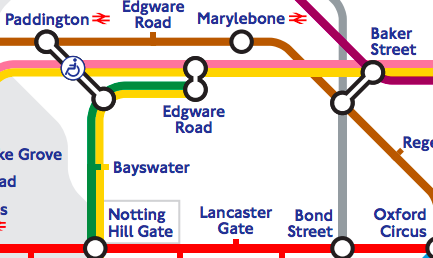
Snippet of the London Underground map

London Underground map

I’m rather enjoying this trip down memory lane, revisiting some of the interesting things I remember from my graphic design days, though I was always more of a ‘suit’ than a ‘roll neck’. I hope you are too, because I’m about to continue in this vein.

One of the great things about typography is the detail. We take the printed word and fonts for granted, so much so that we forget that someone very gifted actually invented each of them, drawing each letter out, labouring over every contour and fighting for them to get popular so that printers would design the blocks to print stuff using them.

One such someone was Eric Gill, a superb artist and – as it has emerged many years after his death – a complex, pretty disturbed individual. He did, however, give his talents and his name to one of the most recognisable typefaces around. You see, the eponymous Gill Sans typeface is the one used to this day on the London Underground, an infrastructure and system so brilliantly signposted and easy to follow that you’re only reminded of this when you try and navigate the systems of other world cities. It was also adopted by many of the UK regional railway bodies and graced advertising posters up and down the country for generations.

A long time ago, I wrote a corporate brochure using the Leitmotif of ‘renowned art’. As well as a Henry Moore statue, the Chrysler Building and a few others, I also featured Mr Gill and his Gill Sans typeface. Worthy company for an inspirational typeface I think.

Speak of graphic design, there are some handy words from the world of typography that are good to know if you are in any way responsible for marketing end products like websites or brochures. Design used to be this black art that creative types used to jealously guard like masons. Now, with the advent of technology, everyone can turn their hand to design and everyone in turn can contribute to the creative process.

First, the typeface. Typeface means the same as font as far as I’m concerned. The typeface is the generic family of font style used for letters. For example, Arial is a typeface and you can have variations of it, like bold, italic, and so on. OK, that was easy.

Next, we have pointsize, or more accurately, point size. Otherwise known as – yes, you’ve guessed it – font size, the pointsize is the size of the typeface measured in the number of points high, a point being kind of a full stop. So, standard document lettering might be Arial regular, 12-point, for example.

When you get a bunch of letters forming a paragraph, then you have more choice around how you present those letters, for visual attractiveness or readability. For example, how close together should the letters be together, horizontally or vertically?

The leading is the distance between the lines, or more accurately the between the bottoms of the lines. It has the similar effect to the ‘line spacing’ in Microsoft® Word, so the greater your leading, the more white space between your lines and the more readable and less dense it it. The word is pronouncing ‘ledding’ and harks back to the heavily metallic engineering days of printing. A designer is able to adjust the leading by minute amounts using design software, which can often buy an extra line on a page to help with layout.

Finally, and most obscurely in today’s post, we have kerning. Kerning is the spacing between the letters. Again, this allows the designer to cheat slightly by adjusting the kerning in a few words to avoid unsightly widows or orphans.

Handy, eh?


Graphic design is the art of making stuff look good with images, text and the use of the areas around the images and text, ie nothing. I worked for a number of years in a marketing and design agency and acquired a considerable respect for the craft of the designer.

I am a writer. The text part is my thing.  I am not a designer and I will always defer to a designer to concentrate on what they do best, which is the presentation of my content. I also have a degree of awareness about design, so there are a few things I’d like to share with you that will go some way to making the text look better in your important documents like collateral and proposals, without necessarily changing the content.

First of all, widows and orphans. A widow is a single word that appears on its own on the last line when your paragraph is laid out. It doesn’t look good. Do what you can to avoid widows by editing your ‘para’, up or down. An orphan is when the single word at the end of your para is stranded on its own at the beginning of the next page. It looks worse than a widow and you should remedy it as you would remedy a widow.

Secondly, use ‘white space’ wherever you can. White space is the areas around your paras and your text. It is your friend and lets your content breathe, makes it look better, makes it more readable and increases the chances of someone reading it and acting on what you want them to act on. Use white space liberally, more is definitely more here.

Thirdly, typefaces, otherwise known as fonts. There are hundreds of different typefaces, but two ‘families’ of typefaces. One is called ‘serif’, where the ends of the letters are pointy. It’s more traditional looking and is suited to long form content like documents, newspapers, magazines, brochures and books. The other is called ‘sans serif’ and being without the pointy bits is more blocky, modern-looking and better suited to headings and short form content. You’re reading sans serif right now. It works nicely to have some variety and use both types in your longer documents, typically with the headings a particular sans serif and the body of content a particular serif.

Fourthly, be ruthlessly consistent in your hierarchy of headings. Make sure your main headings are all the same style and size, your sub-headings are all the same style and size (but a different style and size to your main headings) and so on down to your para headings. Headings signpost your reader through your ‘doc’ and there are few things more frustrating than getting lost in a document.

I realise I’m taking subjects that would fill shelves of books and reducing them to a few paras. That said, a little awareness can goes a long way, which is the purpose of this post.

Caveat no.2: you will see widows in my blog posts. Blogging is an altogether more casual medium, rather like email, so don’t get too hung up on them for your less formal forms of communication.

That’s what they say about imitation and me too products: the sincerest form of flattery.

I’m sure it rankles with the pioneers in a category when the giant comes in second with the massive resources and does it cheaper, better and more effectively. There has long between tension between the western markets who have laws in place to protect certain forms of imitation, copying and plagiarism, and the eastern markets where copying is considered normal. ‘Oh, we’re not copying your product, we’re improving it.’

I’ve noticed this tactic become much more prevalent with the German supermarket giants Lidl and Aldi, or Lidly Aldi as they’re sometimes rather hilariously known in Irish musical wag circles. They take a well known product and either call it exactly the same name, like Fruit & Fibre cereal of Kellogg’s fame, or make a very small adjustment so that you’re in no doubt as to what they’re ripping off, then sell it for about half the price of the branded version.

There are lots of examples of these marginally renamed products, but the one that sticks in my mind is the branded Angel’s Delight, that lovely fluffy dessert from our childhood, renamed in a German stylee as Heavenly Delight, with packaging so redolent of the pioneer product you wonder how on earth they get away with it.

What always strikes me as amusing though is that Lidl and Aldi are themselves, for me, completely interchangeable. I can never remember which one is which, which one I’m in when I’m in it and whose product is whose. It’s like the scene from Love Actually where the Bill Nighy character is interviewed by Ant & Dec, and replies to them as ‘Ant or Dec.’

They don’t really imitate each other. They are practically the same. Watch the song in the link above and you’ll empathise.

What’s your business model? Is it a high volume, small deal size business? Or is it a low volume, large deal size business? It really has to be one or the other. It’s really hard to fall in the middle or do a bit of both. How many medium volume, medium deal size businesses do you know? How many that have a bit of both?

High volume businesses rely on great metrics, reliable conversion rates, and a constantly full pipeline so that the army of small deals makes a big total. Low volume businesses face a lumpy, more unpredictable sales chart but when the deals come in life is good, until the next big deal.

You could argue that the best business model is a blend of all three, so that you’ve got a pipeline of big deals, middle deals and small deals. Getting the blend right, however, is a tall order, especially when you bear in mind that different deal sizes are usually subject to different groupings of buyers, different sales processes and different sales cycle lengths. Hmmm, you need to be a pretty sophisticated and well practised sales organisation to make that work.

I’ve seen a number of organisations with a volume business model who haven’t done the maths to figure out how much sales and marketing they need to do to create enough leads, to create enough pipeline and so on. When they do, it makes for a pretty sobering meeting. Then there are the companies with a large deal business model who don’t know their sales cycle length and so don’t know how long they need to go between deals.

Whatever your business model, if people don’t have a genuine need for your product, or if you have to evangelise and educate in order to create the need, you have an uphill struggle.

There is one type of thing in business where it’s good to see the words ‘religiously’ and ‘vicariously’ in the same sentence.

Normally they might be words of questionable credibility. After all, ‘religiousness’ can sometimes be confused with over zealousness, fanaticism even. Then there’s the notion of living through someone else, like you sometimes hear being levelled at a parent who ‘lives vicariously through her daughter’s sporting achievements’, for example.

When it comes to marketing, however, especially areas of digital marketing like email marketing and web marketing, where conversions via landing pages or listing pages are what counts, there’s an excuse for both the religious and the vicarious. And that excuse is testing.

If you’re lucky enough to be in a volume business where you can see immediately the effects of a change in the customer journey, then you can test practically everything. The subject lines, lengths, action buttons and calls to action of your emails. The headings, processes and wording on your landing pages, product pages, listing pages and detail pages.

All your testing should be through the eyes of your customers, living the awareness-interest-decision-action journey through them, hence the vicarious part.

This is where ‘a/b’ testing comes into its own, where you can test 2 different versions of something like a heading, leave everything the same and see what the response or conversion is like. You can a/b test relentlessly on every element of your communication until you’re happy it’s as good as it can be, by which time you’re probably onto your next communication.

If you’re not in a volume business, then your results can be slower to come around and are not always statistically significant. Your testing has to be more anecdotal, more qualitative. But it can still be regular and rigorous.

Testing is like voting in corrupt countries. Test early and test often. Your business will thank you for it.

In a previous post I talked about the Leitmotiv, the guiding theme or concept that can help be the glue for the persuasive story you’re trying to tell.

The one thing you need to guard against with the Leitmotiv is excess. When your theme tries too hard, or is too clever for its own good, it detracts from your message rather than reinforcing it, and you don’t want that.

A good way to tell if you’re stretching things too much is if your reader has to work too hard to see the link between your theme and your message. If the link is lost, your objective is lost too. I saw this recently with some excellent copywriting done on a brochure. The Leitmotiv was a good one, it was a musical one, using the idea of a conductor who coordinates all the different elements of an orchestra into something beautiful.

The tone was good, but the language was too musical, too specialist, and so the link was lost. Toning down the language – if you pardon the pun – reestablished the link and made it more powerful.

As with many things, it was about getting the balance right, the fit right. Make sure your Leitmotif gets it right too.

Rather like French, some very cool German phrases – for which we don’t always have a great translation, hence the term idiomatic – have percolated into and enriched the English language.

Amongst my favourites are Zeitgeist – spirit of the age, and the mighty Weltanschauung – ‘world view’.

When it comes to business writing, something that can really hold your story together is the Leitmotif, the theme that moves through it. A guiding theme can keep your reader focused on what you’re writing about and help them imagine what you’re trying to convey. For example, you could use the Leitmotif of a journey and use lots of journey-related language – steps, destination, travel, milestones – as the vehicle, pun intended, for your story.

Pretty much any Leitmotif will do – a picture, harmony, the sky, planets, the list is endless – as long as it helps you tell your story and guides your reader to where you want to take them.

Most languages are blessed with a number of moods, and the more linguistically inclined of you will either recognise or know more than me about things like subjunctive and optative moods.

Fortunately, there exists a mood which is ideal for business writing. It’s the imperative and it has the advantage of being active, as well as inviting your audience to do something. It’s a great ‘take charge’ way of writing persuasively.

For example, instead of saying ‘our software improves your productivity’, make it stronger by reordering it like this: ‘improve your productivity with our software’.

This kind of approach works really well when you’re extolling the virtues of your product or service with a bulleted list. They stand out better and are easier to digest than a paragraph of narrative. It also invites your reader to take charge.

Doing it this way will help you make sure your bullet points are benefit focused rather than a trawl of features.

For example:

– flexible price options

– range of models

– offer ends this week

work much better as:

– pick your pricing option

– choose your perfect model

– buy now to lock in this price

Try it in your writing next time. (geddit? 🙂 )

That Winston Churchill chap was a bit of a legend. As I write this, it’s the 50th year of his death and the 75th anniversary of his so-called ‘finest hour’ in 1940. As well as the pre-eminent British politician of the 20th century, he was also a very good orator indeed.

But what, I hear you say, does that have to with a blog on sales, marketing and the universe? Well, perhaps not quite the universe, but business and life generally, within the confines of our modest planet. Well, he’s also a very good writer.

When I did my Master’s in Business Admin degree in the US about a hundred years ago, one of the main courses was on business writing. We were taught to write using as few long words as possible, since shorter words are easier to follow, have the tendency to obfuscate less with jargon and increase the overall persuasiveness and conviction.

In order to illustrate this, they used something called the Fog Factor, also known as the Fog Index. The higher the index, the ‘foggier’ the writing. The lower, the clearer. The lower the index, the better. Now, if you read up on this you’ll find the formula can be quite complicated, but I’m all for simplicity so we calculated it as the number of words that were 3 syllables or more per sentence in a passage of writing. Anything under 3 is good, anything over 3 is foggy, not good.

So, in the awful second sentence of the third paragraph of this post, for example, the fog factor is a rather wading-in-treacle score of 6. The sentence before it has no 3-or-more syllables, so much more readable,

Guess who the author was that they held up as an example of how to write clearly and persuasively with the fewest number of long words? Sir Winston Churchill himself. And if you listen to some of his speeches, or read any of his stuff, you’ll know why. The man could write.