Archives for category: Language

I vividly remember the Sam Mendes-directed launch video for the Apple iPhone 4. This was the democratisation of video calls. High quality video calls reducing the geographical distance between people. Kirk to Enterprise had become a reality.

We’d already had Skype video calls for a while of course, between computers. But now it was for mobiles and tablets.

It promised so much, and has probably delivered in places with an abundance of one critical ingredient in the successful video call.

Bandwidth.

I travel quite a bit, and miss my family when I do. Yet, I find the Facetime call is an increasingly frustrating – rather than satisfying – experience. We live in the country, and the broadband is 30MB ‘down’ in theory, but the contention is 1-to-48 so the video element at the family end is jittery, or falls out, or freezes.

This is also a problem in business where company networks have insufficient bandwidth. You don’t need video so much on business calls, but it’s more important to connect visually with people you love, I find.

So, until our contention improves, I’m leaving video calls and going back to audio. The kids are less distracted and you get a better quality of conversation. I’ll simply have to imagine their faces better.
Clear language is so, so important, both in the written and spoken word. We have to make ourselves understood of course, so the easier we make it for our audience, the better it is for both parties.

I travel quite a bit on trains in the south of England. The train companies announce the service, the places where it calls, and for the busy commuters how many carriages there are. More carriages, more comfortable travel, at least in theory.

‘This train is formed of 8 carriages.’ Why oh why do they phrase it that way? They’re using the spoken word. When have you ever uttered ‘something is formed of 8 somethings’ in conversation? You would never say that. You would say ‘this train’s got 8 carriages.’

I’ve gone on about the unnecessary use of the passive voice before.  What’s wrong with saying ‘This train has 8 carriages?’

Clear language shouldn’t be difficult. It should be easy. We make it difficult, and in so doing make it difficult for everyone.

Sovereignty and nationality are interesting concepts where sport is concerned. National lines seem to blur and vary – at least in the islands of Britain and Ireland – depending on the particular sport.

When it comes to Brexit, the question of sporting nationality – UK, GB, Northern Ireland, the Republic of Ireland, to name but a few – could get a lot more complicated.

I’m sure sport was the last thing on people’s minds when they contemplated both the Brexit referendum and its aftermath.

I’m sure also that there was no plan for it. There was no ‘what if’ plan to withdraw from the Euro single currency when it was conceived and executed, so when a country does decide that it wants to abandon the Euro and reclaim its sovereign currency, it’ll make for some interesting fallout.

Similarly, it seems abundantly clear that there was no plan for Brexit either, judging by the scrambling around and hasty senior resignations from many of the architects of the shambles.

To brighten your day, here’s a well observed take on the difficulties of sporting nationalities in the current political climate from Foil Arms and Hog, somewhat in the style of CPG Grey. Enjoy.

I love the definite article, otherwise known as ‘the’. This is not a post about the ’80’s electronic band of the same name as the blog post title, it’s about the importance of the word the.

Some languages do without a definite article, like Russian. What an awful waste of possibilities! Like having one hand tied behind your back.

When I was in my mid-teens and studying ancient Greek, I remember disagreeing with a writer on Greek tragedies. He argued that the ‘the’ was a small, unnecessary word that didn’t deserve to grace some of the greatest plays of all time, like Agamemnon or Persai. They deserved to stand on their own, he said. It’s one of the earliest times I can remember where I displayed to myself a developing critical faculty, that I didn’t simply believe everything I was told or read from learned people.

For me the the was grand, majestic even. ‘The Agamemnon’ sounded so much more substantial than leaving it to its own devices, naked without its accompanying defining word. Agamemnon, meh!

You’ve probably noticed, if you’ve read a few of my posts, that many of them have titles starting with the the. It’s not called a definite article for nothing. ‘The’ defines what you’re talking about, gives it focus. It’s not a something, it’s the something.

Someone’s misfortune is almost always someone else’s fortune.

You get offered a great job or contract, someone else loses out. Someone gets pulled over for speeding, you escape punishment. You find a wallet, someone loses theirs, and the contents, giving them a truly frustrating day cancelling cards, and ruing lost money and irreplaceable keepsakes.

What do you do in these situations? Do you indulge in a bit of schadenfreude and have a laugh at their expense, being secretly relieved that it didn’t happen to you?

Do you return the wallet you found, or do you pocket the contents? Do you take a perverse pleasure in someone else’s reversal, or do you help out, knowing that at some point you’re going to hit a downer and hope to meet someone who can lift you up?

It’s karma baby, you do with the situation as you see fit, and everything will, in all probability, level out over a lifetime. But make sure you’re in credit, in case you need to make a withdrawal…

Image owned by Reuters via the Japan TImes

Image owned by Reuters via the Japan Times

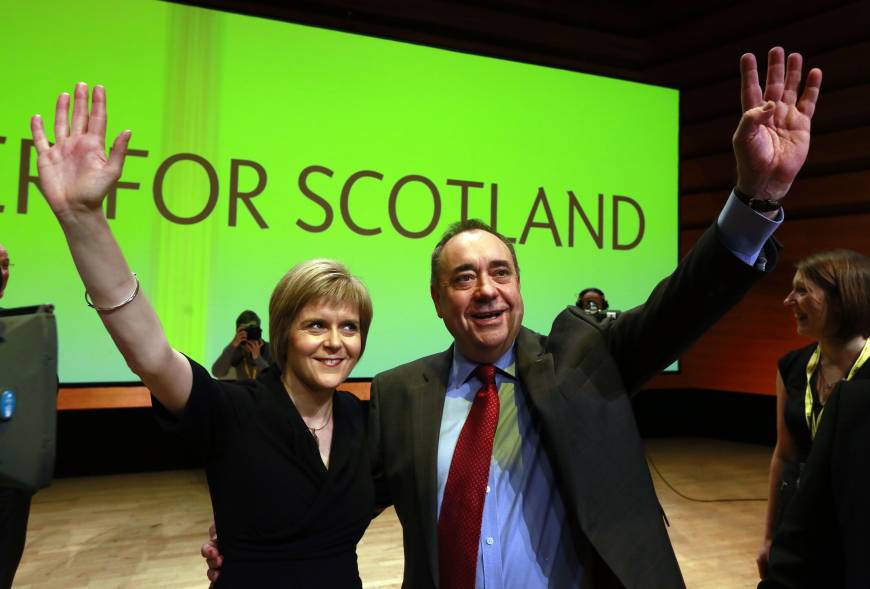
I’m sure politicians get coaching on body language and mixing with the proletariat. It’s such an important part of the role; you can’t afford to be aloof these days.

What makes me surprised, then, is when you watch election results and vote count announcements, and the victorious politician, male or female, has to indulge in this straight-armed ‘martial wave’. It’s not quite Hitler-ish, but it’s not far off.

Perhaps they’ve been told that it makes them look authoritative and indicative of leadership potential. I can’t stand it, it’s all triumphalism and ego-basking, without so much as an ounce of humility, the true indicator of greatness.

Yes, the martial wave sets altogether the wrong tone for leadership. Why can’t victorious politicians, after a brief moment of relief or celebration, take a leaf out of the books of either soccer players or Chinese performing arts exponents, and clap their audience, the people who funded them or put them in the exalted position they are now?

The victory wave; you have to get it right.

‘Yep, give me 2 minutes, I’ll be right with you.’

Except that it never is 2 minutes. In Ireland, a couple minutes really does mean somewhere between 2 and 7, since the Irish world ‘cupla’ means ‘few’. When an Irish person says I’ll be a coupla minutes, you know what – and when – they mean.

In England we don’t have that luxury, so when someone says two minutes, or a couple of minutes, or 2 seconds, or 2 ticks, they never mean that, which is frustrating to the recipient because you feel like something else is more important than you, and you’re being put off because your priority is not theirs, when sometimes you need them for 10 seconds.

I used to work for a guy who made a point of being over precise in his expectation setting. He would say things like, ‘I’ll come back to you in 17 minutes,’ ‘I’ll be back at the hotel in 12 minutes, please order me a Cab Sauv.’ or such like. When he said it there was a hint of irony, but it served a useful purpose. More often than not he was there within a minute of the expected time he’d set. He would especially do this if he knew or picked up that you were pressured with one of your own priorities.

And do you know what? The useful purpose this ploy served was that it helped you, in turn, manage your time better.

It’s not always possible in the heat of battle, but it really helps others when you set a clear idea of when you’re available for someone who needs you. And if you can beat that time, thereby over-delivering on your promise, everybody wins.

The London Underground is a beacon of clarity in visual communication. The tube map, using the supreme Gill Sans typeface beloved of regional British railways in the art deco years, is a masterpiece of design and possibly the easiest-to-comprehend legend for a major city’s underground system in the world.

It makes it easy to move around the capital as both a tourist and a newcomer. OK, so sometimes it’s faster to walk over ground after you’ve factored in the subterranean distances you might cover changing lines – especially to the Central Line which is not so much in the bowels of the city as the bottom of the toilet pan itself – but that doesn’t matter. You can plot your journey from A to B with ease.

Except when you get to B that is, and the voice on the speakers instructs you to change at the next stop for another line or ‘alight here’ for somewhere well known and adjacent.

Alight? What is that all about? Is something on fire at this stop? Why do we settle for a word so arcane that we might as well be dismounting from our trusty steed? What’s wrong with ‘exit here’ ‘or leave the train here’ for Madame Tussaud’s or some such place? I can’t think what percentage of tourists have ‘alight’ in the armoury of their second, third or fourth language, but it can’t be many. It creates confusion. I’m all for the Reithian principles of educating one’s audience by driving the language in 6th gear, but not when it comes to the binary process of ‘help me decide if I get off here or not’.

No, the audio dimension of the London Underground falls short of the visual aspect. B-minus, could do better.

As marketers we can occasionally be accused of ‘dumbing down’ content or messaging. Dumbing down has a pejorative connotation these days, as though we’re being condescending or patronising to our audience by using words and language they understand. Sort of lowest common denominator stuff.

As craftsmen and craftswomen of words and pictures, our role is not to dumb it down. Our role is to communicate clearly. It’s about simplifying something complex, arcane or esoteric and making it both accessible and memorable. We should strive if at all possible to distil what we want to convey into one key message. Sometimes we only have that one chance to resonate with someone important to us.

This is because we remember some of what we hear, more of what we see, and the most of what we do, hence the need for something direct, engaging and simple. Our less understanding colleagues may feel that we’re ignoring the detail, avoiding industry jargon and acronyms that they can use as crutches, but that doesn’t work with our prospects and customers. They’re invested in something and they want to see some of that detail and erudition come out in the communication, but it’s lost on those we’re seeking to influence who are nowhere near as invested as we are.

Don’t think dumb, think simple. It’s not about ‘how can I oversimplify this’, but ‘how can I simplify it’. Dumb is foolish; simple is smart.

Simple really :-).

‘Culture eats strategy for lunch.’ I love this phrase!

I hadn’t heard it in a while and was reminded of it recently in a meeting. It makes me laugh out loud when I hear it. It’s both pithy and witty. I don’t know if Peter Drucker did first coin the phase, but I think the sentiment rings true.

But why does culture eat strategy for lunch? My view on this is as follows: if all of your staff behave in the same way, and have the same attitude, and these behaviours are consistent with corporate culture, then whatever they execute is going to be done consistently too. They’re all pulling in the same direction, for the same things.

Strategy is only as good as the success, consistency and constancy with which it’s applied. When the culture’s not right, you don’t have everyone buying into the way things are done. It’s half-assed execution.

Culture is a bit like the goodwill you get from a brand. It’s hard to quantify but you know it’s important, you know it has immense value, and you want it for yourself or your business.

And that’s why culture never goes hungry.