Archives for category: Customers

Many businesses with sales people don’t have a formally defined sales process. Many don’t even have an informally defined sales process. They either survive on organic growth and referrals or they muddle through, intuitively following a series of steps that either works for them or that they’ve always followed.

‘Process, Schmocess,’ they say. ‘We don’t need a process, we all know what we’re doing.’ That may be true, but do you all know what each other is doing? And how does someone manage you if you’re all doing things your own way? How can they plan and grow the business?

Companies design and follow a sales process for a variety of reasons. Times change, and so do industries and companies, so you want to make sure you’re best serving your industry. Every sales organisation has good and less good salespeople, and you want to instil the behaviours of the good people in the less good. If there is an ideal way of selling that closes the most amount of deals to the long term benefit of your customers, everyone should follow it. You can’t possibly sell to customers until you understand how they want to buy, and a sales process is simply the buying stages that your customer wants to go through to buy from you. Your sales process is simply a mirror of that buying process.

You may feel you’re in an industry that is slow to embrace the latest technologies like social media, but all of your customers and prospects have access to the Internet. This has huge ramifications for you as a selling organisation because it means that companies can complete the first stages of the buying process without ever involving you; they do the online the equivalent of asking around, which means looking at your website, industry discussion groups, forums, review portals. Before they would phone you up and ask for a brochure. If they’re not showing and telling in the first stages of their buying process, you’re missing out on the first stages of your selling process, if you even have one. So you need a sales process that acknowledges this and pushes you to get information early that can help you compete.

I was over-simplifying when I said your sales process is a mirror of your customers’ and prospects’ buying process. Your customers may choose to buy in different ways from you, especially if you have a range of products and services. Then you need to group your customers into buying groups that make sense to you and design a sales process for each group. In other words, you need multiple sales processes – yikes!

Here are eight things you need to take into account.

– your customers’ buying process – and therefore your sales process – will reflect the thing that’s being bought. You don’t want a 7-stage process for something that’s bought over a phone call, and you don’t want a 1-stage process when someone is taking 9 months to decide to invest half a million with you

– a sales process is a linear series of steps you take to guide your customer towards buying something that will uniquely or best help them fix their problem. You do the steps in order, you don’t ask for the order before you know if you’re talking to the decision-maker

– a sales stage mirrors a portion of the buying journey that represents a meaningful milestone to your customer. Example buying stages of a sales process might be: define the problem, design the requirements, evaluate the alternatives, select the winner, negotiate, do the deal, implement the project, review the progress

– a sales stage mirrors the buying stage. Example buying stages might be: identify the prospect, qualify the prospect, define the requirements, demonstrate the evidence, acquire the business, get the order, implement it, review the progress

– each sales stage should contain a series of steps that you need to take in order to progress the sale. Ideally, these steps are verified by the customer. For example, has the customer confirmed when the project has to start by? Has the customer confirmed the quote is acceptable?

– get your sales people to feed into and buy into the sales process. You need them all to follow it. When they’re all doing the right things – which are the same things – at the right time, with the right kind of customer, and are recording the information in the right way, you then have objective, scientific activities and data on which to base your forecasts, your planning and your coaching, rather than no data, or subjective data based on people’s estimate of how they’re doing. As you know, some are optimistic, some are sandbaggers, and the rest fall somewhere in between

– find a sales technology that allows you to design and manage a range of different sales processes, so that you can report on and coach according to the specific parts of your business. The technology should guide your sales people through the steps to take, and cause them the minimum amount of keying and effort to keep up to date. It has to give them back much more than they put in. This is so much easier said than done, so choose the technology carefully. If it makes them win more deals, it makes them more successful and wealthier, which makes them smile more, which makes them want to use the system more. Behold, the ‘virtuous circle’

– you’re looking to instil regular, repeatable, ‘best practice’ behaviours. When you bring in this kind of thing, you are doing change management, and most people – and especially sales people – resist change. Small checks early and often, not large infrequent milestones, are the way to go, otherwise the new behaviours will never become the accepted behaviours

Don’t know where to start? Ask a sales consultant, or look online for sample sales processes, then adapt them for your use.

Despite what you might think, you need sales process in your life. It’s the spine for your business. You ain’t going anywhere without it.

“Meetings, Bloody meetings!” So goes the refrain – and the heading – in the hilarious management training videos from John Cleese’s company in the 1970’s. A well-run meeting is a rare and beautiful thing. A poorly run meeting – well that’s the norm in most companies. They become a forum for delaying or avoiding decisions rather than arriving at them.

In the sales world good, well-qualified meetings with customers and prospects who have budget, the power to make decisions, a need for your product and a timeframe for making a change are worth their weight in gold. Poor meetings are a waste of your time and their time – and time is the most precious resource. They’re not even good practice.

Many managers work off the principle that the more qualified meetings you have, the more deals you’ll close. It’s largely right of course. Take two sales people with identical abilities, identical opportunities, but one with twice the opportunities of the other, and one will close 12 deals and the other will close 6. The more calls you put in, the more conversations you have, the more meetings you make, the more quotes or proposals you submit, the more deals you win, as long as you’re following a defined sales process.

It’s not only about working harder to be more successful though. It’s about working smarter, and coaching people to work smarter.  If you want your team to be more effective – ie more successful – and you’ve identified that your team needs more meetings, there are a number of things you can do to increase the performance of your sales team without having to add to your sales team. Here are ten of them:

– Is a face-to-face meeting necessary? Would a (video)conference call do? Could we do a web-based meeting?

– what’s the travel time like to meetings, from meetings, between meetings? Could it be better organised?

– could our sales team be better split geographically to optimise the number of meetings?

– is our team properly prepared for the meetings, so that they can close deals with the minimum number of meetings?

– what are the behaviours that drive more meetings? Better leads, better telephone work, better sales skills, better emails and collateral?

– who’s doing well at meetings that we can celebrate so that others can learn from their best practice?

– who needs coaching or other support to get more meetings?

– what sales technology can we use to help us manage the sales process?

– what sales technology can we use to optimise meeting routes and geographical clustering?

– what sales technology reports on meeting productivity can gives us insight to make improvements and correct poor behaviours early?

Maximising your customer contact and minimising your non-contact activities help you maximise your sales success. If your business is relatively high deal volume and small deal size, you need to make this your mantra. Meetings, blessed meetings!


So much business-to-business software these days is based around the recurring revenue model. Much loved of SaaS (software as a service rather than bought outright as a product for your perpetual use) companies, the recurring revenue model eschews the big up front license payment in favour of a lower regular payment, sometimes structured by per user per month, or annualised to per user per year.

Customers like it because it means no up front payment, no being tied into a certain technology or provider for ever, and no maintenance fees on top as they are generally priced into the recurring revenue fee. Software companies like the set-up because it is theoretically easier to sell in the first place and makes it easier to upsell additional products and services which then all recommence on a recurring anniversary. Investors like it because at the start of each new financial year you can count on all or a great majority of the historical recurring revenue, plus all additional new business you close during the year. This makes this kind of company, which is essentially an annuity-based business – the gift that keeps on giving – very valuable, with companies typically being sold for 5 to 10 times their annual revenues.

Some of these types of recurring revenue arrangements are paid a full year in advance, locking in for the customer a good price and for the vendor income that they can bank and account for in financial terms over the course of the year. Then there are arrangements which are looser, where you pay an agreed fee on a monthly basis, and you pay month-to-month, only needing a month or less to give notice of cancellation. In these types of situation, companies have to work much harder to persuade the company to stay vested, because the window for adoption and continued use is much narrower.

When you think about it, lots of businesses outside of software operate what is effectively a recurring revenue business too. They sell something, they hope there will be services down the line, and they hope for repeat business as well. These might be companies in industries that charge subscriptions, membership fees, retainers, premiums and so on. When you’ve sold to a customer, it’s anything between 3 and 4 times as easy to sell to them again as it is to sell to someone new, so companies should do a really good job of managing the future revenue streams and protecting the future business. This should be obvious, because in the recurring revenue business your cost of acquiring the business is usually the same as it is with traditional up-front business, but you have no big sum coming in to offset the considerable cost of sale. Recurring revenue businesses need to make sure their companies stay with them at least 3 years to make the similar kinds of profits over the long term, so retention is much more important while the barriers to exit are much lower. Your dissatisfied customer pays for what they used and they’re off.

So if you’re counting on the revenue coming in from sales you’ve just made, you need a really good plan – and a really good system – to make sure you are profitable over time. Too many recurring revenue companies are in a constant state of treading water because they churn too many customers and their new business wins simply replace the business they lost, rather than building on it. If you don’t have a high renewal rate in the 90’s % (by revenue rather than by number of customers) – or a low churn rate under 10% – in your recurring revenue business, you will die.

Here is a number of things you can do to make sure you are properly managing your future recurring revenues:

– decide who’s responsible for securing future recurring revenues. Do you operate a hunter-farmer system where the new business people break open the new sales and the account management people develop the relationship, or should your sales people manage the recurring revenue from the business they brought in?

– provide them with the training and skills they need to do the role that you’re asking of them

– make sure you have the right system to make it easy for them to set up the recurring opportunity. For example, when you record the new business win, you should be able to record in the same process what the future recurring revenue items are, and when they should fall, so that the system prompts the person at the right time to begin the process of securing the next piece of business. Automating this will stop deals falling through the cracks and will increase your effectiveness, productivity, renewal rate, all those good things that make you more profitable

– measure, measure, measure. If you can’t measure, you can’t manage

– don’t manage, coach. If you have your responsibilities delineated properly, your people know what they’re doing, and your sales team management system is in place to help them sell more and administer less, you can focus on improving their performance and helping them get the important deals over the line

You shouldn’t count your chickens before they hatch, but you should count the revenues you’re counting on, before they go elsewhere.


When it comes to experiencing things, there are two kinds of people. The first type is those who, if they can’t actively follow something live, they follow it online while they’re doing something else. For example, getting updates on the Wimbledon semi-finals while you’re at work. The second type is those who, if they can’t experience all of it live, they want to shut the world away and experience it later, recorded, and have their own ‘private live’ – albeit somewhat delayed. The example of this is someone who doesn’t want to be disturbed with any updates on an event, and who rushes home unmolested by real-time devices or intrusions to watch or listen to the recording.

I belong to the former group. I can’t see the point of experiencing an event in a sterile environment that’s live only to you. It’s asocial rather than anti-social. Being off the grid – and staying off the grid, which some people prefer to do – is pretty hard to do, especially in this connected world we inhabit. If we haven’t bothered to configure our settings, our laptops and mobile devices get pinged all the time by social media updates. Our instinct is to check the ping, even if we’re on silent – I’d better check, it might be important – and before we know it, our concentration drops for a moment, we read the update unwittingly, and the surprise is gone.

From a sales and marketing point of view, we have customers and prospects who embrace always-on technology, and some that don’t. We also have customers and prospects who are the first kind of people and some that are the second kind. As sales and marketing professionals, we need to try to allow customers to interact with us by whichever means they prefer, which might be exclusively one, or both.

Ask yourself this question: if I work in a predominantly digital environment how should I serve my customers and prospects who prefer to be off the grid, who respond to traditional rather than digital forms of communication, who don’t want to be contactable sometimes? Do I actually want to serve them at all?


Always Check Your Comms

Always Check Your Comms

It always pays to check your customer communications before they go out. It’s a good idea to have someone else – ideally someone away from the business – to check the communications, because you’re often too close to it to see a problem.

This is a recent sample of emails in my inbox. One of them is a problem for me. Can you tell which one? [Pauses, for dramatic effect…] It’s the bottom email. I can say with some certainty that there is no chance that this email will make my Dad smile, since he died some years ago and his ashes are probably fertilising a bowling green somewhere in the middle of England.

Had I received this email in the immediate aftermath of his demise, when I was a teary, shambling wreck of a man, I would probably have torched the offices of the people who sent it, and certainly unsubscribed for ever.

Where you can, always try and put yourself in the shoes of the person you’re sending something to, the person you’d like to buy from you. You’re hoping to build a rapport with them, not dash it to pieces in one fell swoop.

When we look back on our lives or our careers and contemplate some of the decisions we made that didn’t go according to plan, we have a tendency to rationalise them and explain them away. It makes us feel better. “Yep, that didn’t work out, but at least I know that industry’s not for me.” “Shouldn’t have bought that car, I’ll put that down to a learning experience.”

I use this ‘backward justification’ approach myself, by reasoning that every decision we make in life is a good one. It was good for some reasons, not good for others, and at least it was better than not making a decision at all, wasting precious time stuck in a rut. It’s better to have been proactive and have thought through the permutations and ramifications before deciding, but sometimes you just have to go.

In the marketing context this back-to-front way of thinking is similar to what we call ‘reverse segmentation’, and in business it can be very costly indeed. Segmentation is of course a really important part of plotting your own brand of world domination. It’s part of the ‘S-T-P’ holy trinity of marketing, namely segmentation, targeting, positioning. You segment your defined market, choose the segment or segments you want to target, and present yourself in the best light to those chosen segments.

How you segment is the $64,000 question. According to what criteria do you segment? If you’re going to segment along two key axes and plot your market or audience on a matrix, you had better get the two key criteria right, otherwise you might as well segment according to favourite type of pop music and preferred colour of pyjamas – unless you’re in the musical pyjama business. Lots of businesses, however, are not market-focused. They’re generally product focused. They develop a product which they think is great, then they try and find a market for it. This is also called a solution looking for a problem.

When you already have your product, it’s really hard to come up with objective segmentation criteria that don’t play directly to your strengths. This, dear reader, is reverse segmentation, and you might as well put your cart in front of your horse. It gives you an erroneous picture of where your market is heading and of your likely success. You’d be amazed how many companies do it!

When you learn how to write a press release, you’re taught to get the 5 W’s into the first para, because those short-attention-span journalists may not read any further if they don’t get drawn into your story. The 5 W’s are Who, What, When, Where and Why.

It’s still a great guiding principle if you write for the web, as the online world has driven all people’s attention spans down to the length of a journalist’s, with the result that someone else’s content is always a click away.

Of all the W’s, the last one is the most important. On balance, it’s the only one that really matters. The ‘why’ explains the connection.

Consider these questions in the customer context:

  • What’s in it for me?
  • Why should I care?
  • Where is my order? This is otherwise known as WISMO in ecommerce.
  • How could you pull that stunt?

Despite what you might think, these are all why questions. Your customers are not interested in the ‘how’, because that’s generally about you, and that’s not a major concern to them. They generally don’t want to know how you made the meal, or how you built the aeroplane they’re riding in, or how you came to design the software to work that way. They want to know why they’re being charged extra, why the release is late, or why they can’t have it in blue.

I was coming back from the UK the other day on a Ryanair flight. It wasn’t one of those flights in the 93% that arrive on time. It wasn’t close to being on time, it was horrendously late. In fact it was one of the 1% of their flights that was over an hour late. Now this is very unusual for Ryanair, and the first time in probably 50 flights I had been seriously delayed, but it was late on a Thursday evening, the last flight out, and I was tired and irritable.

The trouble was, Ryanair kept delaying the departure time and not saying why. Even an apologetic text to each passenger did not say why the flight was delayed, so you start getting frustrated, and these days that frustration can boil over onto social media so easily. When you trade on your punctuality and you don’t deliver punctuality, you’re a bad flight away from losing a frequent flyer, at least if they have a choice of airlines, which of course is not always the case. Monopolies and near-monopolies in small and developing countries is a topic for another post.

When we finally got into the plane, the pilot came on the intercom to apologise for the plane running 1 hour and 35 minutes late.  This was because – and ‘because’ is the corollary to the ‘why’ question as you know, dear reader – that the previous plane developed a fault that couldn’t be fixed so they had to despatch a replacement aircraft from Dublin over to the UK to bring us back to Ireland. Well, that’s fair enough, I thought, it happens from time to time, that’s pretty much unavoidable. The frustration soon dissipated after that.

But why on earth did they not come clean with the why sooner? You owe it to your customers to always be transparent and give them the why whenever you can. Early and often is the golden rule, rather like voting in corrupt countries. Your customers will continue to love you for it.

One of my most fun projects over the last year or so has been to help a company in the ecommerce business with a few product marketing challenges. As a result of writing and blogging on their behalf, I’ve come to know the industry pretty well.

One of the factors that really drives the industry is customer service. This is because everything revolves around the buyer experience, so that people can find what you’re selling, select it, pay for it, receive it, consume it and come back for more as often as possible. Competing on price can often become a race to the bottom and a loss-making business, so your chief competitive weapon is continuous customer delight.

This sounds pretty simple. It gets less simple when you want to sell your product in more marketplaces, because then you have more portals to manage stock levels for, and more places to manage your customer service communications from. Technology comes to the rescue in the form of software platforms that allow you to centralise your stock control, orders, shipments and most important of all customer communications, in one place.

Interestingly, the vast majority of us all are also online consumers, so at an anecdotal level we know what it’s like to be on the end of exemplary or excremental service. Which brings me to the reason for this post.

About three months ago I succumbed to a Living Social bulletin advertising, of all things, dental floss heads at a ludicrous discount. In Ireland, these offers tend to be from UK companies, so you then have to stump up for the shipping as well. Except, it’s not so straightforward. Sometimes, you contract with Living Social to buy the product, then with your special code you then go through to the vendor’s website to arrange and pay for postage directly with them. The first time I couldn’t get the website to accept any of my credit cards, so I had to raise a ticket with them and Living Social, who referred me back to the vendor. Two weeks later, I managed to get the website to accept my credit card and take the requisite amount.

A month later, no floss heads. I sent a pithy email to their support centre to say that I had never received them.

How Not to Do Customer Service

How Not to Do Customer Service

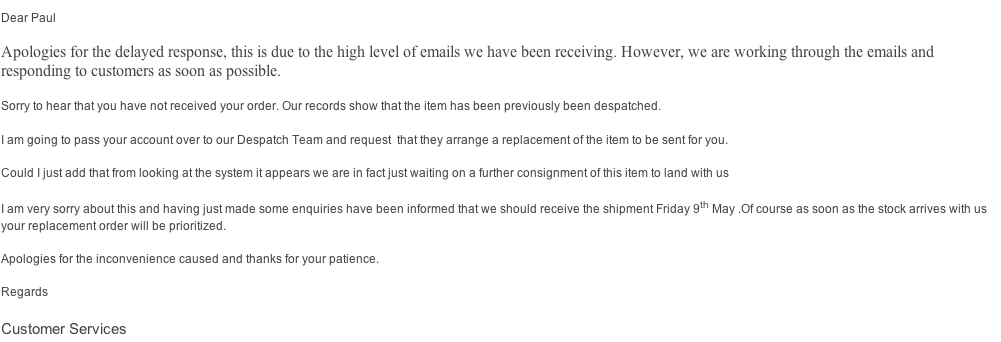
This is what I got back. A loose collection of standard responses and qualifying comments pasted and patched together in different typefaces, masquerading as a considered reply to my problem. I didn’t hold out much hope. They’re either appalling at customer service, or too busy correcting hundreds of undelivered orders, or both, with one being a consequence of the other. Suffice to say, I haven’t got my floss heads yet. These days though, being woeful – or woegious as my Irish friends say, one of my top ten new words of the last decade – is a very dangerous game, because it’s easy for buyers to rate their experiences and influence other buyers. We all know that folk don’t ask vendors for a recommendation, they ask their peers, and the online world makes this a breeze.

I’m too nice, and too tolerant to make a big fuss. But that’s about to change. They have my money and Mr Nice is about to become Mr Nasty. The online pen is far mightier than the sword :-).


Ach, how to rid ourselves of the scourge of the self-servers, people who always put themselves ahead of others! In English, we say ‘I’m alright Jack’ to refer to these kinds of undesirable people.

In Irish, we call them ‘me feiners’. Here’s a good example of someone – a pretty laconic and articulate Kiwi as it happens, using the word to describe someone else.

It doesn’t matter in what walk of life or work you’re in, the me feiner is to be avoided, shunned even. They don’t pay back, they take but don’t give, they feather their own bed. If you’re in sales or marketing, you won’t last the course if you put yourself first the whole time. Success in those spheres is based on partnership, equity, balance, equilibrium. A fair exchange of effort, investment and reward.

You may be alright Jack, but not for long.

What is it with mini-roundabouts? You don’t have them in the US as far as I can remember, favouring instead your 4-way stop junctions and that kind of thing. People’s ability to navigate roundabouts varies inversely according to their distance from the capital city. Out here in the country in the west of Ireland, they’re hilarious entertainment.

At mini-roundabouts with 4 or more approaching roads, people either wait at them politely, even though they might have the right of way, or else they blithely head on through without a care in the world. Farmers are legendary for this, on the rare occasion they venture out from their place of work.

Then you get mini-roundabout that were formerly T-junctions. At this treacherous kind of a roundabout, cars plough across the top of the T at great speed, in both directions, whereas those approaching the T edge up timidly to avoid being totalled, even though they might have the right of way.

So here, dear reader, I offer my rules for mini-roundabouts. By way of disclaimer, I should say that I have no idea if these are the highway code rules for your particular country, so don’t take them as gospel, but they make sense to me anyway. Note that they only apply to places where you drive on the left :-).

1) A mini-roundabout is like a proper roundabout, except that a proper roundabout might have 2 lanes, so your lane position is important.

2) A mini-roundabout is not like a large roundabout with traffic lights on it, or even a huge roundabout with lights on it, or a ‘huge-about’ as my daughter calls them. You simply obey the lights at these kinds of roundabouts.

3) You approach the mini- roundabout and give right of way to the cars on your right. So, if a car to your right is on the roundabout, or is close to the roundabout and if you pulled out you’d cause it to slow down, let the car pass and wait until the road to the right is clear.

4) Once on the roundabout, signal as you’re about to exit the roundabout. This lets the person know who’s giving right of way to you that you are coming off and they can get on.

5) If you don’t use your indicators, or if you keep your indicator on as you pass one or more exits, folk don’t know what you’re doing and will hate you for it.

Being a good driver is as much about communicating to other drivers what you’re doing as it is watching for what they’re doing. Pretend other drivers are your customers. You want to please them and improve their lives, right?